Joplin City Council Informal Meeting - May 18, 2026
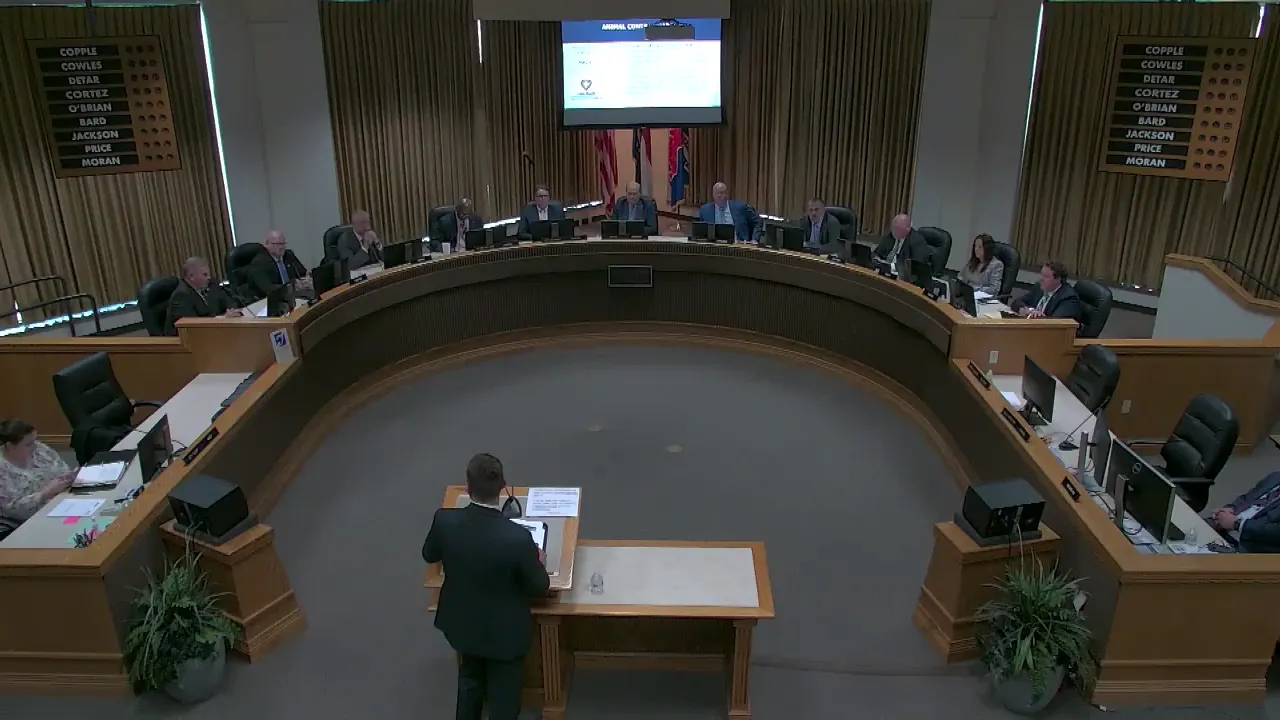
STREAMING COPY IN PREPARATION — RECORDING AVAILABLE FROM THE ORIGINAL SOURCE
Joplin City Council Informal Meeting - May 18, 2026
The Joplin City Council held an informal meeting on May 18, 2026, at 5:30 PM. The agenda included a financial update from Leslie (Finance) and a detailed presentation on the animal control program by Ryan (Animal Control Director). Council members discussed budget sustainability, animal control operations, and follow-up procedures for abuse cases.
Discussion Items
- Financial Report (Leslie): May sales tax revenue was up nearly 12% over the same month last year, attributed partly to income tax refunds and inflation. Year-to-date sales tax is up 4.25%. Use tax was up 36% for the month, year-to-date up 8.4%. Marijuana sales tax was up 123% for the month (though May 2025 was a low month); year-to-date marijuana tax is up 20%, approximately $67,000. General fund operating revenue exceeded year-to-date budget by $311,335, while operating expenditures were $664,000 under budget. One-time revenue is below budget by about $653,000 (partly due to timing and lower interest income). The city has a small net gain of $58,478, but outstanding encumbrances total $4.4 million. Leslie noted that operating revenue and expenditure trends require one-time revenue to balance the budget, which is not sustainable long-term.
- Animal Control Program Presentation (Ryan): The presentation covered staffing, hours, call volumes, services, and future improvements. Animal control has three officers (15, 5, and 30 years of experience) plus office staff (one with 55 years). Hours vary by season; staff are on call 365 days/year. In 2025, total calls for service were 5,018 (a decrease), but animal welfare check calls (ANABU) increased. Services include nuisance complaints, bite investigations, quarantine (10-day hold for rabies), wildlife control (snakes, skunks, bats, roadkill except deer), dangerous/potentially dangerous animal determinations, and assistance with other city departments. Officers are non-commissioned and issue citations for municipal violations; more severe cases go to Joplin Police Department. A standard operating procedure (SOP) for complaint follow-up cadence was outlined: unsubstantiated complaints get one follow-up within 7-14 days; substantiated/developing concerns get follow-up every 3-7 days or daily for urgent conditions, with compliance verification in 14-30 days. Repeat unsubstantiated complaints without new evidence result in no further field response to prevent harassment. Future actions include continuing work with JPD on interdepartmental response, formalizing policies, using delayed-call features in dispatch software, and reviewing staffing levels (unchanged for 30+ years despite growth). Officer Miranda received the John Rhodes Award from the Missouri Animal Control Association.
- Q&A on Animal Control:
- Councilor Moran asked how often the Humane Society is unable to accept animals. Ryan responded it happens in cycles, roughly every three to four weeks, and typically for extended days at a time.
- Councilor Campel inquired about the regional animal control concept. Ryan confirmed a consultant is reviewing it, with a final report expected around November.
- Councilor Campel raised concerns about the “snoop case” where initial contact was not made in a timely manner on an abuse complaint. He emphasized the need for someone (possibly evening police) to lay eyes on the animal quickly. Ryan agreed to discuss with Nick and the police department to implement a mandated follow-up process.
Key Outcomes
- Council accepted the financial report as presented, noting the need for long-term budget sustainability.
- A directive was given for animal control to work with the Joplin Police Department to improve timely initial contact on suspected animal abuse cases, particularly when officers are off-duty or unavailable.
- The regional animal control study is ongoing, with results expected in November 2026.
- Officer Miranda’s John Rhodes Award was acknowledged by the council.
- No formal votes were taken during this informal meeting.
Meeting Transcript
Well, good evening. It's 5 30, and so we'll get started here with the informal agenda. And uh Leslie, welcome. You're already uh headed this way. Might as well get started, Mayor. Good evening, Mayor, Council. Um I have May Financials for well, May Sales Tax and Use Tax, which is really for March. Uh May sales tax, we're up almost 12%, which is outstanding. Uh so for the year we're up four and a quarter. Uh I've been thinking about why. Uh I really don't know why, except for a couple of reasons. Maybe people got their income tax refund. Um also prices are increasing. Uh so I'm sure some of it's due to inflation. Uh, but we'll see if it holds uh throughout the year. Uh Mr. Kobel, I did want to follow up on something I said to you last month. Um you asked me about the percentage increase, uh, what we budgeted. Um and I I answered that, but I should add to that answer. So remember when we're working on budget, um it's the middle of the year that is not complete. So we actually estimate where we will end up on that fiscal year, and then do a percentage of that estimate. So really the percentage is not important, it's really the dollar amount because if I didn't estimate right for the current year, then the percentage is really irrelevant. So that's why we added that column off to the side. So that's really more important really than even the percentage. And um, I should have said that uh last month, and I didn't I just didn't think about it. So then on use tax, uh also good month for use tax, up uh 36% uh over the same month last year, so we're up eight point four percent. Um and you can see the dollar amount uh to the side, so that's also good news. Uh marijuana sales tax also up uh 123 percent. But if you look at the same month in 2025, that was one of the lower months. Um but for the year we're we're up 20 percent, uh which is about sixty-seven thousand dollars. Uh any questions on those before I go to the financials. Okay. If not, I'll move to the financials, which are as of April 30th, uh, because that's the month we just closed. Uh that is six months into the year, so half a year. Uh so for the general fund, uh you can see our operating revenue. Um we have collected more than our our year-to-date budget by 311,335 dollars. Uh our operating expenditures we are below budget by 600 and almost 664,000. Uh but on the one-time revenue, on the one-time revenue, we're actually below the budget. Uh, this is a lot uh because of timing, but also interest income is uh running uh below budget at this point. Uh so we're below budget about six hundred and fifty-three thousand dollars on the one-time expenditures. Uh we are also below budget uh by about one point three million. Uh so right now we have a small gain of about fifty-eight thousand four hundred and seventy-eight dollars, uh, but we still have outstanding encumbrances of four point four million dollars. Uh and then uh here's our graph. And just want to recap this. This is operating revenue and expenditures, so it does not include one-time revenue and one-time expenditures. Uh so when you see a graph like this, what it means is if everything uh meets the projections that we've made, it's gonna take our our one-time revenue uh in order to balance our budget, uh, which is really not uh it's really not sustainable over the long term. So wanted to make sure I covered that, and I'd be happy to answer any question. Thank you. Thank you. So we'll run through this.
openpublica.com