Joplin City Council Informal Session - August 3, 2026
STREAMING COPY IN PREPARATION — RECORDING AVAILABLE FROM THE ORIGINAL SOURCE
Joplin City Council Informal Session - August 3, 2026
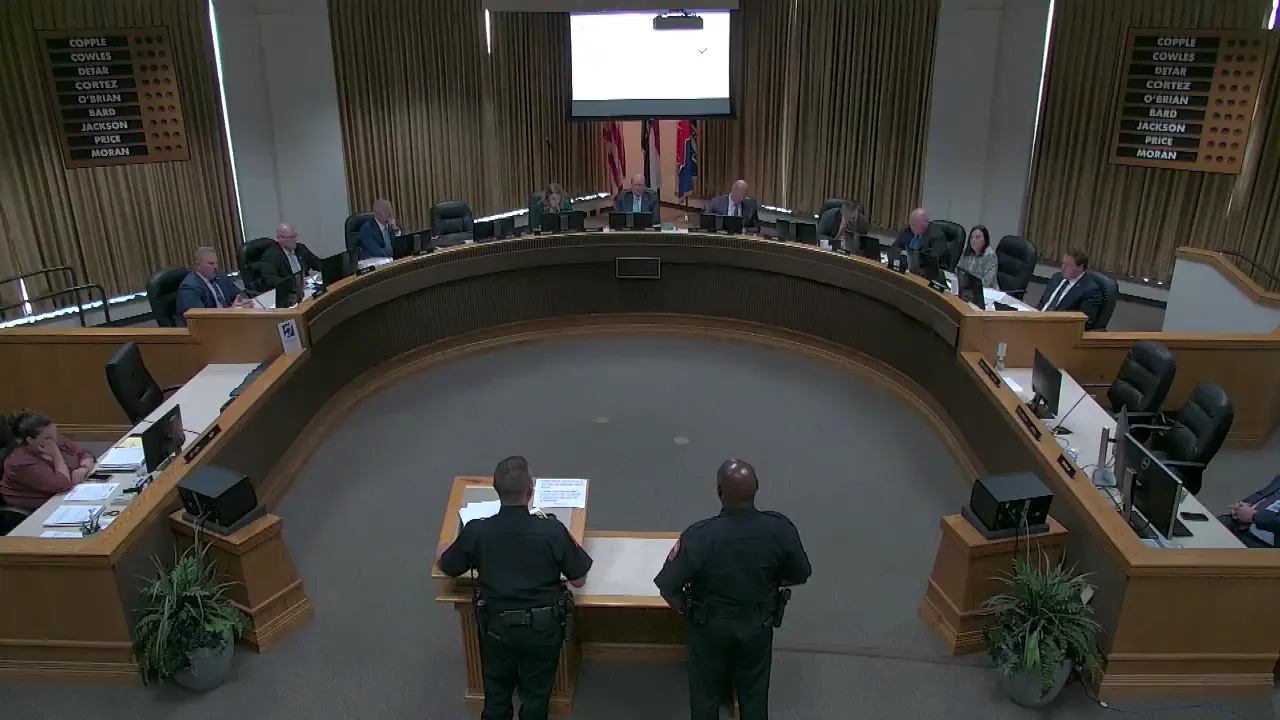
The Joplin City Council held an informal session on Monday, August 3, 2026, to receive updates on the Education Assistance Policy, the Municipal Court, and a presentation on Drones as First Responders (DFR). No formal votes were taken during this session.
Discussion Items
-
Education Assistance Update: Leslie Haas presented an overview of the city's education assistance policy, which was updated in 2023 and 2025. The program is available to full-time employees with one year of service, with a current budget of $27,000 per year. Reimbursement is prorated per semester (fall: $12,000, spring: $12,000, summer: $3,000) based on total requests. The policy moved from first-come, first-served to a prorated pool, which has received positive feedback. Employees are notified of the minimum reimbursement amount before the semester starts, and the budget appears sufficient. (Speakers: Leslie Haas, Council Members Moran, Coppel, Price)
-
Municipal Court Department Update: Court Administrator Lamont provided an overview of the municipal court's operations, jurisdiction, docket types, and staffing. The court is one of the busiest divisions in the 29th circuit, handling misdemeanor, traffic, and ordinance violations. Staffing includes 8 listed employees with one vacancy. The court offers various programs including interpreter services and education programs. Key initiatives for 2026 include reducing legacy ENCODE cases and beginning talks to move to a new system; 2027 initiatives include updating the court website and video. Council Member Cows inquired about community service nonprofits and case filing trends. (Speakers: Mr. Lamont, Council Members Cows, Coppel)
-
Drone as First Responders (DFR) Presentation: Police representatives presented a proposal for a DFR program, detailing the limitations of the current independent drones (time delays, pilot certification requirements, lack of support for DJI drones). The DFR program would involve strategically placed drones in automated "hives" capable of self-dispatching to emergencies within two minutes. The drones are American-made, have built-in FAA restrictions, and come with a 5-year contract with mid-term refresh. The estimated annual cost for two docks is approximately $150,000 and for four docks $200,000 (exact figures not specified in transcript). The department recommends continuing existing priorities (staffing, wages, Proposition Police and Fire) and developing a robust policy with public input before implementation. Funding remains a challenge due to population under 100,000 disqualifying most grants. (Speakers: Captain Will? (unnamed presenter), Council Members Jackson, Coppel, Detar, Cows)
Key Outcomes
- No formal decisions or votes were taken during the informal session.
- The council received information on all three topics and asked clarifying questions.
- For the DFR program, the presenters recommended continuing to prioritize staffing and wages, fulfilling Proposition Police and Fire commitments, developing a policy, and pursuing external funding. The council indicated interest in exploring community partnerships for funding.
- The next steps include further policy development and continued research on DFR options.
Meeting Transcript
All right. We'll begin the uh informal session for the Jonklin City Council for Monday, August 3rd. And thank you all for being here. First up, Ms. Haas, Education Assistance Update. Good evening, Mayor, Council. Tonight wanted to go through some information on our education assistance policy. This policy was updated in 2023 with the adoption of the new employee handbook and then updated again in 2025. Really, the reason for this policy is to help employees advance within the organization. It's available to regular full-time employees who have one year of service. They have to be actively working and performing satisfactorily. It needs to relate to their career development. They have to do an application and have their supervisor sign it. They have to achieve a passing grade. Currently we are budgeting $27,000. This was increased in 2024 from $25,000. The reimbursement is set at the undergrad uh rate at Missouri Southern State University, and we cover expenses, tuition and up to 50% of the cost of books. And there is a $5,000 a year limit. Also we deduct grants before we do any reimbursement. Master's classes are only considered if they're available budget dollars after reimbursing for undergraduate classes, and if it's required for the career development of that employee. But now there are a lot of eight week eight-week classes and uh all kinds of different classes. So we set we defined what fall is and what what spring is and summer, uh, and we allotted budget dollars for each one of those. So right now it's 12 for fall and spring each and 3,000 for summer. Um all the employees that meet the criteria are then placed in a pool for reimbursement on a prorated basis of the total amount being requested to the total amount of education assistance budget available. Um any employee who does receive education assistance, they're required to work for the city for two years. If they don't, uh then they repay it again on a prorated basis. So here's how it has worked uh since we adopted the new policy. This is fiscal year 24. Uh, this is the only year that we have had to prorate, um, and we did learn a few things uh this first year. Um, but you can see uh we had a lot of participation that year and we were able to get everyone some money, uh just not quite all of the money uh for spring and summer. But in 2025, uh you can see we did not use all of our budget dollars, and we were able to reimburse everyone what they were eligible to receive. And then this year, same thing. This this year we haven't had as many people participating, so it kind of ebbs and flows. Uh so in summary, uh this program seems to be working really well. It used to be first come, first serve that uh I don't think there was anyone happy at the city about the first come first serve program. It just uh was not fair. Uh but with this program, employees know up front the minimum amount of their reimbursement available if they meet the qualifications. Uh it's much more equitable. Uh we've received a lot of positive feedback about the program. The reimbursement process is streamlined and improved, and right now our budget amount is sufficient. Uh so with that, I'd be happy to answer any questions. Okay. Are there any questions? Mr. Moran? Hey, Leslie, just real quick, do you know how much per is when you say the minimum that the person is eligible for, is it based off years of service, so they get an increased amount, or is some one person going to get $500 a new hire? So it's prorated. So if we have a year, and we that's why we break it down by semesters. So if you take the fall semester, if we have people who have submitted, say $15,000, which is over the $12,000 budget, then we're prorating what they're due based on those available dollars. So it's just prorated uh based on that particular semester.
openpublica.com