Kaua'i County Council Finance & Economic Development Committee Budget Review: Department of Public Works - March 28, 2025
STREAMING COPY IN PREPARATION — RECORDING AVAILABLE FROM THE ORIGINAL SOURCE
Kaua'i County Council Finance & Economic Development Committee Budget Review: Department of Public Works - March 28, 2025
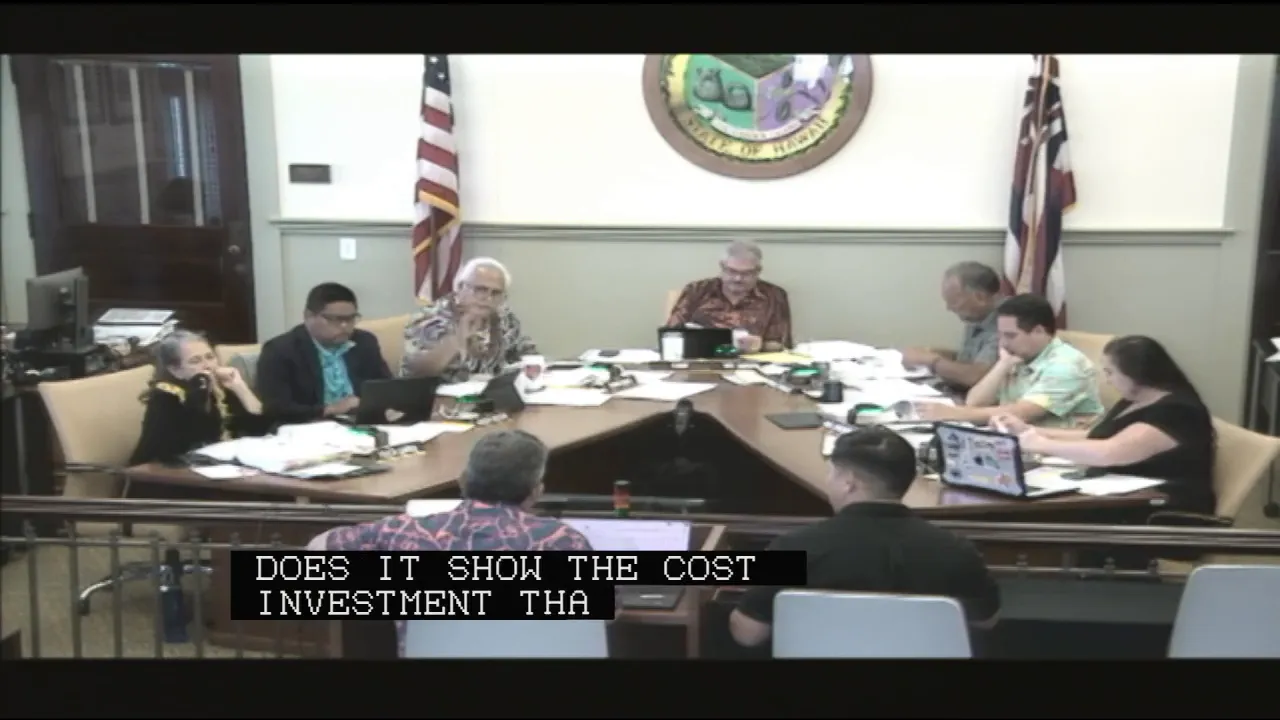
The Finance and Economic Development Committee met on March 28, 2025, to review the Department of Public Works' operating budget and capital improvement projects for Fiscal Year 2025-2026. The meeting included public testimony, a departmental overview, and detailed review of divisions including administration, fiscal, engineering, building inspection, auto maintenance, highways and roads, wastewater, and solid waste. Key discussions centered on staffing vacancies, sick leave abuse, equipment challenges, solid waste diversion, landfill expansion, and wastewater infrastructure priorities.
Public Comments & Testimony
- Joanne Kimora testified on the county's landfill problem, presenting waste categorization data: traditional recyclables (glass, metal, plastic, paper) constitute 36% of landfill waste; food and other organics (including sewage sludge and green waste) 28%; and inerts and construction/demolition materials 24%, totaling 88%. She argued that the current RFP for long-term waste management should only address the remaining 12%, and should not allow respondents to also handle composting and recycling, as that would create a conflict of interest and lead to dependency on a steady trash stream for waste-to-energy systems. She also expressed concerns that projected costs were based on inflated consultant figures and recommended obtaining the full report before budget decisions.
Discussion Items
- Department Overview: Public Works Director Troy Tuning noted a slight overall budget decrease across all funding sources compared to the prior year, attributed to a shift from outright equipment purchases back to lease-purchase arrangements, spreading costs over multiple years.
- Staffing and Vacancies: Multiple divisions reported chronic vacancies, especially for engineers, equipment operators, and auto mechanics. The engineering division has struggled to fill positions despite creating a new salary schedule competitive with the state. The auto maintenance shop has 13 of 22 positions filled; the shop supervisor noted ongoing recruitment challenges and heavy reliance on in-house training due to lack of dedicated training funds.
- Sick Leave Abuse: Council Chair highlighted sick leave abuse, with overtime costs typically triple the annual budgeted amount, and urged proactive engagement with unions. The director acknowledged working with other counties on policy, but council members emphasized the need for enforcement ("stick") rather than rewards ("carrot"). The chair reported that employees are tracking attendance and the council is conducting an audit.
- Equipment and Maintenance: Council members raised concerns about new equipment (e.g., bulldozers) at transfer stations not staying in service, insufficient rental equipment, and theft of tools at the Hui Transfer Station. The solid waste manager noted that camera footage shows nighttime thefts; police reports are filed.
- Herbicide Use and Vegetation Management: Discussion focused on roadside herbicide use (primarily glyphosate) for guardrails and signs. Council members questioned long-term alternatives, including extending pavement past guardrails (now included in repaving contracts) and training crews to identify coconut rhinoceros beetle larvae. The department clarified that pesticides are funded through highway funds, not the general fund.
- Solid Waste Diversion and Landfill Expansion: Council members expressed urgency about extending landfill life. Current diversion efforts include 40,000 grant programs for nonprofits (two grants of 40,000 each) for composting start-ups. The department noted an upcoming RFP for alternative technologies, but the MERF (Material Recovery Facility) study update is expected within a month. The landfill expansion includes vertical expansion of cell three (line 75) costing an estimated 1.693 million for planning/permitting, and a new landfill development (line 78) for site selection with 920,000 remaining. Host community benefit rate is $3.65/ton; council requested a formal briefing on that program.
- Wastewater Infrastructure: A major discussion centered on the feasibility of investing $70 million in the Wailua wastewater treatment plant while relocation remains uncertain. The department requested $2.5 million (half of an anticipated $5 million study) for a comprehensive collection system study for Lihu'e, to address inflow/infiltration and capacity issues. Council members pushed for exploring a land swap with DHHL (20 acres) for a regional plant rather than investing in the current Wailua plant, which is in an inundation zone. The chair emphasized that previous councils were not asked for funding, and urged aggressive prioritization.
- CIP Projects: Reviewed several capital projects, including:
- Historic County Building Annex renovation ($400,000 for design and painting).
- Kīlauea Road reconstruction ($1.8 million county match for $8.5 million total).
- Mōʻī Road improvements (design phase, community input included).
- Anahola Bridge temporary bridge (at port, completion expected this fall).
- Culvert assessment projects (800,000 fully expended).
Key Outcomes
- No formal votes were taken during this session; all figures remain part of the proposed budget under review.
- Council directed administration to explore: increasing training funds for auto mechanics; improving equipment inventory controls; providing a breakdown of planned paving schedules and costs per mile; and assessing feasibility of full funding for the wastewater collection system study ($5 million).
- Council requested a committee briefing on the Host Community Benefit program administered by the Office of Economic Development.
- The budget review session recessed at approximately 4:30 p.m. and will reconvene on Monday, March 31, 2025, at 9:00 a.m. to hear remaining CIP budgets from all other departments.
Meeting Transcript
Okay, good morning. I'd like to call back to order the Finance and Economic Development Committee and the fiscal year 2025-2026 departmental budget reviews that directly reflect that all members are present. On the schedule today, we have Department of Public Works operating budget followed by public works projects contained in the CIP budget if time permits. Following the department's introductory remarks and any questions on their synopsis, we'll be taking public works divisions in the following order: admin, fiscal engineering, building inspection, auto maintenance, highways and roads, wastewater and solid waste last. Um as we do each morning, we'll take public testimony at the beginning really relating to any of the departments or agencies we're reviewing today. With a presentation. Oh, Joanne, you kimora, pardon me. Can you repeat that please? Um I'd like to speak on um how to solve the county's landfill problem, and in seeking to divert as much as we can, planning is usually done based on categories of materials um based on how the materials will be processed. And as you can see from our waste categorization study. Um oops. Oh well. Let me um you'll see that we have three main categories. The first is on the right, glass metal, plastic papers that are called the traditional recyclables, and that's 36% of what goes into the landfill. Um on the left, food and other organics, which includes sewage sludge and green waste, that consists of 28% of what goes into the landfill, and the third category is 24% inerts and other construction and develop uh demolition materials. Of the three categories, the largest is traditional recyclables. That's okay. Um analyze the projected costs. And I'd like to suggest that you and the public get the report as soon as possible at it as it is critical information to have before making budget decisions. The three categories which you see outlined there constitute 88% of what goes into the landfill. So the RFP that is out for a system that deals with long-term management. And I want to point out that composting is long-term management. Curbside recycling is long-term management and construction demolition is all long-term management. But that's your first three minutes, but I'll let you take your other three right now too. Thank you. So the RFP should just be dealing with the 12%, in my opinion. Because it should not allow respondents to do composting and recycling. That's a conflict of interest. And having a system that deals with all the wastes will make us dependent on a steady stream of trash. That is, in order for this new technology to deal, they're going to need all the trash they can get. Even if they take out some of the recyclables, they're gonna want as much as gives them to burn or to make into pellets or whatever. Um and then we have to pay for it, even though there may be ways to reduce our trash. If that all goes to the contractor who's gonna do the waste to energy, they're gonna keep wanting as much as they can get, and we're gonna keep wanting to give them as much as they can get if we have to pay for it, no matter if it's there or not. It's a terrible dilemma, and um uh I don't think that it's a good plan for how to deal with our solid waste. Thank you very much. Are there any questions? Thank you. Any uh follow up any clarifying questions? Simple clarifying questions without going deep. Don't need a deep answer, but you said you felt that the costs in the projections were inflated, and I just recognize how much inflation we've had over the last five to six years. So I know it's a lot higher than the 2017 study. What makes you think they're inflated? Thank you for that question because I'm seeing now that I use the wrong word. Okay. Um the county is rejecting the use of the resource center site. And if you have to get a new site, you have we already own the land there. So that will cut part of the cost. And um, as compared to what they're thinking now, if you get have to get a new place, you will likely have to purchase the land. Okay. And so that's an additional cost.
openpublica.com