Kearney City Council Presentation of 2025-2026 Preliminary Budget – July 22, 2025
STREAMING COPY IN PREPARATION — RECORDING AVAILABLE FROM THE ORIGINAL SOURCE
Kearney City Council Presentation of 2025-2026 Preliminary Budget – July 22, 2025
The Kearney City Council met on July 22, 2025, at 7:00 a.m. for a special meeting with a single agenda item: a presentation of the City of Kearney's proposed 2025-2026 preliminary budget by Finance Director Kayla James. The presentation covered proposed expenditures, revenues, capital improvement projects, debt service, tax rates, fee schedule changes, and key financial challenges. No public comments were heard, and no formal votes were taken except the motion to adjourn.
Discussion Items
- Personnel & Operating Costs: Personal services in the general fund increased by approximately $2 million (9%), driven by higher health/dental insurance costs (20% increase, about $530,000), a 3% pay plan adjustment ($760,000 total), merit increases, enhanced police and fire retirement contributions, and full-year Sportsplex operations. The city reduced its total workforce by five positions (one full-time, four part-time) to 358 employees.
- Expenditures Overview: Total proposed expenditures are $9.2 million higher than the previous year, a 7% increase. General fund expenditures rose $2.8 million (7.5%), primarily in personal services. Other funds (special revenue, capital projects, enterprise, etc.) increased $6.3 million (6.7%). Capital outlay decreased by 0.6% overall due to offsetting projects.
- Capital Improvement Projects (Top 9):
- Fire Station #3 – $12.3 million, funded by public safety tax anticipation bond.
- Airport parking apron reconstruction – $8.7 million (federal community directed funds and bipartisan infrastructure funds; city pays upfront, ~90% reimbursed).
- Box Butte business development – $3.7 million ($2.6 million grant, local match and sewer fund connection fees).
- Avenue A (31st–35th Street) – $1.6 million (special sales tax).
- Landfill new cell – $1.5 million (solid waste disposal fund).
- Avenue N & 45th Street – $925,000 ($600,000 STP funds, $330,000 special sales tax).
- Lead service line replacement – $800,000 (zero-interest SRF loan and NDEE grant; total project $4 million, $2.9 million grant, $1.1 million loan).
- Centennial Park playground upgrade – $400,000 (donation).
- Highway 30 lighting – $300,000 (special sales tax; city pays portion in city limits). These nine projects total $25 million, representing 62% of the $41 million capital budget.
- Debt Service: The city has three bond types (public safety, various purpose, revenue). Net debt increase of about $8 million in principal. Annual principal and interest payments typically run about $10 million.
- Revenues: Total budgeted revenues increased $21 million (20%). Charges for services (34% of total) and taxes (25%) are top categories. Bond proceeds are significant this year due to fire station and airport projects. Sales tax revenue is budgeted at $19 million (including $13 million for property tax relief and $6 million for special sales tax/capital). Property tax request is $6,334,053, based on an estimated 3.8% growth in valuation (final certification August 20). The estimated property tax levy is $0.16 per $100 valuation, an increase of about 1.5 cents. For a $200,000 home, the city portion would increase by $32 annually; for a $300,000 home, $48.
- Sales Tax Distribution: City receives 1.5 cents per dollar (of 7 cents total). One-third of that (0.5 cent) goes to special sales tax for capital. Sales tax revenues are occasionally reduced by state tax incentives (Nebraska Advantage, Nebraska Imagined).
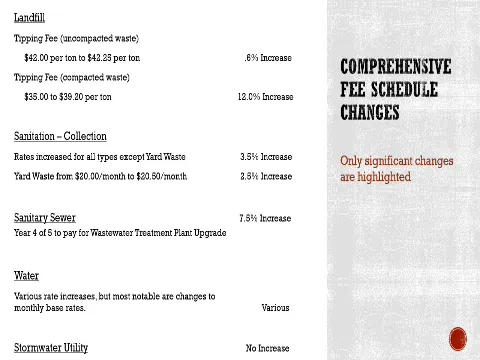
- Fee Schedule Changes:
- Landfill: Uncompacted waste fee from $42 to $42.25 (0.6% increase); compacted waste from $35 to $39.20 per ton (12% increase, phased over 2–3 years to match uncompacted rate). Tire disposal fee from $200 to $250 per ton (state requirement).
- Sanitation collection: 3.5% increase for most waste types; yard waste from $20 to $20.50 (2.5%).
- Sanitary sewer: 7.5% increase (fourth of five planned years, funding wastewater treatment plant upgrade).
- Water: Monthly base rate for residential homes increases by $2.41 (to $12.75, annual increase of ~$29); consumption rates unchanged. A third-party rate study is planned.
- Financial Challenges: Flat sales tax growth with mandated incentive reductions; rising costs for goods, services, health/dental, and property insurance; flat NPPD revenues; uncertainty over state property tax changes; workforce competition and minimum wage increases; continued service expansion without new revenue streams.
- Upcoming Dates:
- August 20: Valuation certification.
- September 3: Public hearing on city and off-street parking district budgets.
- September 9: Hearing to set final property tax request and adopt appropriation bill, personnel ordinance, and fee schedule.
- September 22: Joint public hearing with other political subdivisions (if growth exceeds 2%, likely) at Buffalo County Extension Building at 6:30 p.m.
Key Outcomes
- No formal action was taken on the budget; the presentation was informational. Council members thanked Kayla James for her work.
- A motion to adjourn was made, seconded, and passed unanimously (Mayor Nikkila absent; Council members Moore, Schmidt, Stratman present; roll call not fully recorded). The meeting adjourned shortly after the presentation.
Meeting Transcript
Copy of the open meetings act is available and uh for review and posted on the wall. Um please call roll. Uh Mayor Nicola, absent bush cutter more Schmidt Stratman. Here uh the agenda item really the only one agenda item number three is a presentation of the 2025-26 preliminary budget by Kayla James. Morning. Thanks for getting here so early. I'm pretty sure I've got pants on, but I'm not sure. So yeah, we're here this morning to take a first look at the budget. Um there are a couple of amounts that we're still waiting on to put into the budget. Um the sales tax or excuse me, the property tax won't be the evaluations won't be certified until August 20th. So that number is still pending, as well as the um highway allocation funds number had not been released last time. I looked. So we're gonna take a quick look at this. Um I kind of grouped it to made it made it into a presentation that kind of gives you some um analysis of comparing last year to this year. Um I'm gonna try to run this, but I don't walk and chew gum at the same time very well. So here we go. Okay. So we will talk about expenditures, revenues, and fund balances, and a few other things. On the following slides, we'll take a deeper dive into but basically these areas, and please feel free during the presentation to have some discussion, ask questions. I know we've got two new council members here, so this might all be different for you. Um, the first slide is proposed expenditures by fund, and we are comparing last year's budget to this year's budget, and general fund. We broke that down a little farther because you know that's what runs a lot of the city services. Um personal services went up about two million, just a little over two million dollars or nine percent approximately, and we attribute some of that to higher insurance costs. Um, the COLA that we are offering this year, um merit increases that the employees get. We also had an increase to police retirement that we had to provide. Uh we started providing an increased retirement amount to fire last year, and then also a consideration is that we're having we will have the sportsplex open all year, so that increased our expenses as well. Supplies and materials held pretty steady. Um, they increased $841,000 or about six and a half percent. Capital outlay actually went down about almost thirty-four thousand dollars or two point five percent, and the general fund does not have any debt service in it. So, total overall for the general fund, we had an increase of two point eight million or seven seven and a half percent, and like we said, most of it is in personal services. The other funds um are grouped together, and the other funds are special revenue, capital projects, debt service, enterprise, internal service, and fiduciary funds. Um, the other funds expenditures went up six point three million or six point seven percent, and we'll get into more detail in the following slides. But in total, our proposed expenditures by fund went up nine point two million or seven percent. And just kind of a little fun fact. I broke this down the last two years, I didn't have time to do it this year, but generally the budget almost always breaks down to 60 percent operating expenses and 40 percent capital and debt service. It can sway a little bit either way, but it's almost always this the same. Um, this is a little bit of information about personal services. Sorry, that's so small. We had a lot of a lot of uh position changes, but the highlights really are that in providing a three percent pay plan adjustment for the governmental funds, which are the general fund and special revenue fund, which we only have one special revenue fund. Um transportation is the only one that has salaries in it. Um the three percent increase will cost the general or the governmental funds 537,000, and uh it a 3% pay adjustment for the proprietary funds, which are the enterprise funds and the internal service funds will cost 221,000. So that 3% increase cost us about $760,000. The number of employees that we had compared last year to this year. Um, last year we had 363 total. Uh in fiscal 26, we are looking at 358, which is a reduction of five employees, one full-time employee, and four four part-time employees, and like I said, there's the additions and deletions um by year, and the not so great news is on the bottom. Um, the 20% increase to employee and employer health and dental premiums. So any questions on personal service and Kayla, that 20% that's about $500,000 is about $530,000 is what the um health health insurance increase was. Okay. Yeah. We've been trying to dig out of that.
openpublica.com