Kearney City Council Preliminary Budget Presentation - August 11, 2026
STREAMING COPY IN PREPARATION — RECORDING AVAILABLE FROM THE ORIGINAL SOURCE
Kearney City Council Preliminary Budget Presentation
The Kearney City Council met on August 11, 2026 at 7:15 a.m. to receive a presentation of the proposed 2026-2027 preliminary budget from Finance Director Brian Schultz. The meeting focused on revenue and expense assumptions, personnel changes, capital projects, and enterprise fund rate adjustments. No votes were taken; the presentation was for discussion and feedback.
Discussion Items
- Budget Overview: Brian Schultz presented the preliminary budget, noting the city uses a new budget software (ClearGov) which delayed the timeline. The budget assumes a 1.5% increase in sales tax revenue over the FY26 estimated actuals (approximately $650,000 additional), based on a 1.5% growth rate. Property tax revenue assumes a 5% increase in valuation (final numbers not available until August 20). No tax rate increases are proposed. The city remains sales tax heavy, with sales tax making up the largest portion of tax revenue.
- Revenue Assumptions: The preliminary budget includes $23 million from tax streams (sales tax, property tax, occupation taxes, licensing, permits). Interest income is estimated at $900,000. Occupation taxes are flat, with cable TV occupation tax declining. The city uses the General Fund as a pass-through for G.Bot revenues; staff plans to create a special revenue fund to reduce General Fund bloat.
- Expense Assumptions: Overall expenses are projected to increase 1.5%. Personnel costs remain the largest category. The budget includes a 2% cost-of-living adjustment (COLA) for employees, but internal discussions are leaning toward a 3% COLA to better address inflation (currently 5.26%). Health insurance premiums are expected to remain flat with no changes to plan design or employer/employee split, which staff noted as a significant improvement.
- Personnel Changes:
- Additions: One fire engineer for the upcoming Fire Station #3, and one police officer funded entirely by a Department of Justice opioid grant (if awarded).
- Removals/Conversions: Removal of an assistant facility supervisor (planned succession), conversion of one full-time position to two part-time at the senior center, and removal of a utilities maintenance worker (lead service line program phase-out).
- Capital Projects Highlights:
- Fire Station #3 is funded through property tax levy.
- 39th Street project: $700,000 for engineering in FY27, with total project cost of $7.4 million likely requiring new borrowing.
- Lead service line replacement is in its final year (approximately 1.5 years remaining).
- Harvey Park pickleball courts were removed; Centennial playground upgrades will be funded through the Stevenson fund instead.
- Enterprise Fund Rate Adjustments:
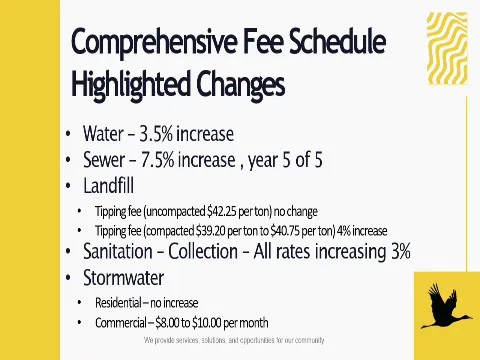
- Water: Proposed 3% increase (likely 3.5% final).
- Sewer: Last year of a planned 7.5% increase for debt service; rate structure will be re-evaluated thereafter.
- Landfill: Compacted rate will increase to match uncompacted; sanitation up 3%.
- Stormwater: Commercial rate proposed to increase from $8 to $10 per month (flat rate). Council member Randy Buschkoetter questioned the flat structure, suggesting rates based on lot size and impervious surface. Staff acknowledged this and indicated future discussions on restructuring stormwater rates to fund major drainage projects (twin 60-inch pipes, southeast drainage plan).
- Budget Timeline: Final valuation from the county is due August 20. A special public hearing on the property tax request and budget is set for September 9, followed by a pink postcard hearing on September 15, and adoption on September 22. Next year, a new state law will require a preliminary budget hearing between July 1-15, which will include all major taxing entities.
- Council Questions: Council members asked about the relationship between revenue and expense growth (Randy Buschkoetter), the inclusion of CRA and off-street parking levies in the property tax calculation (Jonathan Nikkila), the source of stormwater fees (Kurt Schmidt), and the impact of landfill tipping fee increases on private haulers (Tami James Moore). City Manager Brenda Jensen and staff provided clarifications.
Key Outcomes
- No formal votes or decisions were made. The presentation was informational. Staff will incorporate council feedback and return with a final budget proposal for the September 9 special public hearing.
- Council directed staff to consider a 3% COLA for employees in the final budget.
- Staff will explore restructuring stormwater fees from a flat rate to a lot-size-based model within the next 12 months.
- The budget timeline was adjusted to accommodate the late valuation date and publication requirements.
Meeting Transcript
41412 the Nebraska Revised Statutes a current copy of the Open Meetings Act is available for view and the council members Peggy please take roll Mayor Nicolas Cutter here Moore here Schmidt Hotsiopolis here agenda item three is a presentation of the 2026 2027 preliminary budget by Brian Schultz morning everybody You won't learn it uh today you will you are I do not like the mornings so thank you having this presentation at 7 a.m. I particularly so uh the PowerPoint slide was sent out um previously um we've made some minor tweaks to it so I will when we get to those um changes I will point those out to you guys here from what you had seen in the original packet but we're gonna go over the general fund revenues and expenses we are going to talk about some of the considerations that we use when we were coming up with the budget this year go over some of the comprehensive fees schedule stuff the existing budget timeline that we have rest left through the rest of the year and then we can have some general discussion on anything you guys want to as uh I'm discussing any of this stuff there's a strong probability um Brenda will interject so I am planning on I am planning on that so don't worry and then if you guys have any questions while either of us are talking please just ask why and we will answer the best of our ability so um just a quick overview of kind of what we do uh we do all of the initial requests from all the department heads that are here present today they make those at the beginning of the calendar year um right now we are actively using our clear gov budget software that's new for us this year so we had a bit of a um implementation software implementation earlier this year that's why we're kind of a little behind on some of our timeline stuff this year uh then those items they will go through an internal review through the administration team which is the finance and admin um suite upstairs here um kind of reviewing for accuracy asking questions looking for cuts things of that nature and then we will get to this step where we come to you guys uh have our for formal presentation inquiries with you and then hopefully incorporate some of that feedback as you guys ask us questions on them as well and then we will have the final budget approval so here's our revenues for the uh some historical ones that you can see that we've been trending up the last few years as long as you guys know we have been sales tax driven heavy the last few years um and sales taxes kind of slowed down a little bit uh so that's where our 26 estimated actuals are where they're at um for the upcoming um 20 FY27 preliminary um numbers so what I've done for some of the forecasting uh to get the preliminary numbers uh we are using a one and a half percent sales tax on what we are anticipating the estimated actuals to be this year not off of the FY26 budget number um that's about a six hundred and fifty thousand dollar increase um we are anticipating taking the growth on property taxes so that will increase property taxes a little bit and the other large one that I want to point out are the uh G bots um so we do use the general fund as a pass through right now so we are collecting G bot revenues and then we pass those through so as more businesses get built in the G bot we need to make sure that we're um anticipating that revenue coming in so that we can pass it through so that numbers a little fluffier um our anticipated final numbers we are going to probably pull all that stuff out Brenda and I have kind of talked about creating a special revenue fund for everything that is a pass through item so it doesn't make the general fund kind of look overly bloated um so that's uh kind of an internal cleanup thing um that's the way I've used that in the past and that would be my preference moving forward so we're gonna kind of just clarify so from my understanding our expenses will go up a percent and a half yep we'll yep most of that's more than a percent and a half so is that three million so is that is that due to this G bot I mean some of it's G bot some of its occupation taxes um some of it is just necessary revenue needs in order to fund the operating costs so the kind of transfers that we we need to make in order to fund those okay fund operating a percent and a half expenses and more than a percent and a half revenue increase yeah so otherwise we would be upside down the budget would be upside down right so we have to make those transfers um from compute north and um okay yeah so those are going into there instead of other okay yep all right so kind of give a little breakdown of what the revenue stream where it's coming from so this slide is gonna look a little different I kind of broke out I had the types on there but we figured it'd be easier for you guys to see the actual dollars on there so again we kind of get a little over 23 million dollars from our tax stream which is you know sales tax property tax occupation taxes licensing permits a little over 500 charges services 2.2 um right now I'm anticipating 900 thousand dollars in interest and then our interlocal agreements which are these are primarily um counties but it also includes anything that we might get from the uh state as well in there that if it's a grant or the feds those are all deemed in our local um and then other which is Um so again, we kind of get a little over 23 million dollars from our tax stream, which is you know, sales tax, property tax, occupation taxes, licensing permits, a little over 500 charges services 2.2. Um right now I'm anticipating 900,000 dollars in interest, and then our interlocal agreements, which are these are primarily um counties, but it also includes anything that we might get from the uh state as well in there that fits a grant or the feds, those are all deemed in our local, um, and then other which is kind of a hodgepodge of random stuff sometimes. So we have our budgeted tax revenues by source, have a pie chart here, so you can kind of see that breakdown. And this is just to reiterate again that we are sales tax heavy as it comes through our tax stream. Um I don't anticipate that changing any time soon. Um but we also have a pretty sizable chunk of our occupation taxes as they stand today, and just to reiterate, none of these models have any um actual tax increase uh recommendations in them. A little bit about property taxes here. So again, these are preliminary numbers. We will not get our valuation numbers until August 20th. So we're making our best guess on what we think the actual new valuation will look like. So these are very much subject to change at this particular point. Um, but we are anticipating um the slice factor, well, not anticipating the slice factor is already set in stone the 5.26. The anticipated is the estimated new construction percentage that we have on there. Um that one is our number from last year. We think it'll be similar, but we we we will not know for a few more days. Um, and then kind of estimating if those if that was the valuation, kind of what our tax dollars and our levy might look like if we anticipate taking the growth. Um, so that would be a little over four hundred dollars on a two hundred thousand dollar home and a little over six on a three hundred thousand dollar home for next year. So tax request by fund. Um back a slide, sorry absolutely again. I'm just trying to, and we can work time to work this out. I'm trying to just square things, like last year's presentation, which we're saying we're just taking growth, which would keep in the levy the same. In the presentation last year, the number was eighteen point or like you know, the decimal eighteen, two, three, two. So that number's different. So one of the reasons why is last year in the presentation, the next slide that Brian's gonna show. It the levy did not include the CRA and the off-street parking district levy built in. Yep, that's just included because we now submit the forms differently to the state. We include everything on to one form. Um previously we had them we submitted three different forms. We submitted one for the city, one for the CRA, and one for off-street parking district. So that's where that comes into. What yes, what what Brian presented on this one is taking inflation and new construction growth, which is historically what we've always done. Gotcha. So that last number includes other numbers in the past that we didn't show. Okay. Thank you for clarifying. That process has changed a little bit since I've been here. There's a lot of red tape with the state as is, and we were quadrupling the red tape. So I tried to have that the best I could. Okay. Um so the tax request by funds. Here's the pie chart again, very heavy on the general fund, and then you can kind of see the breakout that we have on the bonds that we have taken out for the fire station three. If you were looking at the dollars from last year, where would they've kind of shuffled around a little bit? Um our off street parking district is obviously only the businesses in the downtown area, and then the CRA is across the whole city limits. It's just a smaller pot piece of the pie. And then we have the overall piece of the pie, which kind of shows us where we stand with the other taxing districts. So this is the calendar year or taxing year 2026. So the year everybody's paying on their taxes right now. This is the current breakdown.
openpublica.com