2025-02-25 City Council Workshop on DDA IGA and Capital Project Financing
STREAMING COPY IN PREPARATION — RECORDING AVAILABLE FROM THE ORIGINAL SOURCE
2025-02-25 City Council Workshop on DDA IGA and Capital Project Financing
The Lafayette City Council held a workshop on February 25, 2025, to discuss two major agenda items: an intergovernmental agreement (IGA) with the newly formed Downtown Development Authority (DDA) and a comprehensive analysis of capital project financing for aging city facilities. The workshop also included a new ideas section for councilmember input.
Discussion Items
Downtown Development Authority Intergovernmental Agreement
- Economic Development Director Bridgie Kuting presented the proposed IGA between the City and the DDA, which will be seated in April 2025 with seven members (one council member, four property owners/residents, two business owners).
- The agreement establishes three buckets: general administrative support (shared city resources, an administrative fee determined by cost allocation study with a reduced fee for the first five years), funding mechanisms (joint grant applications, potential city loans to the DDA for projects repaid through future TIF revenue), and cooperative agreements (allowing the city manager to sign agreements within purchasing authority for shared projects aligned with city plans).
- Councilmembers asked about potential conflicts of interest when the DDA executive director is also a city employee, and about council oversight. Staff noted that the DDA budget will require council approval, and the plan of development aligns with existing city plans to reduce conflicts.
Capital Project Financing – Analysis and Outreach
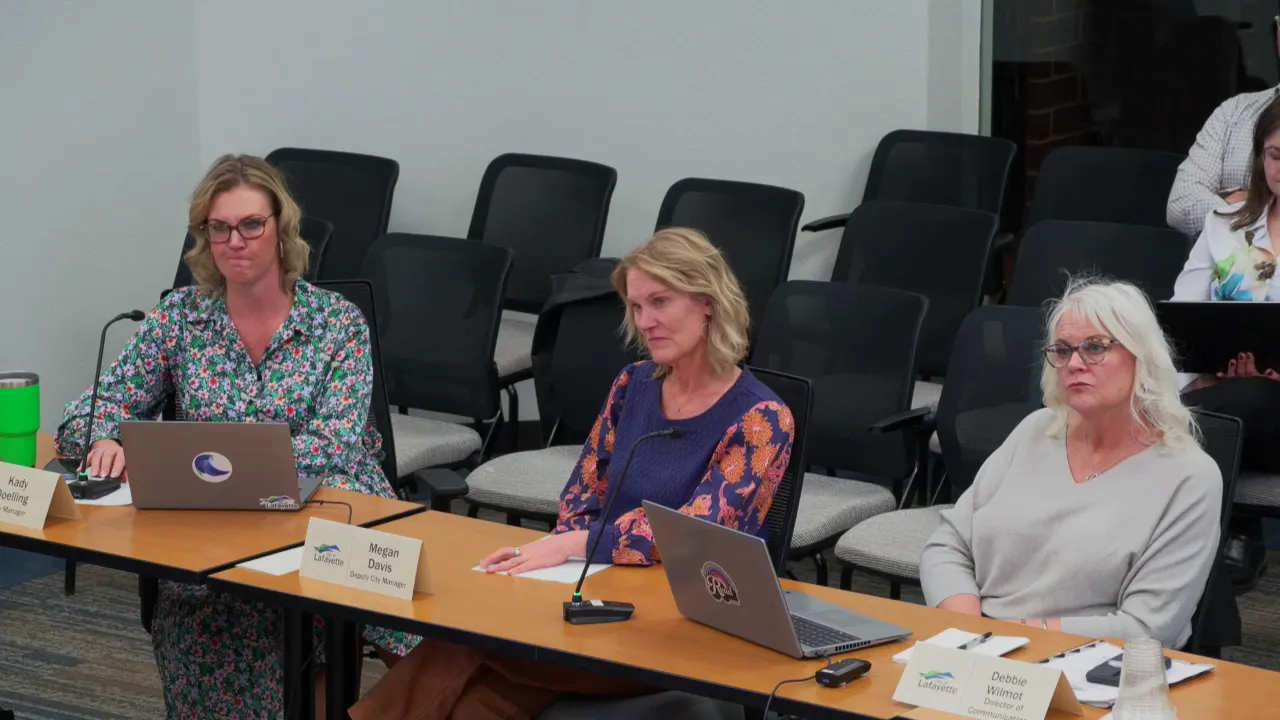
- City Manager, Deputy City Manager Davis, and Communications Director Wilmot presented an update on three proposed capital projects: the Recreation & Aquatic Center (option A: major expansion for approximately $34 million; option B: renovation of existing facilities), a new Civic Center (estimated $34 million) to replace the aging City Hall built in 1985, and the Service Center (estimated $6 million) built in 1973.
- Staff explained that population growth from 3,500 in 1973 to over 30,000 today has outpaced facility capacity, and many departments are at capacity with outdated infrastructure (ADA issues, lack of fire sprinklers, inefficient energy systems).
- For financing, staff analyzed a 20-year debt service package of approximately $5.9 million annually for all three projects. They compared a sales tax increase (current combined rate ~9.055%, high among neighbors) versus a property tax increase (current mill levy ~15.873, low among neighbors when including special districts). Staff recommended pursuing a General Obligation bond funded by property tax, not sales tax, due to volatility and high existing sales tax rates.
- Staff proposed a two-phase community outreach plan (April–May and June–August) including statistically valid polling (cost $10,000–$12,000), questionnaires, community sessions, and digital communications. Council supported proceeding with polling to gauge community appetite for property tax increases and project priorities.
New Ideas
- Councilmember Samson raised safety concerns about bike lanes on Emma Street between Wilson Gardens and South Public Road, where parking and delivery vehicles force cyclists into traffic. Staff indicated preliminary design work is already underway and will provide an update at the March workshop as part of the Safety Action Plan update.
- Mayor reported progress on sister city discussions with a nonprofit working with a city in El Salvador and another (One Voice for Change) interested in Iquitos, Peru. An update will come to a future council meeting.
Key Outcomes
- Council supported moving forward with the DDA IGA, with appointments to the DDA board to be made at the next regular council meeting. The IGA will be presented for approval in April 2025.
- Council agreed to proceed with the recommended approach: focus on a General Obligation bond funded by property tax, continue exploring all three projects (do not eliminate any), and conduct community polling and outreach. Staff will bring a draft polling plan to the March workshop.
- Staff will provide a safety update for Emma Street at the March workshop.
Meeting Transcript
We can go ahead and get started. This is I'll open up the workshop for city council for February 25th, 2025. We have two items on our agenda tonight. It's a um downtown development authority intergovernment agreement with the city of Lafayette. Following that discussion, we'll be talking about some of the capital improvement projects going on in the city and at least to find potentially finance those. And at the end, uh we do have a new ideas section. I haven't heard from anyone of the new idea, but you know, if you do have something come up, please let us know. Um so we can just go ahead and get right into it. Um we have our uh economic development director here, uh Bridgie Kuting, uh, to talk to us about uh the new DDA. Great, thank you, Mayor and Council. Excited to be here. Um, as the mayor mentioned, I'm gonna be providing a presentation of our proposed intergovernmental agreement with the newly founded downtown development authority, the DDA in the city of Lafayette, and this agreement will establish a clear framework for how the city and the DA can collaborate on shared initiatives, funding, and um projects. And so um I'm gonna for the agenda this evening, just provide a brief overview of the DDA since we're very familiar with it at this point, and then dive into the the three buckets of the framework of the IGA of general administrative support, funding mechanisms, and cooperative agreements and then talk about next steps. So, as we are all familiar with, the Lafayette DDA is dedicated to building a thriving old town by supporting local businesses, creating welcoming spaces, and strengthening the community connections, and our DDA board, which um will be seated in April, and the mayor will be uh making those recommendations for appointments at our next council meeting, will be comprised of seven members. There'll be one council member, four property owners or residents, and then two business owners. One thing to note is that entities can own or lease property within the DDA, they can appoint a manager, agent, or employee to represent the NID on the board. So um, we are at the finishing line to getting this board together, and our first meeting will be in April. And so tonight we're talking about the framework for um setting up the the uh the staff and the resources within the DDA. So, some example structures um looking across the state for how DDAs are set up. Um the first is that they're completely separate entities from the city. Examples of this is Loveland and downtown Longmont, and these areas are very large, they're much larger cities, and the DDAs within them are completely separate. They're quasi-municipal corporations, they hire their own executive director, they contract their HR, they pay for office space, and they're really separate from the city. And these are much different areas as far as their downtown. This is what Laura has done for the past 25 years, the shared city resources model, and going into the DDA, we knew that we always knew that this would probably be the best bet for us, particularly because it's a much smaller geographical area, and we want to build upon a strong foundation, so having the shared city resources model made sense. So it's general administrative support, funding mechanisms, and cooperative agreements. So diving into administrative support. The first is the executive director. So the city will assign one or more city employees as determined by the city manager to act out and carry the functions of the executive director of the DDA. This is a staff person that is similar to how Laura had an executive director, and also the DDA will have a similar one. Neither the city nor the DDA anticipates that this signed employee will be exclusively devoted to the authorities' activities. And similar to Laura, Laura does not have an exclusive executive director. They I split my time between the both. So this is a just a graphic to kind of illustrate that. For administrative support continuing this, right now, you know, Laura functions within the city of Lafayette. They have their meetings here. I can sit here in my office space, and this will be a similar model for the DDA. So the city will provide reasonable administrative support through the various offices and departments as assigned by the city manager. So that includes facilities, finance with the DDA needs to do a contract or invoicing, it will be part of the city audit, human resources if there was any new employees that needed to be tied to this, IT, etc. The other part is that the general legal services would be through the city attorney's office, which we've been doing for Laura. We would be able to use facilities to hold our meetings, do outreach in the library if we needed to. And then the last one is including the DDA as insured on city insurance policies. We currently do this, it's at no cost to the city to do this because of the entity size. We looked into this and it would be the same no cost. And so this is a great way to just save on overhead by being able to tie into these resources. So the fee. So the first bullet here is as compensation for general administrative support, the DDA shall remit an annual administrative fee to the city as determined by the city's cost allocation study. In our urban renewal plan, the way that the fee is determined is that it's 10% of the annual revenue generated by urban renewal. And since then, we've gone we've moved towards a cost allocation study where we actually look at how much time finance and IT and parks and public works actually work within these different business units and determine what that fee is. And so this is a model that the city in general is has moved towards, and we would want to use the same approach within the DDA. The fee, though, you know, does a substantial for a DDA who's just getting started up.
openpublica.com