Capital Bond Exploration Community Meeting #3 – Sustainability Focus (May 15, 2025)
STREAMING COPY IN PREPARATION — RECORDING AVAILABLE FROM THE ORIGINAL SOURCE
Capital Bond Exploration Community Meeting #3 – Sustainability and Environmental Stewardship
This third community meeting in the series focused on the sustainability and environmental stewardship aspects of three proposed capital projects: the Bob Berger Recreation Center (BBRC), the Civic Center, and the Service Center. City staff presented current conditions, desired improvements, and potential sustainability upgrades for each facility. The projects are estimated to cost $34 million for the rec center and civic center combined and $6 million for the service center, with an annual debt service of $5.9 million. No decisions were made; the meeting was for community input, and the next step is a city council meeting on May 27, 2025.
Public Comments & Testimony
- A community member expressed concern about the potential loss of the outdoor hot tub at the BBRC, calling it a unique feature of the facility.
- Another attendee asked about possible fee increases, noting that the BBRC is currently inexpensive compared to other rec centers, and requested that trade-offs such as cost increases be clearly communicated.
- A speaker raised concerns about the loss of green space and the trend toward concrete and asphalt, suggesting that the city risks resembling Southern California. They specifically noted that the last open green space on Public Road would be replaced by concrete under the current plan.
- Residents asked about the city's current electricity and water costs and the potential return on investment from energy efficiency improvements.
- Questions were asked about incorporating green roofs, solar panels, and light pollution mitigation into the designs.
- An attendee inquired about backup power for new buildings and the feasibility of microgrids in relation to Xcel Energy.
- A question was asked about whether the city's building code requires all-electric construction and why electrification is important for reducing greenhouse gas emissions.
- A resident asked about the process for determining which sustainability features would ultimately be included in the finished projects.
Discussion Items
- Katie (city staff) opened by providing context: the three projects are at the end of their lifespan (Service Center built 1973, City Hall built 1985, Rec Center built 1990) and are very public-facing, serving the majority of residents.
- Megan (city staff) presented sustainability details, including current energy use, renewable energy sources, heating/cooling systems, and building envelope issues for each facility.
- For the BBRC: The facility uses 1.2 million kWh annually, with solar garden purchases and on-site solar thermal heating for pools. Proposed improvements include a 30% expansion (primarily aquatic center), new mechanical systems, electrification options, and water conservation measures such as regenerative pool filtering and a new piping system to reduce leaks.
- For the Civic Center: A new build is proposed on a site near South Public Road, with opportunities for efficient design, electrification, geothermal heat pumps, and community spaces (council chambers, court, office space). The current building is leaky and has inefficient heating/cooling zoning.
- For the Service Center: The facility is used for public works, fleet maintenance, and parks operations. Improvements include consolidation of staff spaces, insulation upgrades, increased electrical capacity for electrification, updated building envelope, and better site security.
- The city's Climate Action Plan (adopted 2024) guides the sustainability efforts, with priorities including renewable energy, energy efficiency, electrification, and water conservation.
- Staff noted that commercial buildings account for 39% of Lafayette's greenhouse gas emissions, making city facilities a key opportunity for reduction.
- The city has adopted the 2021 International Energy Conservation Code and the Colorado Model Electric Ready and Solar Ready Code, requiring electrification for new buildings.
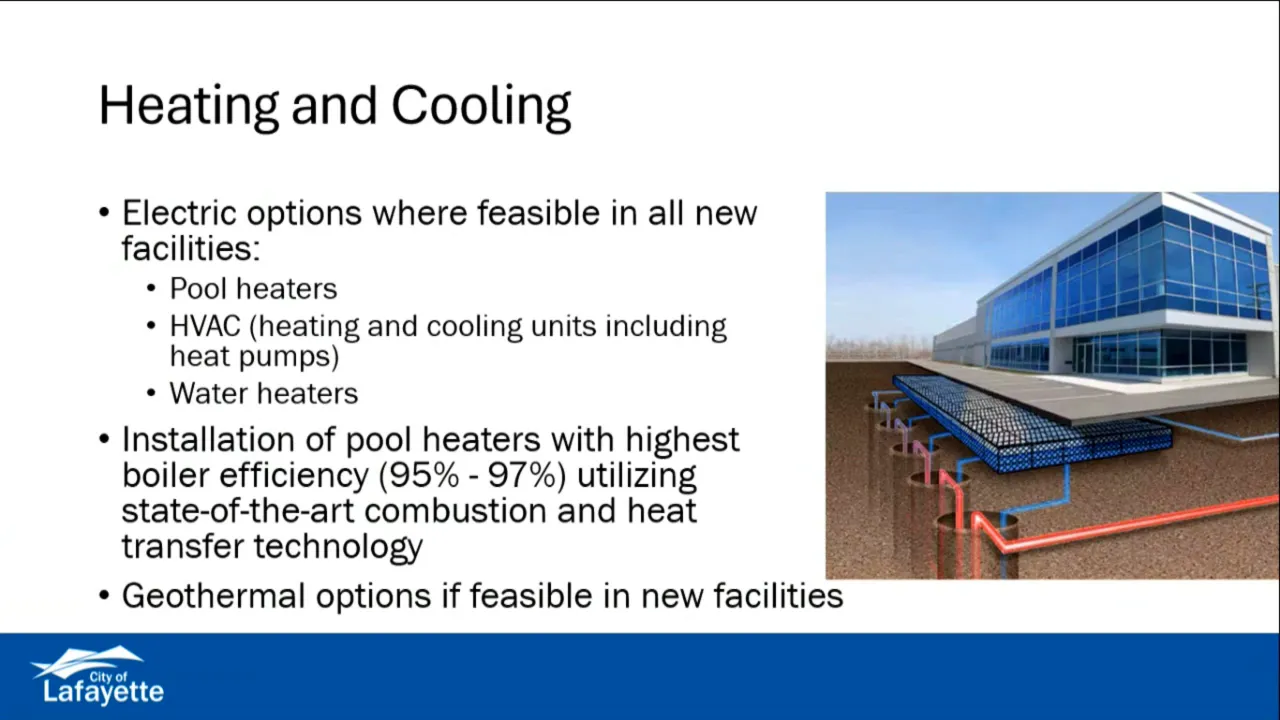
- Potential sustainability improvements across all projects include: electrification of heating/cooling (e.g., geothermal), LED lighting, efficient pool pumps, additional EV charging stations, xeriscaping, low-flow fixtures, and nature-based solutions for stormwater management (rain gardens, bioswales).
- The concept of resilience hubs was introduced; a sustainability intern is studying the BBRC as a potential location for a community resilience hub with renewable energy and microgrid capabilities.
- Next steps: Community polling and feedback will be compiled and presented to the city council on May 27, 2025, to determine whether to proceed with a ballot measure for voter approval of the projects.
Key Outcomes
- No votes or formal decisions were made during this community meeting.
- The community survey is open until May 16, 2025, and additional comments can be submitted via sticky notes at the meeting or by email to communications@lafayetteco.gov.
- The city council will review all feedback, statistical polling data, and input from boards and commissions at their May 27, 2025 meeting to decide on next steps, which could include placing a bond measure on the ballot, adjusting the project scope, or delaying the process.
Meeting Transcript
Our best. They have helped us with this presentation. We've presented to the Sustainability Advisory Board, but we are no experts. So give us your best questions, but we will also maybe need to get back to you. So thank you for that grace tonight for that piece. As a reminder, our first session really highlighted the capital projects, our second one highlighted financial stewardship, and tonight again is around that sustainability. So we'll talk a deep dive into the current conditions of the facilities that we're talking about, some desired improvements and those impacts that they have on our sustainability goals, and then some next steps. So just as a reminder for the three projects we're talking about, the sustainability or the service center was built in 1973, back when we had a population of about 3,500 residents. City Hall was built in 1985 when we had just over 9,000 residents, and the recreation center was built in 1990. And so the city has evolved a lot over those multiple decades. We have both increased services but increased demands and needs from our community, which is something that we're trying to address with the facilities that we currently own. So again, the projects under consideration are the Bob Berger Recreation Center, the Civic Center, and our service center. We chose these three projects because while we have a lot of different assets that we'll be needing to evaluate, these three are largely at the end of their lifespan and are very public facing and serve the majority of our residents. So just as a reminder again, the project costs for the three projects that we're talking about are 34 million for the rec center and civic center and the service center just over $6 million, which brings us to about a $5.9 million dollar annual debt service. Again, we've been highlighting kind of how these projects and how this exploration aligns with our strategic outcomes. So tonight, again, is focused on that environmental stewardship and excellent city services and infrastructure. So with that, I'm gonna turn it over to Megan to present the remainder of the presentation. Thank you. Okay, so when we uh talk about these projects tonight, we're gonna primarily be talking about kind of the sustainability elements and potential for the projects and looking at the current conditions around from kind of an environmental responsibility and sustainability lens. So sort of guiding this for the city is our climate action plan. So we have a climate action plan that was adopted last year by the city, and there are several uh aspects of the climate action plan that are guiding our work in this area. Um, first is around renewable energy and support. We have a specific priority in the climate action plan that specifically outlines uh this for the city to really seek opportunities for Excel energy programs, but also enrolling in renewable energy programs and expanding our renewable energy programs, also making energy approved energy efficiency improvements and making our city facilities more energy efficient and with electrification options, and then also looking at our water infrastructure for city facilities and developing conservation strategies for city facilities and for our parks. So we've really kind of paid attention to those in our preliminary designs, but also in thinking about what we need to prioritize as for moving forward. When we complete completed the assessments for our facilities and looking at the facilities, we had some guiding principles that intersected with the climate action plan, and one of them was to really embody both the climate action plan but also the community at large's commitment to environmental stewardship in promoting resource efficiency, green building principles, and no carbon emissions. And then to really balance these needs, we know that we have a lot of financial pressures. Um again, the previous conversation that we had with the community on these projects was around financial stewardship, and so really how we can balance meeting our needs around sustainability with our kind of long-term financial planning and the financial impacts of these projects as well. And then we also want to really look at flexibility use of these facilities and the use of the materials in these facilities. I'm gonna start by talking about the Bob Berger Recreation Center. Um, if you're not familiar with the project that we're talking about for the BBRC, um, this is a project where we will maintain the recreation center so it's not a complete rebuild of the recreation center, and do an addition, which is about a 30% expansion of the space at the BBRC. The primary part of the expansion will be the aquatic center. So it would be basically rebuilding the aquatic center and then adding on some additional fitness space and adding on some additional space for community use. So potentially for space for older adults, for teens space that can be used as more of kind of community space. Currently, our recreation center is just about 46,000 square feet, and our energy use at the site at the facility is just over a million kilowatts of annual energy use. We have kind of two sources of renewable energy. The city buys solar. We have some different solar contracts through solar gardens throughout Colorado that we buy solar energy through. Right now we buy solar energy from a solar garden for just over what our energy use is, our typical energy use is at 1.2 million. And it's because it covers the total use, it fluctuates a little bit. And then we have 70,000 kilowatt hours of on-site solar production. So that's actually solar thermal, and that solar energy is used directly to heat the water, and then the water that is heated is actually heating the kitty pool there where there's a water feature, and then the lazy river pool, and then we usually heat more than enough water for those two pools, and then it overruns into the lab pool to help keep the kind of equalize the temperature in the lab pool. So that's what we currently have on site. The heating and cooling systems for the facility are all gas rooftop systems. And again, we have solar heating for some of the water heating, and then we have gas boiler systems as well. The building envelope for that building, because it is a 1980s building. If you've been in there, you know that it's kind of concrete brick. It's a it's a pretty leaky building. It has original windows and kind of limited limited air ceiling and roofing, you know, kind of poor poor roofing around the kind of junctions. And then the lighting is really mixed. We have some electric in the aquatic, I mean, sorry, some LED lighting in the mandatorium, but all the pool lighting is LED, and we have kind of mixed lighting throughout.
openpublica.com