Lafayette City Council Workshop on Capital Bond, Finances, and New Ideas – June 24, 2025
STREAMING COPY IN PREPARATION — RECORDING AVAILABLE FROM THE ORIGINAL SOURCE
Lafayette City Council Workshop - Capital Bond Measure Scoping, Financial Update, and New Ideas
The Lafayette City Council held a workshop on June 24, 2025, to discuss a potential capital bond measure for the November 2025 ballot, review the city's financial outlook amid economic uncertainty, and consider a proposal for improved communication with boards and commissions. The meeting began at 5:30 PM and featured detailed presentations from staff, bond counsel, and financial advisors.
Capital Bond Measure – Ballot Measure Scoping
- Background & Polling: Staff presented results from a community poll on three proposed projects: Bob L. Burger Recreation Center (BBRC), Civic Center, and Service Center. The poll showed 79% of voters indicated the BBRC would make them more likely to approve a tax increase, 58% for the Civic Center, and 64% for the Service Center. Key themes included strong community support for the Service Center and BBRC, preference for property tax over sales tax, and concerns about economic uncertainty and timing.
- Financing Options: Maddie Pradonovich (Hilltop Securities) explained phasing strategies for general obligation bonds with a 20-year term. Two options were modeled: Option 1 (20-year total term with staggered issuances) and Option 2 (each issuance with its own 20-year term, resulting in a 22-year total). The difference in maximum annual payment was about $300,000, while total repayment varied by $5 million in interest. Staff recommended flexible language to allow the city to choose later.
- Project Package & Question Structure: Council discussed whether to include all three projects ($74 million debt, $120 million total repayment) or only the BBRC and Service Center ($40 million debt, $70 million total repayment). The estimated tax impact for the average home was $296/year for all three projects (previously) and approximately $160/year for the two projects (updated). Staff noted that a neighboring city (Longmont) saw failure when separating projects into multiple ballot questions.
- Council Positions: Council members expressed varied views. Some supported all three projects to be proactive (Councilors Tapia-Vega, Barnes, and Sampson), while others favored the two-project package due to economic uncertainty (Councilors Bertling and Burland). Councilor Tapia-Vega initially suggested two questions (three projects) to give voters choice but later aligned with the consensus for one question. Council reached a majority consensus to put forward a single ballot question, but remained split on whether to include two or three projects. The decision was deferred to the July 15 regular meeting for a formal vote, with staff to prepare language for both options.
- Next Steps: Staff will bring draft language for the two options to the next meeting, and the final ballot measure will be certified in August after further community engagement.
Financial Update
- National & State Economic Overview: Sarah Culsa (Interim CFO) presented a "time of uncertainty" due to tariffs, federal policy changes, high national debt, global conflicts, and declining consumer and business sentiment. U.S. GDP growth in Q1 2025 was negative (preliminary), and the University of Michigan consumer sentiment survey showed a sharp decline in May 2025 (highest inflation fear since 1981). JP Morgan estimated a 40% chance of recession. Colorado's growth is slowing: home price growth fell to 4% (from double digits), and retail sales flattened (1% growth in 2023, slightly negative in 2024).
- City Revenues: Megan noted that sales and use tax (45% of general fund revenue) grew only 0.6% in 2024 to $27.4 million, with flat projections for 2025-2026. Property tax (25% of general fund revenue) increased 25% in 2024 due to reassessment, but preliminary 2025 data shows only 4% growth (non-assessment year). Fees for services (11% of revenue) were flat in 2024 at $7 million. A parks, rec, and golf fee study is underway to update cost recovery; proposed changes to fee approval process would shift some fees from council to city management approval (e.g., recreation programs, administrative fees), while public safety and utility fees would remain with council.
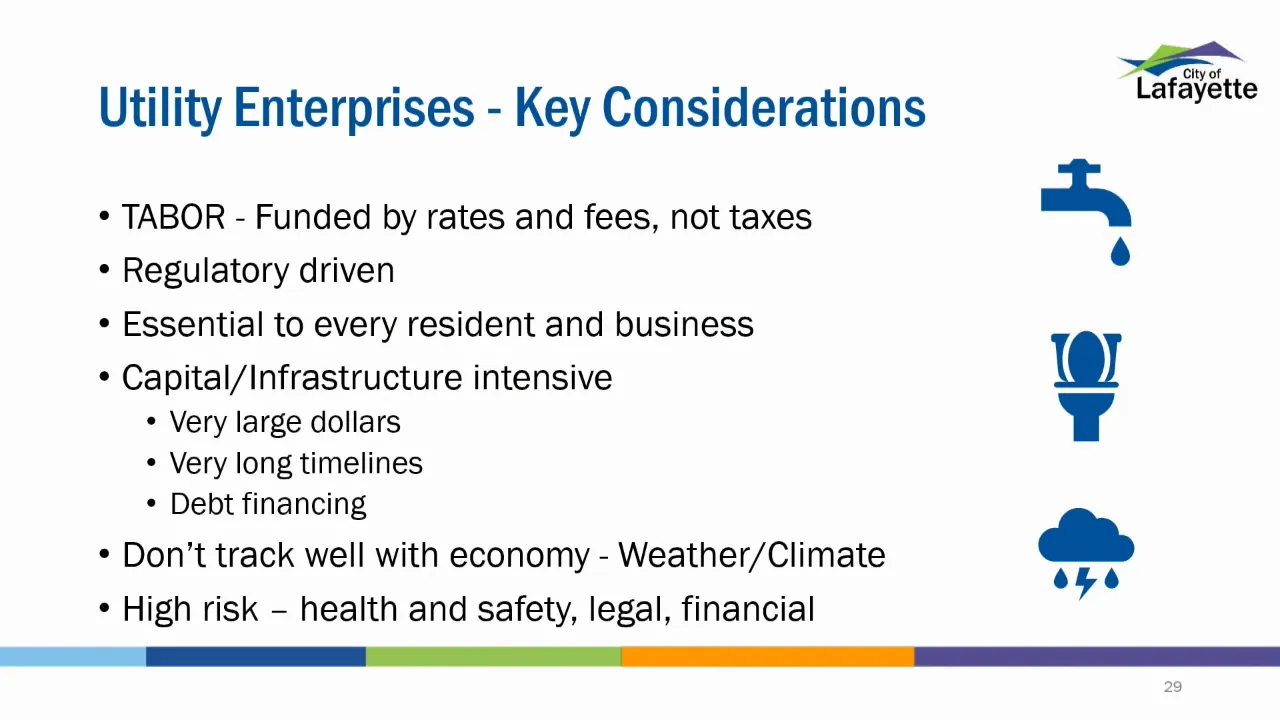
- Utility Enterprises: Jeff Arthur (Public Works Director) reviewed water, wastewater, and stormwater funds. Revenue varies significantly with weather (e.g., 80% of summer use is outdoor). Even with rate increases, high water users have not reduced consumption significantly. Delinquency rates are trending upward. Major capital projects (e.g., NISP water project, $2.2 billion) and aging infrastructure (e.g., failing pipes found at Willoughby Corner and South Boulder Road) create significant cost pressures. The utility rate study will develop options for revenue increases, including refining rate structures and adjusting development-related fees. Deferrals of some capital projects are likely.
- Budget Process: City Manager Dolling noted that early 2025 revenues are tracking to budget, but no large revenue enhancement opportunities remain. The 2026 budget will be conservative, with minimal new investments and a flexible approach. The annual financial report for 2024 will be presented in August, and budget hearings in October.
New Ideas: Boards & Commissions Communication
- Councilor Bertling raised the idea of creating a structured process for boards and commissions to ask questions or share feedback directly with council, as some liaisons report that communication is unclear. Suggestions included allowing a representative to speak during public comment, having quarterly presentations, or forming a small group with staff and board members to design a process. Council agreed to task a subcommittee (including staff and interested board members) to develop a formal mechanism for two-way communication. Staff will coordinate and bring recommendations back to council.
Key Outcomes
- Capital Bond Measure: Council reached consensus on a single ballot question but remains divided on whether to include two projects (BBRC and Service Center) or all three. Final direction will be sought at the July 15 regular meeting, with staff preparing language and updated financial numbers for both options. The bond measure must be certified by early August.
- Fee Approval Process: Council expressed general support for staff's proposal to clarify fee approval authority (some fees to be approved by city management, others by council). Staff will bring an ordinance for further discussion in August.
- Boards & Commissions Communication: Council directed staff to form a small working group (including council members and board representatives) to develop a standardized process for boards to communicate with council. A proposal is expected in the coming months.
- Budget Outlook: Staff will continue monitoring revenues and present a conservative 2026 budget with flexibility, focusing on optimizing existing resources rather than new investments. No immediate cuts are anticipated.
Meeting Transcript
Tuesday, June 24th, 2025, to order. We'll go ahead and start with the capital bond measure. So if we'll turn it over to Megan. Yes, yes. Good evening, Mayor Pratem, City Council. We're going to have another conversation this evening about the Capital Bond projects and specifically talk about the ballot language scoping. We have a number of folks here with us this evening. Alex and I, assistant to the city manager, will be presenting along with Maddie Pradonovich with Hilltop Securities, and then we also have Butler Snow, our bond counsel here. We'll talk about next steps and then discussion and direction. So in terms of background, um, just as a reminder, we kind of have been discussing with council some of the capital improvement needs throughout the city, and we have significant capital needs. Um, with kind of the results of that to get council direction on moving forward. Um council gave us direction at that time to move forward with the capital with a capital projects ballot measure, but recognize that we need a little bit more discussion about what um projects to include in um the ballot measure. So here we are tonight, and we're hoping to finalize the scope of work and get further direction from you all. Um the poll, as you recall, was quite extensive, and we got a lot of feedback from the community. We got everything from kind of that top-line information about the community sentiment around their confidence in the city and their confidence in how the city is kind of running. We got information on their feedback on the projects before having any information about the projects themselves, and then feedback on the projects after being educated a little bit. But in terms of the kind of top-line responses, you can see here that with the question that we asked for each of the three capital projects, please indicate whether the inclusion of this project on the ballot makes you more likely to vote yes and approve a tax increase, or more likely to vote no and then reject a tax increase, or if it does not make a difference to you in your decision. And as you can see, with each of the three projects with the BBRC, 79% of voters indicated that they would be more likely to approve it approve a ballot measure with the civic center, 58%, and with the service center, 64%. So we generally got pretty good favorability for these projects from the community. We also took all of the engagement response, including the responses to the survey that we conducted, as well as the information that we kind of gleaned from the engagements and pulled them together in these key themes. And the key themes that we heard from the community were that the service center and the Rick Recreation Center projects received the most support, although all were favorable by the community. And while there is concern about increased taxes, property tax was more favorable than sales tax. And there is concern over the timing of projects. As you know, when we um started this discussion, it was right with the community, it was right around March, which was kind of when the whole tariffs discussion started. Um there has been a lot of uncertainty in the in the economy and just um with what's been happening at the national and international level over the past six months, and so I think that's been you know, weighing on the voters' minds. So that's a consideration. And we heard that these projects are really viewed as a positive investment in Lafayette's future. So we're gonna talk a little bit about financing options. Again, we've had a lot of discussion about this, but we wanted to come back and provide a little bit more information about some financing options around phasing. So we reviewed several financing financing options with you and um determined that a general obligation bond with a property tax for repayment is going to be the best option for what our needs are and what our revenue generating mechanisms are here at the city with a 20-year general obligation bond scenario, is what we've modeled. Um, and if council would like to advance the two largest projects, so the BBRC and the Civic Center, those were the two projects that are about 34 million dollars cost estimate. We believe that phasing debt issuance would be ideal because this would allow us to align the debt issuance with our capacity to design and construct the projects and still meet the requirement to expend the proceeds within the required timeline. And this would also be well aligned with our capacity at the city to construct them in a way that would minimize the impacts to our operations to staff and to residents in terms of constructing them and having kind of impacts on our operations. So I'm gonna turn it over to Maddie to give a little bit more detail about kind of what this would look like and what she's modeled in terms of what that might be. Thanks, Megan. So uh and good evening. Uh thanks for having me back. Um, in addition to the considerations on the city side from construction of projects, uh, there's also a requirement, and this is a little bit more in Dalton's wheelhouse as bond counsel than mine, but um at the time of issuance, uh, the city needs to certify a few things in order for these bonds to be eligible to be tax exempt, which is what we want because that gets you the lowest borrowing cost. Um the first is that you know the proceeds need to be used towards good public purpose capital projects, so not for operations and not for private use. So we don't have you know those issues here, obviously. So to the second piece that we care a lot about is uh particularly to Megan's commentary on the prior slide, is that uh the city needs to have a reasonable expectation to spend 85% of proceeds within three years. Um that essentially allows you to be able to certify and and bond council give their opinion that you know there's no overissuance here, we're not you know intentionally creating some arbitrage issues and and things like that. Um so because of that, when we start doing sort of larger bond programs, and we see this a bit more on the school district side, but it does happen on the city side as well. Um, we typically see then staggering of issuances. So you may be asking for authorization for all projects, but you're not actually gonna issue bond all of that authorization. So all in this instance, 74 million at one time. Um, you would do you know, a single issuance first that would go towards one or two projects, and then you know, two or three years later, you do a second issuance to construct the remaining project. Um, and so uh as far as overall timing, big picture, you know, if if you decide to put something on the ballot this November, uh, and if it is successful, then really the soonest you would be able to sort of go issue bonds and have proceeds in hand to start on projects would be kind of January or February of next year. And that's just because uh after the um election in early November, there's some processes that we have to go through both to come back to you all to actually get approval to issue the debt uh related to the authorization, and then there's um some documentation and and disclosure and things like that that has to happen to be able to go sell bonds in the market. Um that said, you're not required to turn around and issue bonds immediately.
openpublica.com