Las Cruces City Council Work Session on Housing and Economic Outlook - March 9, 2026
STREAMING COPY IN PREPARATION — RECORDING AVAILABLE FROM THE ORIGINAL SOURCE
Las Cruces City Council Work Session on Housing and Economic Outlook - March 9, 2026
This work session featured two major presentations: an update on the city's housing needs assessment and consolidated plan, and an economic outlook for 2025. Council members discussed affordability challenges, federal funding uncertainties, and the need for policy interventions to address housing instability and economic mobility.
Discussion Items
-
Housing Needs Assessment and Consolidated Plan Update (Presented by Avilia and Heidi)
- Rents and home prices were stable from 2015-2020, then jumped about 50% between 2020-2023, a trend seen nationally. Vacancy rates are tight: rental vacancy at 3.5% (target 5%) and homeownership vacancy below 2%.
- A resident survey (nearly 800 responses, 70% from Las Cruces) found 36% of respondents had household incomes under $25,000; 29% lived in overcrowded housing; 60% identified as Hispanic. Top reasons for displacement were job loss or reduced hours, not rent increases as typically seen elsewhere.
- 13% of respondents reported involuntary moves in the last five years. Needs identified: rental assistance, critical repairs, accessibility improvements. Senior households and non-Hispanic whites were more likely to be housing stable.
- Market analysis showed a rental gap of nearly 4,500 units for households earning up to 30% Area Median Income (AMI). Homeownership affordability is extremely limited: at average wages, no single-earner industry can afford a median home; only dual-earner households in financial activities, professional services, and public administration can.
- Projected needs (2025-2045): 4 rental units below 30% AMI, 675 rental and 225 ownership units for 30-50% AMI, 521 rental and 375 ownership for 50-80% AMI, etc. The city's building permit rates are meeting overall demand, but not at the lowest affordability levels.
- Heidi noted that the city's approach to housing investment has been a model, with needs decreasing but still significant. The 30-day comment period for the consolidated plan (CDBG and HOME funds) is open, with four public input sessions scheduled. The 2026 proposed allocation includes CDBG for home rehabilitation, public infrastructure, and social services, and HOME funds for homeownership and tenant-based rental assistance.
- Councilor Harris commented on the eye-opening slide showing that no single-earner worker can afford a median home. He asked about the feasibility of filtering (higher-income renters moving to new units) and policy options for stabilizing prices. Heidi noted that the city's code changes are well-received and that federal funding constraints are a challenge for meeting needs of the lowest-income households.
- Councilor Cruell asked about federal funding threats (CDBG, HOME) and mobile home parks. Heidi discussed pending federal bills (Housing for the 21st Century Act, Road to Home) that could codify CDBG-DR and tie CDBG to housing supply. Natalie added that CDBG can be used for ADA ramps on mobile homes, and a replacement program is being considered but would require careful structuring to avoid recycling old units.
- Councilor Bencomo emphasized the need for economic mobility, noting that 36% of survey respondents had incomes under $25,000. She advocated for institutionalizing the Family Prosperity Program (a pilot providing cash assistance) and raised concerns about senior homelessness. Natalie confirmed that the affordable housing plan will include objectives for each housing type and population, and that the city intends to implement the plan actively.
- Councilor McClure asked about coordination with a separate survey on unhoused populations being developed by the Public Health Coordinator Anthony Turner, which will cover all four HUD homelessness categories. Turner confirmed it is in development with NMSU.
-
Economic Outlook 2025 (Presented by Monica Torres)
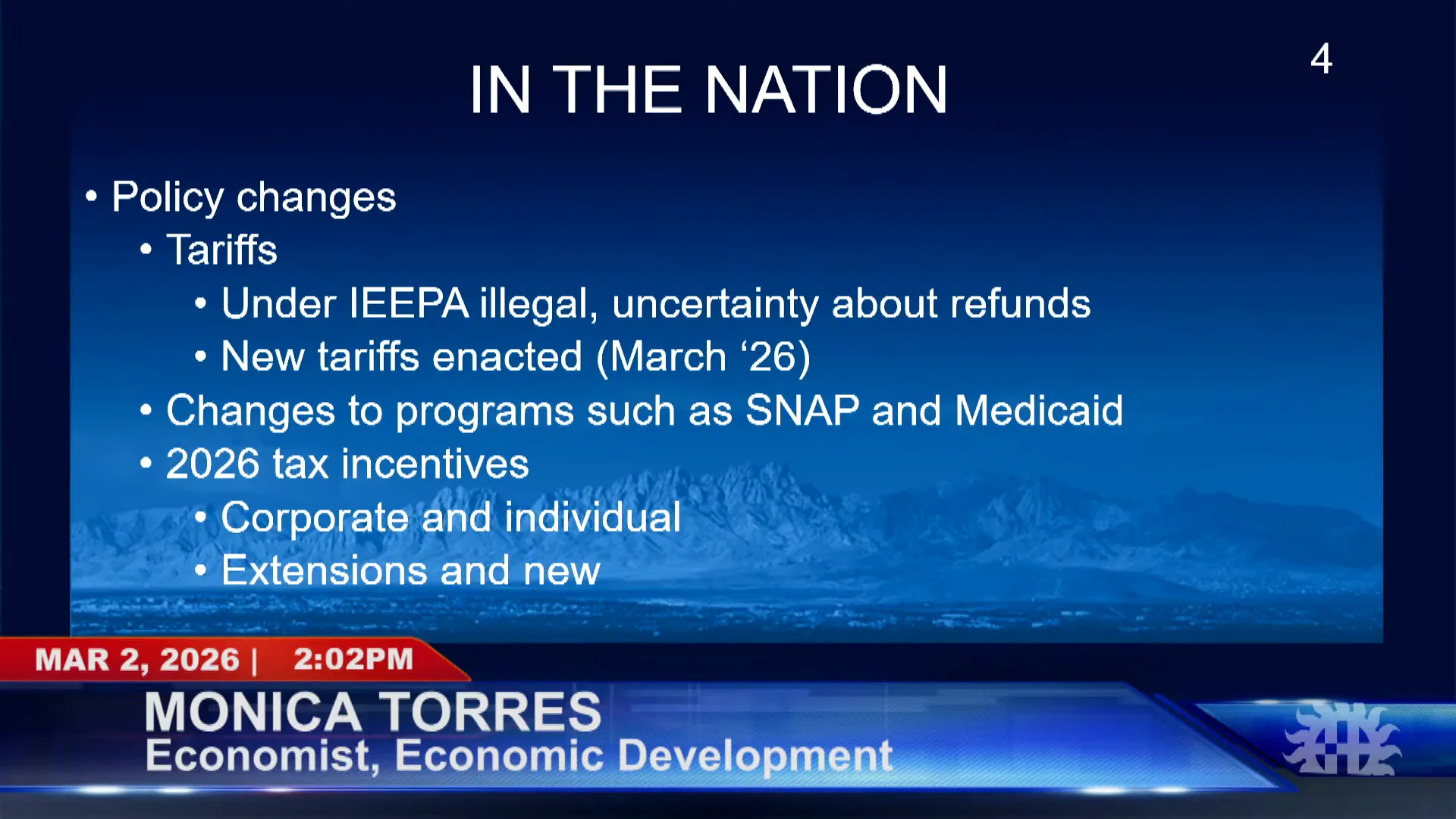
- National context: inflation remained elevated at 2.7% (CPI), federal funds rate at 3.5-3.75%, with tariffs and geopolitical uncertainty. The Supreme Court ruled some tariffs illegal, but new tariffs were enacted.
- Local labor market: labor force and employment both increased ~1% in 2025 vs. 2024 (excluding October). Unemployment rate rose to 4.4% (still low). December 2025 saw a jump to 4.2% from 3.9% a year prior.
- Gross Receipts Tax (GRT) revenue increased 9.6% ($12.6M) to $143M, partly due to anticipatory spending ahead of tariffs. December 2025 reached a record $13.9M.
- Taxable gross receipts (measure of economic activity) grew 4.4% to $4.3B, driven by retail trade, healthcare, and construction. Retail trade declined 0.8%.
- New business registrations rose 24% to 649, but many are home-based or renewals. Residential construction permits fell 12% to 571, partly due to shift to multifamily under new land development code.
- Cannabis market: sales declined 12% for adult use, transactions down 2%, excise tax revenue down 6.4%. Medical licenses continue to decline post-pandemic.
- Looking ahead: economic activity continues to expand but at a slower pace. Average weekly earnings declined 2.7% in the MSA. Inflation remains a concern.
- Councilor Harris asked about the decline in residential permits (clarified that multifamily is counted as commercial) and about business registration categories. He also asked about the stickiness of price increases. Dr. Torres noted the difficulty of forecasting given current volatility, but expects interest rates to remain unchanged at the next meeting.
Key Outcomes
- The consolidated plan is out for a 30-day comment period ending after March 9, 2026. Four public input sessions are scheduled for the following days. Comments will be considered before submission to HUD by May 15, 2026.
- The affordable housing plan is expected in about a month to a month and a half, with a work session to follow. Staff will use it to direct future housing programming.
- Council expressed support for continued investment in affordable housing, home repair programs, and exploring policies to improve economic mobility, such as the Family Prosperity Program.
- The economic outlook presentation will be published quarterly. Council requested more detailed breakdowns of business registrations and churn.
- The work session adjourned at the end of the agenda with a unanimous vote to adjourn.
Meeting Transcript
Rents were generally pretty stable between 2015 and 2020, and the same was with home prices. They decrease through the financial recession. And then we're pretty stable through 2020. And then we see that in both rents and prices. There was a big job of about a 50% jump between 2020 and 2023, 2022, and then prices begin to moderate again. And this trend we see across the countries, not just specific to Las Cruces. And then in terms of vacancies, we see that there was a very high vacancy or higher vacancy environment in 2010 and in 2017, but that's really turned in 2024. For rental vacancy rates, we would like to see them around 5% to be able to allow the churn in the market that allows renters to, you know, find housing and at the price that they want and be able to have options. And that's in Las Cruces, it's at 3.5%, so that's significantly lower. And then on the homeownership side, we would expect to see about a 2% vacancy rate, and that's also below the 2% mark. So we're seeing that the vacancies show tight markets in Las Cruces. And then the analysis has more data shown by different price levels and at lower price levels, there's even tighter vacancy trends. And now I'll pass it to Heidi to talk about the survey findings that we conducted for both the consortium plan and the affordable housing plan. Thank you, Avilia. I'm going to speak a little bit about some of the engagement that we did to support these two plans. And then I will pass it back to Avilia to talk about projected needs. So she's going to get into a deep dive in terms of what to expect in the future and the types of housing that people will need. You're going to come back to me for a bit of a wrap-up. So to support the consolidated plans or the HUD required plan as well as the state plan, we conducted a residence survey. We got a really good response, almost 800 responses. 70% of them lived in Las Cruces. So we have a really good sample to analyze about needs. They're people who are very housing unstable. About a third of respondents were over 65, another third or the similar third, there's some overlap there, had a disability. 13% single parents, 29% said they lived in an overcrowded household, 60%, 62% identified as of Hispanic descent, and a little more than a third were very low income, so had incomes of under 25,000. We ask a number of questions that are captured. The total analysis is captured in appendix A of your packet. But just to give you a highlight of some of the most important takeaways from the survey, wanted to start with those living in poor or fair housing condition. We asked people to self-assess the condition of their housing. Then we also ask them if they say I live in poor or fair housing condition, what improvements are needed. This gives you what we call a crosstab. So those responses by demographic groups. The top news were grab bars, ramps, alarms to notify if somebody with a cognitive or behavioral disability leaves the house. Overall, 13% of respondents to the survey said they did have to move in the last five years when they didn't want to. Those who are currently precariously housed, renters, single parents and those with a disability had the highest rates of displacement in response to this question. On the right hand side here, under the reasons for displacement, I would invite you to take a look at that box. We had an unusual response based on surveys. We do these types of surveys all over the country. We learned in Las Cruces the top reason for being displaced was losing a job or having hours cut back. Almost typically, I typically or almost always see the most uh common reason being that rent increased. So we're in an interesting economic situation right now, and we definitely are seeing that reflected in the displacement question. We also asked people what do you need to feel more secure in your housing? And this shows you those responses by household type. Many, many people said I need rental assistance, I need help paying rent. That was true of people with disability, people living in overcrowded households. But we also saw that people said they needed to make critical money to make critical repairs, and that was true of our large households, people of Hispanic descent. You'll notice here in the over 65, so the senior population and the non-Hispanic white population, the majority of folks said I don't need anything. That tells us that those folks are more likely to be housing stable than other demographic groups. With that, I'm going to pass it back to Avilia, and she's going to get into some of the data findings and projected needs. Thank you.
openpublica.com