Las Cruces City Council Meeting – July 6, 2026
STREAMING COPY IN PREPARATION — RECORDING AVAILABLE FROM THE ORIGINAL SOURCE
Las Cruces City Council Meeting – July 6, 2026
The Las Cruces City Council met on Monday, July 6, 2026, at approximately 1:00 PM, with Mayor Eric Enriquez presiding. The meeting included departmental highlights, public comments on city compliance with the lead and copper rule, bicycle and pedestrian safety, and other community concerns. The council approved several resolutions, including adjustments to grants, ARPA fund reallocation, and write-offs of uncollectible accounts.
Consent Calendar
- The consent agenda was approved as presented, with the exception of item 6.1 (Resolution 27‑001) which was removed for separate discussion.
Public Comments & Testimony
- Lynn Morer asserted that the city is not complying with the Lead and Copper Rule. She claimed that the city’s utilities department fabricated second inspection reports for 36 properties (including Fair Acres Elementary School) after initial reports found galvanized pipes. She stated she has never refused a meeting, contrary to the mayor’s earlier claim, and challenged the authenticity of subsequent reports.
- Liz Rodriguez Johnson echoed concerns about non‑compliance with the Lead and Copper Rule, arguing that the city has not shown that disadvantaged properties are prioritized on the inventory map. She said the city has had 18 months to disprove their allegations but has not done so.
- Juan Garcia criticized both political parties, alleging backroom deals in recent primary elections and a lack of focus on the real needs of New Mexico citizens.
- An unnamed speaker urged the council to protect separation of church and state. He noted that the practice of a moment of silence is not recorded in the minutes and requested that the proclamation process be made more transparent.
- Derek Pacheco thanked Police Chief Story for a recent radio discussion but expressed frustration that elected officials refuse to meet with him. He raised concerns about fentanyl distribution, a proposed data center moratorium, and questioned a Project Jupiter grant to the Boys & Girls Club.
- Gage Peter Burnett described unsafe bicycle infrastructure on Tell Shore and Travis streets, citing debris and gravel pushed into bike lanes by street sweepers. He urged the city to expand and better maintain bicycle lanes.
- George Pearson (Vice President, Velocrucis) called for a Vision Zero commitment after a recent hit‑and‑run fatality. He suggested confiscating speeder vehicles and questioned whether the city has an enforcement, prosecution, or cultural problem with speeding.
- Andrea Algheen (Board Member, Velocrucis; Program Manager, Everybody Rides with Grace) asked the council to demonstrate resolve to stop preventable traffic deaths, including using social media platforms to educate the public.
- Tim Jenkins spoke on the 250th anniversary of the nation, urging unity, faith, and respect, and calling for commitment to common goals over party affiliation.
- Lucas Herman opposed the policy review committee, arguing that decisions should not be made in private. He also noted that the library is still listed as a cooling center on the city website but may no longer be open on Sundays.
Discussion Items
- Economic Development Update – Elizabeth (department head) presented new incentive programs: a Metropolitan Revitalization Incentive Program (MRIP) offering 7‑14 year property tax abatements (targeting commercial, residential, mixed‑use, and brownfield properties), an update to the LEDA plan (adding MRA project model), and an Industrial Revenue Bond (IRB) policy for housing projects. She also noted a workforce development inventory of at least 10 partners, with gap analysis to follow. Council asked about qualifications and the city’s mill levy. The MRIP and IRB policy are expected to come before council in August or September 2026.
- Pets of the Week – Tanya Conway (ASCMB) introduced two adoptable dogs, Katie and Tina, and noted four long‑term residents (over 300 days each). She promoted a $25 adoption special for July (“Red, White and Cute”) and upcoming adoption events.
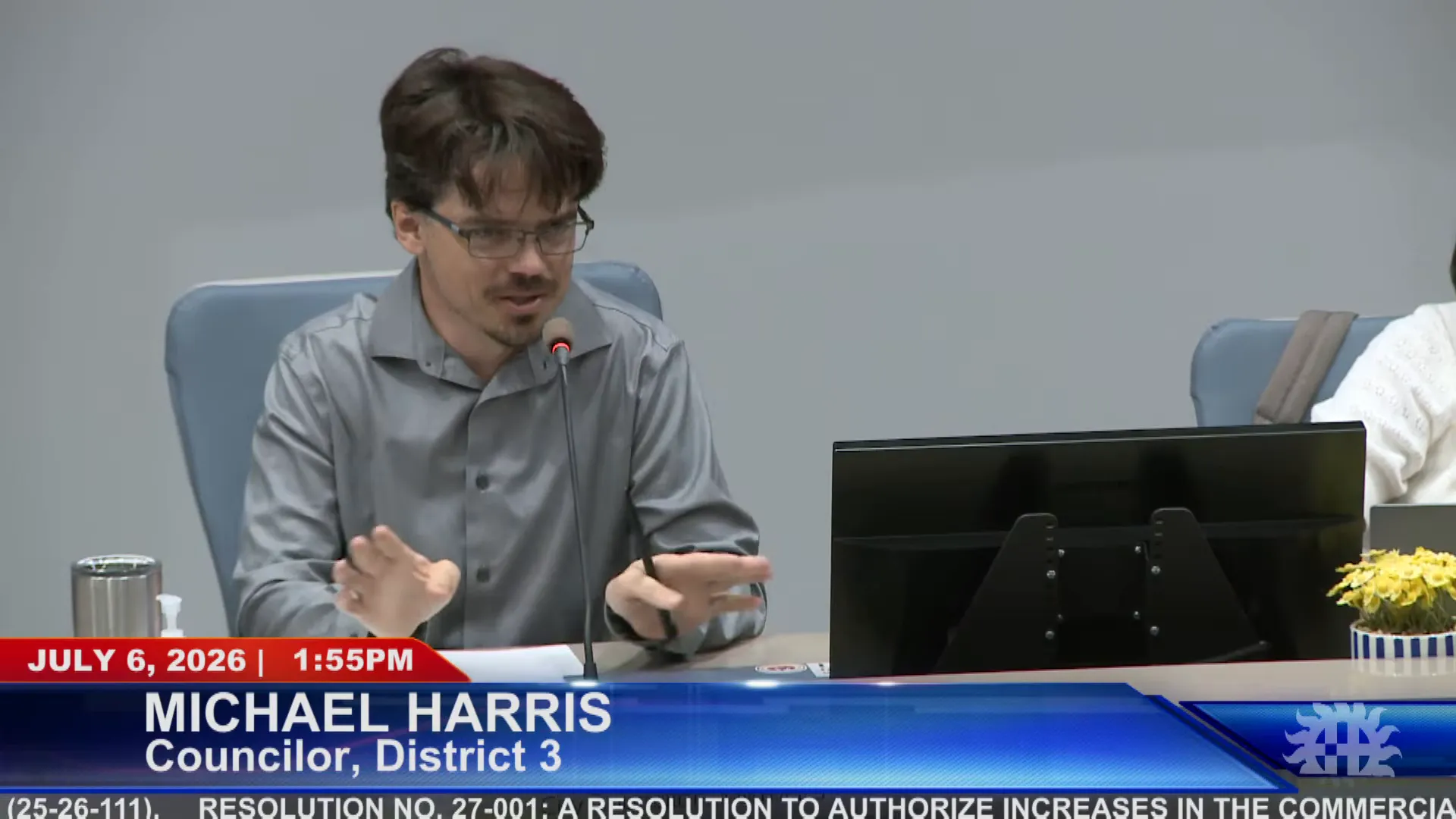
- Item 6.1 – Resolution 27‑001: Museum Systems Storage Facility Lease Increase – Donnie Procise (Purchasing Supervisor) presented a request to approve a retroactive lease increase from $8,000/month to $9,428/month (2.5% annual increases through FY2029). Councilor Harris asked about square footage (8,000 sq ft) and questioned the retroactive nature. Staff explained a prior processing error had exceeded the council‑approved limit; the error was discovered by a new buyer. The resolution was approved 6‑0 (Counselor Matisse absent).
- Item 7.1 – Liquor License Transfer (Cattle Baron Restaurant) – Adam Metro (Community Development) presented the transfer of ownership of an interlocal dispensary liquor license (DIS‑001067) for the restaurant at 790 S. Tell Shore. No opposition. Public hearing held and closed. Approved 6‑0.
- Item 7.2 – Liquor License Transfer (Farley’s Food Fun and Pub) – Similar transfer for Farley’s at 3499 Foothills Road. Approved 6‑0.
- Item 7.3 – Resolution 27‑006: Grant Award for Police Department – Originally presented as a $44,432 grant from NM Department of Finance and Administration for hiring officers. Later corrected by staff: the actual grant is a $5,000 award from New Mexico State University for the youth leadership program. Council confirmed that the approved resolution matched the correct information in the packet. Approved 6‑0.
- Item 7.4 – Resolution 27‑007: Various Budget Adjustments – Vanessa Ferez (Budget Analyst) presented carryover grants and adjustments including a $35,380 match for a fire department grant and $48,000 for senior nutrition kitchen remodel. The total general fund impact is $83,720. Council asked about timing; most were due to timing except the kitchen remodel. Approved 6‑0.
- Item 7.5 – Resolution 27‑008: Reallocate ARPA Funds from Casa Linda Acres to Cortez Drive – Humbley Beasley (Accounting Manager) explained that $1.3 million remaining from the terminated Casa Linda Acres project would be shifted to Cortez Drive Improvements to meet the Dec. 31, 2026, ARPA spending deadline. Councilor Bencomo expressed disappointment about the contractor termination and asked about completion of the Casa Linda project. Kyle Arnd (Interim Public Works Director) stated that the contractor’s bonding company must respond by July 10; funds used for Cortez Drive will be made available to finish Casa Linda. Approved 6‑0.
- Item 7.6 – Resolution 27‑009: Write‑off of Uncollectible Accounts – Alorfo Cardenas (Treasury) presented write‑offs totaling $215,082 ($178,997 utilities, $11,346 general billing, $24,739 library fees). The write‑off does not extinguish the debt. Council discussed pursuit of collection, especially for nuisance abatement and library fees. Councilor Bencomo asked about further canceling library fees; library staff noted they already offer payment plans and replacement options. Approved 6‑0.
Key Outcomes
- Resolution 27‑001 approved (6‑0) to increase museum storage facility lease retroactively, with an annual cap of $113,138.16 through FY2029.
- Resolutions 27‑004 and 27‑005 approved (6‑0) for liquor license transfers at Cattle Baron Restaurant and Farley’s Food Fun and Pub.
- Resolution 27‑006 approved (6‑0) to accept a $5,000 NMSU grant for the police youth leadership program.
- Resolution 27‑007 approved (6‑0) to accept various budget adjustments (grant carryovers and general fund match).
- Resolution 27‑008 approved (6‑0) to reallocate $1.3 million in ARPA funds from Casa Linda Acres to Cortez Drive Improvements; funds from Cortez Drive will be redirected to finish Casa Linda.
- Resolution 27‑009 approved (6‑0) authorizing write‑off of $215,082 in uncollectible accounts.
- Council committed to holding an evening work session on September 14, 2026, at 6:00 PM to seek input from youth and other residents.
- The city manager announced that Finance Director Leslie Doyle received a 2026 recognition for outstanding public service from the Government Finance Officers Association (GFOA).
Meeting Transcript
Your life. Good afternoon. Welcome to City Council. Today is Monday, July 6th, 2026. It's approximately one PM. I am Mayor Eric Enriquez. Before we start, I want to mention that we have the ASL American Sign Language up in the front, if anybody needs our services. If you please rise, we'll start with a moment of silence for the brave men and women of the United States Armed Forces as they protect our interests around the globe, as well as the courageous men and women of the Las Cruces Police Department, Las Cruces Fire Department, as they keep our city safe twenty-four seven three sixty-five. So we'll go into departmental highlights with economic development. Safety has come out of every MRA as a top priority. So it was something we able to implement that had an immediate impact while we started to work on larger policy policy initiatives. Which leads me to the incentive stacking that we're gonna start doing. The first program is a metropolitan revitalization incentive program, which is a property tax abatement for commercial residential and mixed use development. The abatement ranges from seven to fourteen years based on the project qualifications. Um this is a program we are hoping to bring to council for approval in August or maybe September at the latest. Um the process will be that it goes through the internal MRA committee to just decide on the the recommended seven to fourteen years and then final approval comes from council. On top of that, uh we will be doing an update to our LEDA plan. So in order to use LEDA, you have to it has to be written into your plan. We currently have four models that you can use, uh preferred model, basic model, which are your basic um jobs, investment, priority um industries and whatnot. We have a local model that we added about three years ago, and it is for local businesses, which Jim Magic is on the agenda today for first read, and it'll be our first local model project that we will be doing. Um and then we will be adding an MRA project model as well. It this is authorized under state statute that you project specifically in MRAs are eligible for LEDA. So when I talk incentive stacking, while these programs by themselves might not be beneficial for certain developers or small businesses, you start putting them on top of each other, and it really starts to help businesses and help them move in the right direction, or redevelop a property that needs it. Maybe it's a brown field property. You know, whatever it may be, it's it's pointing in the right direction, and we're we're trying to create these programs. So we have multiple options because economic development isn't cookie cutter. On top of that, um, we will be bringing an industrial revenue bond policy forward. So an IRB is a tax exemption tool for both industrial and qualifying multi-family housing projects. Um the purpose of creating a policy is because it establishes the application process, project expectations, clawback provisions, and fee structure, and it provides a greater consistency and transparency for future projects. So why now? Because we have done uh IRBs in the past, it's because economic development and neighborhood services are going to be doing their first housing project IRB in the near future. So we wanted to make sure we had something in place because the housing IRBs are a lot more intense than the ones we're used to. So we wanted to make sure we had a policy. This will also be coming August, September, hopefully. And then finally, just an update on workforce development. Um, what staff has been doing is developing a comprehensive inventory of local workforce programs and partners. Um the list that I know of of workforce partners is at least 10. And so we're meeting with them one-on-one to figure out what programs are out there that can help local businesses, whether they're in an MRA or not. Um, once we identify those gaps based on, and we're gonna be identifying gaps based on employer and community need. Uh by collaborating with our partners, we're hoping that we can develop programming and expand targeted workforce programming to be able to better assist these commute um the community and the businesses in the community. So there's more to come on this. We're in the very beginning stages of it, but I'm really excited to start partnering again with our workforce development partners. Um we've had great projects come out of ARPA dollars that we did for workforce development. So this will hopefully just continue that hard work that everybody's been doing. And that's just a quick update. Any questions? That's great. Thank you, Elizabeth. Councilman Cowan. Thank you, Elizabeth.
openpublica.com