Joint Meeting: Miami-Dade County and Hialeah on Sewer Billing Dispute - April 1, 2025
STREAMING COPY IN PREPARATION — RECORDING AVAILABLE FROM THE ORIGINAL SOURCE
Joint Meeting: Miami-Dade County and City of Hialeah Conflict Resolution on Sewer Billing Dispute
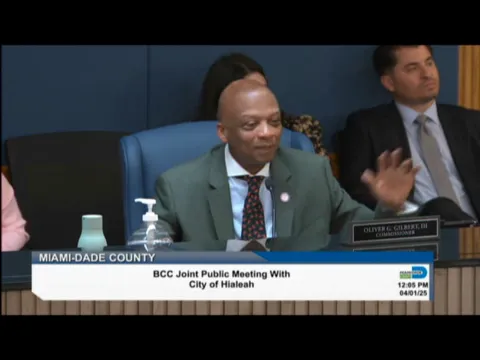
On April 1, 2025, the Miami-Dade Board of County Commissioners and the Hialeah City Council held a joint special meeting to address a conflict resolution proceeding initiated by both parties under Florida Statute Chapter 164. The dispute centers on approximately $17.8 million in unpaid wholesale sewer bills owed by the City of Hialeah to the Miami-Dade Water and Sewer Department (WASD). The meeting included presentations from both sides, extensive discussion, and ultimately resulted in a declaration of impasse and a directive to proceed to mediation.
Discussion Items
-
County Presentation (Chief Roy Coley, WASD): Chief Coley explained that the county charges Hialeah $4.28 per thousand gallons for wastewater services, based on system operating costs with no profit. The dispute involves only one meter (P72) at a connection point. Coley stated that the contract allows both parties to test meters and audit records, but Hialeah has not done so. He presented data showing that the meter has consistently tested within contractual tolerance (98–102% accuracy) and that a third-party expert (the manufacturer) confirmed the meter is functioning properly. He noted that if air is passing through the meter, it would over-read, benefiting Hialeah because the meter in question is a deduct meter for flows from Hialeah Gardens. The outstanding balance is $17.8 million, plus $2.5 million in potential interest.
-
City of Hialeah Presentation (Kevin Linsky, Public Works Director): Linsky argued that the county’s own internal emails from 2019 (a “smoking gun”) indicated that the meter was incorrectly installed and registering air as wastewater, leading to overcharges. He cited an email from a WASD employee stating that the new meter was “filled with water and air,” which would cause over-registration. Linsky noted that Hialeah had previously received credits for similar issues and that the city had hired an independent expert from the University of Maryland who agreed the meter was registering air. He also stated that the city had paid $50 million during the disputed period and believes the $17.8 million represents overcharges. Linsky acknowledged that the city initially withheld payments but later resumed full payments after he joined the city, before discovering the 2019 email.
-
Mayor of Hialeah (via Zoom): Mayor Bovo expressed that his administration initially sought to cooperate and pay down the bill, but after reviewing the evidence, believes a deduction is warranted. He asked the commission to consider a deduction to help Hialeah’s residents.
Key Outcomes
-
Motion to Declare Impasse and Mediate: Commissioner Cohen Higgins moved to declare impasse and direct the county mayor to schedule mediation under Chapter 164, with the option to file a lawsuit if mediation fails. The motion was amended by Commissioner Bermudez to require both parties to perform necessary testing before mediation, and by Commissioner Cohen Higgins to require mediation to conclude within 90 days. The motion passed unanimously (13-0) by the County Commission, and the Hialeah City Council voted unanimously in favor (5-0, with one absent).
-
Motion to Include Reverse Osmosis Plant in Mediation: Senator Garcia moved to include the jointly owned reverse osmosis water treatment plant in the mediation discussions. The motion passed (County vote: 13-0; Hialeah vote: 5-0). However, the county attorney clarified that the reverse osmosis plant issue is separate from the billing dispute and would not be subject to the same litigation timeline; it would require a separate joint meeting.
-
Resolution 250726 – Tolling Agreement: The commission approved a resolution authorizing a tolling agreement between Miami-Dade County and the City of Hialeah to extend the statute of limitations for all claims related to the sewer billing dispute and the reverse osmosis plant. The resolution passed unanimously (13-0) by the County Commission, and the Hialeah City Council also voted unanimously in favor.
-
Next Steps: The parties must select a mediator within 14 days (per statute). Mediation must conclude within 90 days. If impasse is reached, the county attorney is directed to file a lawsuit within 14 days. Both sides are to perform independent testing prior to mediation.
Additional Notes
- Commissioner Regalado emphasized that any credit would impact WASD bond covenants and could not come from WASD funds, only from the general fund. She also noted that the county is not responsible for the reverse osmosis plant’s construction.
- Commissioner Gilbert questioned why Hialeah did not exercise its contractual rights to test the meter or audit the county before invoking dispute resolution.
- The meeting also included a brief discussion on the broader issue of independent water systems, with Commissioner Regalado suggesting that Hialeah consider selling its entire water system to the county.
Meeting Transcript
You can approach the microphone. Good morning. For the record, we have present Councilman Sogmi, Councilmember De La Vega, Councilmember Perez, and also Council Vice President Garcia Roves. I think she's on her way. I just saw her in here. She here. I don't there she is. Okay, so we have a quorum. You have a quorum. All right, awesome. All right, show us officially in our joint special meeting with the city of Hayaleah. Madam Attorney, do you have any uh statement you need to read into the record? Yes, um, if I may read the position statement. This joint public meeting relates to the conflict resolution proceedings that both the city of Hyalea and the County have initiated against one another regarding amounts billed to the city by the county for sewerage services. The amount in dispute is approximately 17.8 million dollars. Florida law requires that the city commission of the city of Hyalea and the Board of County Commissioners have a joint public meeting. In this meeting, the governing bodies of these entities are required to consider the statement of issues, seek an agreement, and schedule additional meetings of the entities in conflict or of their designees to recording in progress. To continue to seek resolution of the conflict. Thank you, Mayor, and please say a prayer for this county while you're in Israel. We need it. Amen. All of us do. All right, with that, Chief Coley, if you can approach the well. Um I don't know if uh City of High Leah has a presentation, but I'm gonna go ahead and start with our county first. Uh with Miami D. Chief Coley is our chief that oversees water and sewer. Chief Corey, if you could introduce yourself and how much time are you going to need for your presentation? Hi. Can our uh can we mute the zoom for a second and our comms people? All right. Chief Chairman Rodriguez, uh, members of the commission, Mayor Bovo, members of the council, I'm Roy Coley. I'm the Chief Utilities and Regulatory Officer for Miami Dade County. I will need about 10 minutes for the presentation I have prepared. That that could work because it's an important issue. If you can make it briefer, it would be greatly appreciated. Okay. Um, I would like to start by reporting to you that Miami Dade County has met with the representative of the City of High Leah, including Mayor Bovo a number of times. Um what I can tell you is Miami Dade County has no interest in collecting monies, not do it. If uh the city of Hyalea is able to show where the county has made any kind of error or mistake, we would gladly credit their bills. Miami Dade County holds two wholesale agreements with the City of Hyaleah. One is for providing drinking water to the City of High Leah. We charge them $2.40 a thousand for that. We also have a wholesale agreement where we provide wastewater services to them for $4.28 per thousand gallons. Both of those charges are based on system operating costs. The county makes no profit on any of its wholesale customers. It it uses the annual cost that is determined by third party, and that's how they're charged. Today's disagreement is only about one of these agreements. It is the wholesale wastewater agreement. Today's discussion has nothing to do with drinking water. I want to point out two things in this agreement for your consideration.
openpublica.com