Monroe Judiciary & Ordinance Review Committee Meeting - May 11, 2026
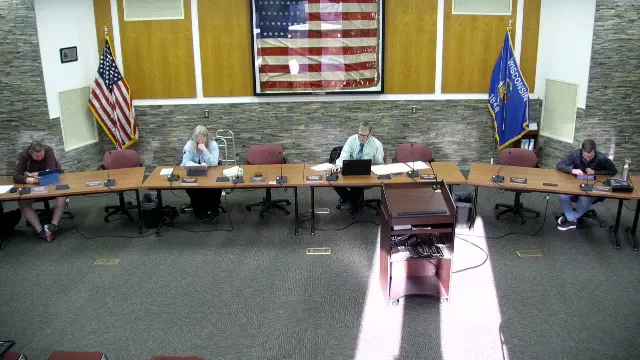
STREAMING COPY IN PREPARATION — RECORDING AVAILABLE FROM THE ORIGINAL SOURCE
City of Monroe Judiciary and Ordinance Review Committee Meeting - May 11, 2026
The Judiciary and Ordinance Review Committee met on Monday, May 11, 2026, at 5:45 PM in City Hall Council Chambers to discuss several ordinance amendments. The meeting was called to order at 6:10 PM with all four members present. The committee approved the minutes from April 27, 2026, as presented, and then addressed four agenda items, making recommendations to the Common Council on all of them.
Consent Calendar
- Correction of Minutes – April 27, 2026: No corrections were offered; the minutes stood as presented.
Discussion Items
-
C.1 – Animal Noise Ordinance: The committee reviewed the current ordinance (9-2-11) which prohibits "excessive, continuous, or untimely" animal noise. City Attorney Bartholf described a case where a dog barked in three-minute bursts with 18-minute breaks, raising questions about what constitutes "continuous." The committee considered language from other municipalities (e.g., Janesville, Verona, Broadhead) that focuses on whether barking is "unreasonably disturbing to other persons in the neighborhood" rather than requiring continuous noise. Police Chief Kelly noted that quality of life complaints are difficult and that more definitive language would help officers but that no ordinance can be 100% precise. After discussion, the committee agreed to draft revised language that removes the term "continuous" and includes references to recurring disturbances and neighborhood impact, with the goal of bringing a recommendation back at a future meeting.
-
C.2 – Charter Ordinance Repealing and Recreating Section 1-5-12: Filling Vacancies on Common Council: City Administrator Rinelli explained that the ordinance would allow a vacancy created by an alderperson being elected mayor to be filled by the next candidate on the ballot who received the most votes. The committee discussed whether write-in candidates should be eligible; consensus was to require a write-in to receive votes equal to the number of signatures required to run for office (currently 50). The ordinance would fill the remainder of the term. A motion to recommend passed unanimously.
-
C.3 – Charter Ordinance Repealing and Recreating Section 1-5-1: Council, Mayor, and Alderpersons Terms of Office: This ordinance would change terms from two to three years, with staggered elections so that roughly one-third of the council is up each year. Implementation would begin in 2027: the three alderpersons with the most votes would get three-year terms, the fourth would get two years. In 2028, the three most votes get three years, and the fourth and fifth get one year. The mayor's term would also be three years. A typo in the clean copy was noted ("with than" should be "with less than"). A motion to recommend passed unanimously.
-
C.4 – Charter Ordinance Repealing and Recreating Section 1-5-1: Council, Mayor, and Alderpersons Spring Primary: This ordinance would automatically trigger a spring primary for mayor if four or more candidates file, and for alderperson if the number of candidates exceeds twice the number of seats available (e.g., more than six candidates for three seats). The current language allows the council to decide within three days after the filing deadline; this ordinance sets automatic thresholds. The committee noted that the implementation section of this draft differed from the version in C.3 and agreed to clean it up before sending to council. A motion to recommend passed unanimously. The committee also discussed combining C.3 and C.4 into one charter ordinance at the council level, which was agreeable.
Key Outcomes
- C.1 – Animal Noise Ordinance: No formal vote; the committee directed staff to draft revised language based on discussion (removing "continuous," adding "recurring" and "neighborhood disturbance") for future consideration.
- C.2 – Vacancy Filling Ordinance: Motion to recommend to Common Council passed unanimously (4-0).
- C.3 – Terms of Office Ordinance: Motion to recommend to Common Council passed unanimously (4-0).
- C.4 – Spring Primary Ordinance: Motion to recommend to Common Council passed unanimously (4-0). The committee agreed to merge C.3 and C.4 into a single charter ordinance for council action.
The meeting adjourned following a motion and a second.
Meeting Transcript
It is 6 10. I'll call the Geno committee meeting to order. Uh clerk call the roll, please. Alder McGuire. Here. Alder True Hart? Here. Alder Frankie? Here. And older Vestine. Here. All right. Everyone is present. Uh any correction of the minutes on April 27th, 2026. Doesn't look like it. Those will stand as presented. On to see business. Uh number one. Discussion on possible recommendation on I can't read all of that. I'm having troubles with the app again. Uh to common counsel on cities animal noise ordinance. So this is something that I actually asked that be put on my on the agenda at some point for just some talking per points. Um our current code is 9-2-11, and it says um no person shall own, keep, harbor, or have custody of an animal that barks, whines, howls, or makes sounds common to its species in a excessive, continuous, or untimely fashion. So recently I had a case where the question of is whether it's excessive and continuous. Um I had a we had um I think kind of probably an overly sensitive neighbor. Um called the police. This is like the twelfth time in four years that they they would they called the police on them. But the dog was hurting, was heard on a ring camera from the neighbor for three minutes barking, three straight minutes. Then there was a break for 18 minutes, another three minutes of barking, and then the the they called up police and officer came and the officer sat, I think sat in his car and listened, and the dog barked for six straight minutes or eight straight minutes or something like that. So the question is, is that continuous? Um I started looking at the statutes of others communities, and none of them have the same language of the excessive continuous or untimely. Most of them still have kind of a grace gray, grayish level of um whether it's annoying to neighbors, um, or un you know disrupts the uh the the uh unreasonably disturbing to other people in the neighborhood. So I don't know if it even resolved this situation because the neighbors don't like each other and stuff, but I didn't know if there was if it was I have a trouble bringing a citation or trying to defend a citation by clearing convincing evidence when it is three all these breaks and time is that continuous? Is it excessive? Um there's like you said, there's other like degleris has where you have to have two written complaints before it kicks in. Um I I don't know if you know does one neighbor annoy isn't that annoying because one one neighbor could be overly sensitive. If it's five neighbors, I mean I don't know what if anybody has any thoughts. Um we can keep it the same and just let the judge decide you know if is it excessive continuous? I just didn't I was looking for some feedback on what if there's any anything from the committee. I mean I wouldn't have a problem with us updating it, but I don't think any of these statutes are quantitative. Looking at all the other all the other towns, yeah. Yeah, I mean they all all the other towns, you know, um have very difficult like gray areas as you were saying and what's excessive to one person may not be to another, and it may be one day. What's excessive? Is that mean like two weeks? Does it mean every day? Does or can they call somebody because their dog barked one day? So I mean you can always always add in a time frame too if you wanted to do that. None of the other communities had it, but doesn't mean it's right or wrong. Personally, to me, it would be habitually excessive. Like one time of a dog barking excessively for 12 minutes or whatever.
openpublica.com