OPENPUBLICA · PUBLIC MEETING RECORD
Record of Proceedings

Monterey City Council Meeting Summary - July 21, 2026
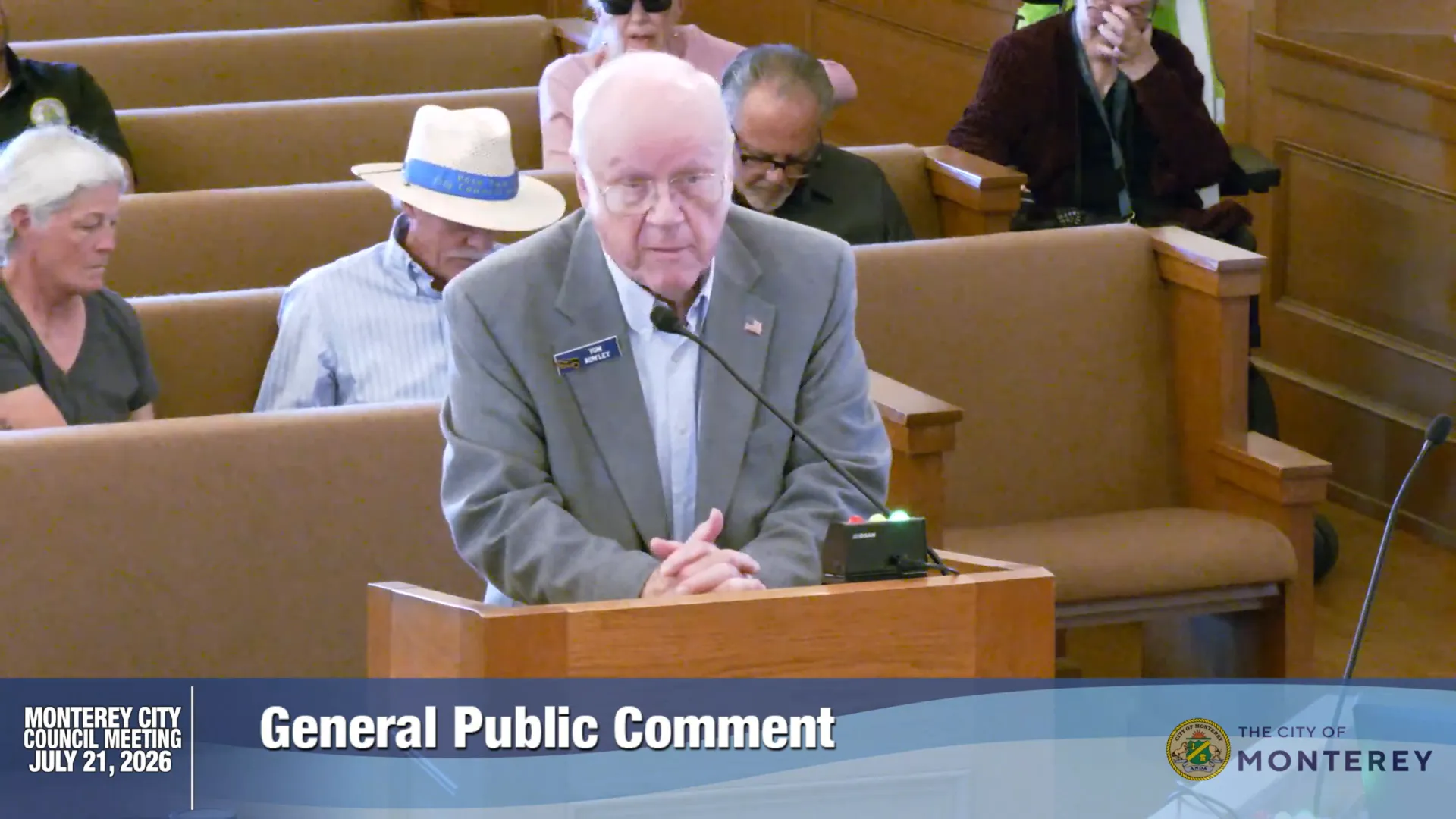
City CouncilTuesday, July 21, 2026
BodyMonterey, California
SessionCity Council
DateTuesday, July 21, 2026
StatusNEW · FILED
Video Record

STREAMING COPY IN PREPARATION — RECORDING AVAILABLE FROM THE ORIGINAL SOURCE

Transcript — Verbatim
6:27

Hello, everybody, and welcome to our afternoon session of our council meeting today, July 21st, 2026.

6:35

And with that, um, I will pass it to Clementine to do roll call and share announcements with the public.

6:41

Public comment, oh, uh, roll call.

6:43

Councilmember Barber.

6:44

President.

6:44

Councilmember Garcia.

6:46

Here.

6:47

Councilmember Rash here.

6:48

Councilmember Smith?

6:49

Here.

6:49

And Mayor Williamson.

6:51

Here.

6:51

And public comment and participation information is provided on this meeting's agenda, which is online at Monterey.gov slash agendas.

6:58

In-person attendees, please keep your electronic devices and phones muted to prevent audio interference.

7:04

Consistent with the First Amendment and the Brown Act, individuals have the right to speak at public meetings, which includes the right to criticize or support city policies or actions.

7:12

The city encourages your uninhibited and robust feedback on public issues affecting the city.

7:16

Thank you for participating.

7:18

Alrighty.

7:19

And with that, we will go ahead and start off with our presentation for today's meeting.

7:24

Item one on the agenda is a housing resource center of Monterey County.

7:28

And with that, I'll pass it to Dante for introduction.

7:32

Thank you, Mayor.

7:33

And oh, we we do have a representative.

7:36

And so we we invited uh Housing Resource Center of Monterey County to come.

7:41

They're obviously a key uh regional partner that supports a lot of our residents and um does a lot of work uh for housing instability um and a range of services, and so um they're gonna be talking a little bit about how they work directly with individuals and families and all the other participating jurisdictions.

8:02

Um I will turn to you to give us our presentation, introduce yourself and give us a presentation.

8:07

Thank you.

8:08

Fantastic.

8:08

Thank you, Mr.

8:09

Hall.

8:09

And I believe that uh our executive director, Alexa had shared the PowerPoint.

8:14

Do they have that there?

8:15

Okay.

8:18

Well, uh good afternoon, everyone, Mr.

8:21

Williamson, members of the uh council and staff.

8:24

My name is Jonathan Amadi.

8:26

I serve on the airport district board, but I also have the pleasure of serving on the housing resource center board with uh Dr.

8:33

Barber, and I chair our community engagement uh committee, which uh brings me here in front of all of you today.

8:40

So who are HRC?

8:42

What is it that we do?

8:43

Uh HRC essentially we work with individuals and families who are either recently homeless or on the verge of losing their housing.

8:53

And as those of you who uh work in the field of homelessness know, the best way to uh help folks who are living on the street is to keep them from uh becoming homeless in the first place, which is part of the the mission of HRC.

9:08

Um in terms of what we actually do, our our summary of services.

9:13

Um we uh we can go to the next slide, Natt, thank you.

9:18

Uh we support our clients by paying uh their evictions and outstanding debts.

9:26

We support uh them by paying their application fees for housing for rental units, uh, with prorated rates, and we support them with first month's rent and security deposit as well.

9:39

I'll talk a little bit in a second about the cars assessments, but we do provide the cars assessments for our clients as well, which uh helps to prioritize which of our uh clients are getting the housing.

9:52

Umly work with clients that are referred to us from other agencies based on the way that our organization is funded.

10:01

We apply for grants from the state and the county, and then we use those dollars to support clients within very specific programs.

10:10

So all of our clients are referred to us by our county and uh other partners.

10:17

And then we also support clients who need help with their uh with their voucher applications.

10:24

So I mentioned cars.

10:25

Uh HUD mandates that homeless services providers and organizations like ourselves uh utilize a what's called a coordinated entry system uh in order to identify which uh persons or families are the highest priority of need for housing.

10:46

And so it's it's essentially a points-based system based on the condition of the family and the client uh that is applying for housing, they get a certain number of points, and then the highest priority are the ones that we work with first to try to grant them housing within Monterey County.

11:06

We have two different roles that are directly supporting our clients.

11:10

We have case managers and housing specialists.

11:13

The case managers are the ones who will do the initial intake, they work with the client to understand their situation, how many piece how many persons are in the family that need to be housed, whether they have pets, what their financial situation is, and uh develop that initial relationship with the client.

11:30

We then pass our clients off to our housing specialists who have relationships with landlords and tenants throughout Monterey County to help identify what might be the best fit for client and housing that is available.

11:46

Um you can see there that there are a number of different roles.

11:50

The housing specialist will work with them until they uh become housed, and then the case manager uh continues to maintain the relationship with our clients after housing.

12:02

So, as I mentioned, housing specialists will close themselves from the case, but at which point, you know, we don't just get people into housing, we then work with them to main ensure that they're able to maintain that housing.

12:16

And so there are regular checkups with our clients.

12:20

We help them by building a financial plan to ensure that they're able to continue to make their rent.

12:27

We we help with the initial rent, and then we have a kind of bridge system where we slowly pair back the amount of financial support that we're giving to our clients so that eventually they get to the point where they're financially independent themselves.

12:39

And we typically work with a client up to about a year to ensure that they are able to stay uh stable and maintain that housing and don't end up in another situation similar similar to what brought them to us in the first place.

12:56

Um there are four main programs that the housing resource center works with uh and applies for grants for.

13:04

The first is the housing support program, that's uh through anyone who's with CalWorks is uh can get benefits through the HSP program.

13:16

We also have the family stabilization program, also uh CalWorks uh benefits, uh beneficiaries can get housing support through that program.

13:27

Uh the Prop 47 housing program, unfortunately has come to an end.

13:34

Uh, that was where formerly incarcerated persons were able to get support, and that ended due to some of the funding cuts that uh we've seen at the state level.

13:46

And then finally, we work with bringing families home as well, which is for any uh families that are part of the county uh CPS program, we can help them to identify housing for those uh clients through that program and through dollars that are available through that program as well.

14:06

So, like I said at the beginning, all of the clients that we work with are referred to us either by the county or uh other case workers who are supporting these different programs.

14:19

So, one of the ways in which we are able to house uh a lot of our clients is because we have fantastic relationships with landlords all across the county.

14:30

We have a landlord gold standard program, which uh really helps to build that initial relationship with the landlords, and to do that, we have a $1,000 incentive to the landlords when they're uh bringing in a client of ours for the first time.

14:48

We have, excuse me, I got that up on that cough that had been going around, and it just lingers.

14:54

So good on you for wearing the mask.

14:57

Um up to 2,000 in repairs.

15:01

So if in case there is a situation where a client ends up damaging one of the rental units, we do support the landlords with up to $2,000 towards repairs for their units.

15:12

And uh we also support our clients by paying off arrears for any uh past rent that they may have uh on their record.

15:21

And you know, one of the reasons that our landlords continue coming back to work with us time after time is because our clients present and represent a stability for them.

15:34

They know that when they're uh supporting one of our clients and and renting to one of our clients, that that's somebody who's going to be there long term and that they have financial stability and backing, and the HRC is going to come in and help to ensure that that client is uh staying housed.

15:52

So the incentives really get them in the door, and then once the landlords are a part of the program, as they have units that are opening up, they reach out to us and say, hey, I've got this unit opening up.

16:03

Do you have any clients that would be interested or would be a good fit?

16:07

And then depending on where the um property is located and what the rent is, we try to identify a match and a pairing for somebody who's on the wait list through the cars points system.

16:20

And then finally, um there are lots of opportunities for the community to partner with HRC.

16:27

One of the best ways that people can help is by connecting us with landlords.

16:32

I know we have a uh landlord uh workshop in Monterey that's coming up uh in August.

16:39

And so being able to uh bring folks to those events to help make them aware of who we are and what our services are hugely helpful.

16:50

And while HRC has funding through those grant programs to pay for some of those direct housing benefits, we also try to help our clients in in other ways.

17:00

You know, if they're having car issues and they're not able to get to work, we might be able to provide them with funding to help get their car fixed.

17:07

Uh sometimes we help with groceries or or medical expenses, but those types of financial assistance comes out of a different pool of money, which is primarily individual donors.

17:18

And so uh folks can go to our website to donate, knowing that those funds will be uh primarily used for direct financial assistance for our clients.

17:28

And then the last slide has uh some contact information for HRC in case anyone had any additional questions.

17:35

I know that it was a lot, but tried to keep it under seven minutes.

17:38

Uh so thank you.

17:40

I'm happy to answer any questions that you may have.

17:42

Wonderful presentation, and um I think it's just a really good opportunity to share the resources with the public um because I'm sure there's a lot of folks out there that don't know that this opportunity exists for them.

17:53

So just truly appreciate you coming out and sharing this information.

17:57

And um I'm I I guess I'll ask a quick question.

18:00

Um I'm assuming there's already a relation established with our housing um staff um in the program.

18:06

So that way if folks are contacting us to participate in the rental assistance program or or any other housing related needs, um, we can help facilitate that that connection as well.

18:16

Yes, and we have relationships obviously with the direct case managers for CPS and uh CalWorks and those other programs that we work with directly, but we also have connections and relationships our case managers do with a lot of different service providers across the county where we're connecting our clients with other resources that they may not be aware of that are available to them, and vice versa.

18:42

We're getting uh folks made aware of our services if they already have benefits through one of those programs.

18:48

Awesome, awesome.

18:48

Thank you for it.

18:49

Um council, any questions at this time?

18:51

Just one, please.

18:52

Uh location and hours so the public knows.

18:55

Yes.

18:56

So we have an office that is in Salinas, regular business hours of uh eight to five.

19:03

Um, but we have clients throughout the whole county.

19:07

We're in we have clients in Monterey, Salinas, South County, uh, Marina.

19:13

We have some some clients up there as well.

19:15

So all of our clients live within Monterey County and all the housing that we place them in is in Monterey County, but our offices are in Salinas.

19:23

Okay, and a follow-up, are you able to meet folks that are on the peninsula that may have transportation problems and do you set that appointment?

19:30

And then where are those appointments typically?

19:33

So the case workers when they're doing that initial intake will work with each of the clients individually to uh set up that exactly.

19:41

Okay, great.

19:42

Thank you, Jonathan.

19:42

You're welcome.

19:45

Thank you, Jonathan, for the uh presentation.

19:47

Good to see you.

19:48

Um just a question about um eligibility.

19:52

So some folks might not necessarily know if they qualify for this service.

20:00

So would it be is it possible for folks to reach out to the contacts that you just shared and get guidance from staff from HRC staff to see if they can determine eligibility for that?

20:13

Absolutely.

20:14

Um they can make direct contact with HRC and for clients who are eligible for, for example, CalWorks and aren't already receiving benefits.

20:26

We connect them with caseworkers for that program to make sure that we get them in, and then once they're in CalWorks, we then will work with them to try to uh get them housed.

20:35

Got it.

20:36

Thank you.

20:36

Yeah, of course.

20:39

Please make sure that we get the um date and the location of that next uh landlord, uh, tenant, staff, um, get together.

20:48

I went last year, it was phenomenal.

20:50

I was I was so impressed.

20:51

Um, because the landlords take away the stigma um that might be remaining from the housing choice vouchers, and and they sing your praises and say they want those clients because they're stable and they're backed by you and your board, and they know if they get into trouble, there's a family to help them.

21:14

So it was very impressive.

21:16

Yeah.

21:17

Uh I will make sure that Alexa is sharing with uh city staff uh the date and time and location for our workshop.

21:25

Did you have anything, Dr.

21:26

Barter?

21:27

Okay.

21:28

All right, Jonathan.

21:29

Thank you for the presentation.

21:29

We're gonna go ahead and open up for public comment.

21:31

Um, just gonna share with the public.

21:33

It's for this public comment period, but all subsequent public comment periods throughout the council meeting.

21:38

What we do is we identify those that want to speak during public comment at the beginning of the public comment period.

21:43

Once those folks are identified, we close it off.

21:45

Then only those folks will be able to speak.

21:47

So if you identify yourself after the cutoff, you will not be able to speak.

21:51

So this is specifically for the presentation that was just given on the housing resource center.

21:55

So check in with folks on Zoom.

21:57

You can use the raise hand function while you're navigating your way there.

22:00

I'll check in the chamber.

22:01

Anyone in the chamber wish to speak on this item?

22:03

See, Mr.

22:04

Reeves.

22:05

Anyone else?

22:06

You want to speak on this item?

22:08

I I want to speak about what's going on in my life.

22:11

Okay.

22:12

So this is so so this public comment period is specifically for the presentation that was just given regarding the housing resource center.

22:18

Okay, I'll say something about this.

22:20

Okay.

22:21

All right.

22:21

So if you wouldn't mind just seeing up to the left of the podium, anybody else?

22:26

All right.

22:26

So we have two in the chamber.

22:28

We'll go ahead and cut it off to the two.

22:29

I'll do a countdown for folks on Zoom to five, four, three, two, one.

22:34

And we have one online.

22:35

We'll go ahead and start in the chamber.

22:37

Hi, my name is Sabrina Lee McPherson.

22:39

I've signed up for the CARS program housing authority.

22:42

I give them my information, but they're using my personal information, my medical information, and giving it to everybody else.

22:48

Why is there 12 people in Selena's with my housing voucher?

22:55

Michael David Homeland.

22:56

It's two and a half stems in my stomach.

22:58

He was arrested because a doctor lied and said he gave me a hysterectomy.

23:04

He's in a federal penitentiary.

23:05

So if a male gets a woman pregnant, they all have to go to prison.

23:09

Kim Kowoney, his birth name is Jeffrey Bertold.

23:13

He kidnapped my daughter.

23:17

Ruby Keller McPherson, her twin sister, fire Chief Ramsey, raped to death.

23:24

And you guys are trying to call me crazy.

23:26

I'm tired of the City of Marina police department and behavior health of the state.

23:32

Sabrina Lee McPherson versus the state of California.

23:44

Good afternoon, uh mayor and city council.

23:47

Um first I would like to say that I think the housing resource center is a really valuable asset to the community.

23:54

I've recently been trying to help a neighbor who's extremely low income by low income.

24:00

I mean $950 a month.

24:02

And she's living in their family's house.

24:06

And I was trying to get her help for housing because that wasn't a permanent situation.

24:12

Um I found it as an able-bodied, able-minded person to be a very, very frustrating process.

24:19

And it was a real groping in the dark to try to navigate my way through it.

24:25

This person happened to have some very serious physical issues, which also rolled through into the person's mental abilities.

24:35

So they weren't able to cope and comprehend what was going on.

24:39

They really needed the assistance of just getting through the bureaucracy to get the help.

24:45

Now I know the housing resource center is not set up to do that.

24:48

I'm just bringing this to your attention because I always think it's best to have empathy for people's situations.

25:00

And this particular situation gave me great empathy for people who don't have the physical or mental capability to deal with the world.

25:05

Try to find housing.

25:06

And sadly, she died a week ago.

25:11

With that, we'll go to our caller on Zoom.

25:19

Esther, you can go ahead.

25:21

Good afternoon, everybody.

25:23

I also had the pleasure of serving on this board a couple of years ago.

25:28

And they do tremendous work.

25:30

Their staff and their E.D.

25:32

Alexa Johnson is the best of the best.

25:37

I do want to point out that there are a lot of people that don't qualify for these programs.

25:46

And those are the very people that we had hoped to help with the City of Monterey's renter assistance program, which you guys all unanimously decided to cut.

25:57

I think it was unanimous.

25:58

I might be wrong.

25:59

But you know, Alexa has been very creative on fundraising.

26:05

I raised significant amount of funds for them when I was on that board.

26:09

She created this landlord uh program, the gold standard program, and she has gotten um national attention for it.

26:19

I I'm very involved with the National Low-income housing coalition, and they they asked her to present her program, and that is shared uh nationwide.

26:34

So um that speaks to how you know how really important it is to get creative on how you are going to approach this problem that we have that is not going away anytime soon.

26:47

Um they can tell you that the reason people become homeless, and we have data showing that countywide.

26:54

The number one reason why people become homeless is because they can't afford their rent, and once they become homeless, they remain homeless for the same financial reasons.

27:06

So as great as HRC's staff is, they can't work miracles, and the little bit of help that the city of Monterey was putting out there for those that don't qualify.

27:21

It's a shame that out of all the things that you guys could have cut that you cut that program in a city that is 66% renters, and the majority of the people that are homeless are kids and women right now, and we have the largest student homeless population in this county of the whole state of California, and we are tied for for the most impoverished state in the country with Louisiana.

27:57

So next time you guys decide to cut anything else that is related to renters, keep that in mind.

28:05

Thank you.

28:07

All right, and with that, we'll go ahead and close public comment, bring it back to the council.

28:11

Um thanks again, Jonathan.

28:12

For is you all right, yeah.

28:14

Thank you again for coming out and giving that presentation today.

28:17

Um, with that, we'll go ahead and move to our next item on the agenda, which is general public comment.

28:21

So this is for items that are not um on today's agenda, it's non-agendized items.

28:26

So, what I'll do is I'll start with folks on Zoom.

28:28

You can use the raise hand function in the meantime.

28:31

I'll check with folks in the chamber.

28:32

If you wish to speak for general public comment, items not on today's agenda.

28:37

This is your opportunity to do so.

28:39

Just ask that you send them to the left of the podium.

28:42

So we have two takers in the chamber.

28:44

Anyone else?

28:46

All right, we'll go ahead and cut it off to the two.

28:48

I'll do a countdown for folks on Zoom to five, four, three, two, one.

28:52

Nobody on Zoom.

28:53

We'll go ahead and start in the chamber.

28:55

Yeah, good good afternoon, uh, Mr.

28:57

Mayor and and uh members of staff.

28:59

Uh Tom Raleigh from uh President Fisherman's Flats Homeowners and Residence Association.

29:05

I want to remind you of some dates that were in our our uh fish wrapper newsletter back in April.

29:13

Um September 13th, Sunday, September 13th, from two to four is the picnic in Fisherman's Flats Park.

29:22

It's our annual event, and you and those that are running for office are invited, and then our fall meeting is Monday, September 28th.

29:34

Doors open at the church at Jocelyn Canyon and Salinas Highway at 6:30 for registration and socialization.

29:42

The meeting starts right at seven o'clock, right early on is the candidates forum, which was announced back in April last year.

29:51

I know you all recorded that and wrote that down, of course.

29:55

Anyway, so just want to make sure Nat has that date this time.

30:00

So anyway, that's Monday, September 28th.

30:02

The other thing is some of you may not be aware, but that church was the Church of the Nazarene for many years.

30:09

It's now the all things new church.

30:13

What that means, I don't know.

30:15

But anyway, they're very cooperative about loaning us their uh facility for our our annual, our semi-annual meeting, which is the fall meeting on September 28th.

30:26

Thank you.

30:27

Thank you.

30:35

Good afternoon, Mayor Williamson and Council.

30:38

I would like to thank public works and city staff for holding the public outreach meeting on the quick build project at the intersection of Madison Herman and Larkin.

30:47

City staff heard overwhelming opposition to this project from the neighborhood.

30:51

I have questions for the council.

30:53

Mayor Williamson, you noted at the last council meeting that you would rather have staff dedicate their time and energy in places where people in the community would actually like them to spend their time.

31:04

I think everyone here would agree with you on that.

31:06

However, this project was moved forward without a consensus of the community.

31:11

You also stated that this project didn't come from nowhere.

31:14

Well, actually, from public records, we know that it was Councilman Garcia that brought this project forward just four months after his appointment, and despite receiving no written safety concerns or requests for traffic calming from any constituents.

31:27

That seems like coming out of nowhere to me.

31:29

Your comment, we are here now and we have the funding.

31:32

Sounds a lot like use it or lose it mentality.

31:35

Perhaps this flippant response is one of the reasons the city is in such a financial pickle.

31:40

You and staff keep referring to grant funds like his free money, when in fact Tamsi funds are taxpayer funds.

31:47

Dr.

31:47

Barber, you told your constituents this past week that anyone who wanted to provide input on this project should return a survey.

31:53

However, there is no such survey, either handed out by city staff at the public meeting or available online.

31:59

This is another example of poor outreach.

32:02

How can a non-existent survey help you make an informed decision on this project?

32:07

Mr.

32:07

Garcia, you proposed this specific intersection for a quick build project to city staff in April of 2023.

32:14

There had been no traffic study done and no data showing this to be a dangerous intersection.

32:19

You have dismissed Tim's traffic data in favor of your personal opinion.

32:23

Your opinion is not more valuable than facts.

32:26

You did not share safety concerns with council members that do have constituents residing nearby and are familiar with the traffic issues of this intersection.

32:34

Your district four constituents should be aware you advocated for grant funding for this project in a district where you have no constituents over available funding for amenity enhancements for the Monterey side of Laguna Grande Park.

32:47

Residents have repeatedly requested help with this area of the park, so maybe you would like to explain that to your voters.

32:52

Despite the complaints of congestion and gridlock at this intersection, the city moved forward to calm traffic.

32:58

The city's stated goal for traffic calming is to evaluate Monterey's neighborhood traffic problems and produce adopted plans for each residential neighborhood.

33:06

Here the goal was clearly missed.

33:08

The city objectives encourage city involved citizen involvement through neighborhood workshops to identify concerns.

33:14

But instead, residents were just ignored until a last-minute public outreach was requested by council.

33:19

Our neighborhood has spoken loudly in opposition to this project.

33:26

All right.

33:26

With that, we'll go ahead and close general public comment.

33:29

Just for folks' awareness, um, we don't respond to public comments because it's not agendized.

33:34

Um, and we have to provide everybody in the public an opportunity to engage if if we were to to respond.

33:40

So for that reason, I'm gonna go ahead and move right next to the next item, which is our consent agenda.

33:45

I understand there's hasn't been anything requested to be pulled from staff's perspective.

33:49

Council wish to pull anything.

33:51

Uh item number five, uh the uh airport um agreement.

33:56

Okay, anything else?

33:58

Okay.

33:59

With that, we'll go ahead and open it up for public comment.

34:02

This is an opportunity for the public to comment on anything that's on the agenda or request an item to be pulled, except for item five.

34:09

Um, so with that, we'll go ahead and go to uh our callers on Zoom.

34:14

You can navigate your way to the raise hand function.

34:15

Anybody in the chamber wish to speak on consent items or wish to pull anything?

34:21

Okay, with that, we'll go ahead and cut it off in the chamber and I'll do a countdown for folks on Zoom to five, four, three, two, one.

34:29

All right.

34:29

There's nobody on Zoom.

34:30

We'll bring it back to the council for motion and deliberation.

34:33

So moved without um number five.

34:36

Uh as that was pulled.

34:38

Is there a second?

34:39

Second.

34:40

So moved and seconded.

34:41

Any other discussion?

34:42

All right.

34:43

All those in favor?

34:44

Aye.

34:45

Any opposed?

34:46

Motion passes unanimously.

34:48

And with that, we're going to move to item five, which is to authorize an easement agreement with the Monterey Peninsula Airport District and accept a public road easement as Olmstead Road and Garden Road.

35:00

I'm just going to pass it to Councilmember Smith real quick since you requested this item to be pulled.

35:02

Did you have a specific question you wanted to highlight?

35:04

Uh yeah, I think I would like to see a presentation because it's of uh great interest to uh I think most of the community that uses the airport.

35:12

I don't know that there's been much in uh any articles, so I think a full presentation would be helpful and maybe uh a map that's attached to our agenda that would show what the proposals are.

35:25

I think it'd be helpful.

35:26

Okay, excellent.

35:27

Well, uh good afternoon.

35:29

I unfortunately I don't have a full presentation, but I can uh perhaps we can show the map on uh that's an attachment to the report, but I can give you a quick overview of the project.

35:38

So the airport is doing their terminal project as part of that, they had an EIR that was circulated a few years ago.

35:45

Um, some of their off-site improvements included um improvements at this intersection at Garden and Olmsted Road, uh, and they were responsible for putting in a roundabout.

35:54

So here we are now, they're constructing the roundabout through an encroachment permit.

35:58

Uh the roundabout has a larger area than a traditional like uh four-way stop or traffic signal intersection.

36:04

And so we needed a little additional right-of-way so cars can circle that that um that island of the roundabout.

36:11

And what we're asking council to do tonight is to uh approve an easement agreement uh so that we would have an easement uh for the area that's hatched out in that map to allow traffic to circle that uh uh center island of the roundabout.

36:26

Um that's what's before you tonight.

36:29

I can go into more detail.

36:31

Do you have more specific questions?

36:32

Yeah, just a few.

36:34

Sure.

36:34

Um so I I know that that section that's highlighted is the described uh area that needs to be um we have to have an agreement with the airport, and I support the roundabout because I think it'll be a significant improvement in the entryway.

36:50

But I'm just wondering uh for the public to be able to know um with the roundabout, what happens on the garden road side of the roundabout, who is doing the work, and does the city of Monterey have to pay for any of this additional improvements for this intersection?

37:08

So the airport's contractor is doing all this work.

37:11

Uh we are inspecting it and we charge encroachment fees that has an inspection, and so it's offsets our cost to have an inspector out there.

37:19

They're fully doing the work.

37:21

We will accept this for uh maintenance responsibility, other than the enhanced improvements.

37:25

So part of this uh easement agreement says the airport's gonna be responsible for maintaining the enhanced uh landscaping, lighting, they have a decorative sign in the middle of the the roundabout that's being proposed.

37:35

So the airport's gonna maintain those enhanced amenities.

37:38

We'll continue to maintain the road uh like we do right now.

37:41

So Garden Road and Olmsted, uh the pavement and sidewalks, the city will maintain, but the airport's actually gonna maintain the uh the landscaping, the decorative signs and the lights that are proposed as part of the roundabout project.

37:52

Okay, great.

37:52

And and I think one last question.

37:54

Uh City Monterey Road, our property as it goes towards the airport.

38:00

And I am not sure where it stops as you're going towards the airport.

38:06

So do you have any kind of a landmark that you can say this is about where it becomes their district and the city of Monterey's uh no longer?

38:17

So that's a great question.

38:18

And actually, we do have an item that's that's coming before you in maybe a month or two as a subsequent action.

38:24

Uh so right now that goes up maybe two or three hundred feet down Olmstead Road is where it it transitions from city right away to airport property.

38:33

Um, as part of this project, we've been talking to the rare port airport.

38:36

Uh we were both in agreement we'd like to vacate that like 300 feet of road that's really just for the airport.

38:42

Uh so that'll be coming to you in a future meeting uh for consideration.

38:46

Uh but right now, um it's it's that transition is probably about 300 feet or so away from the intersection.

38:53

Uh and we'd like to uh vacate that right away and get that back to the airport uh in a future item.

38:59

Okay, okay.

39:00

And then uh when it comes back this other way towards the Olmstead Highway 68 intersection, then I know that um Tamsey has a long-term project not yet executed.

39:13

Um so for interest of tying this together with what else is happening on highway 68, just a comment of that, because I know people will watch.

39:21

Yeah, and people are are uh always concerned about roundabouts, and so I think this one's an impact area.

39:27

So if you could just touch on after this, what's next for Homestead?

39:32

So uh that's a great question.

39:34

Yes, Tamsi still has a uh plan to do a roundabout corridor on uh State Route 68.

39:40

And so as actually part of these plans, we were looking at the splitter islands and the sidewalks to make sure that the two roundabouts were gonna be aligned.

39:46

There weren't gonna be conflicts between those that future project and the project that's proposed now.

39:51

So even though that one's a few years down the road, we were uh looking at that when we were reviewing these plans to make sure that everything was gonna be consistent without kind of conflicting or creating these issues that were gonna have to be reconstructed in the future.

40:04

Okay, great.

40:05

You did everything right.

40:06

Any other questions?

40:08

Any other questions?

40:10

I do have one question.

40:11

So since the city is maintaining responsibility for the road, the city public right away, which makes sense.

40:20

Um I guess how does it work as it relates to the additional cost of maintaining that space?

40:27

I imagine that it's more affordable for the city to maintain a regular intersection than it would be for a roundabout.

40:35

Um maybe my understanding of that is is not accurate, but my assumption is is as such, because you have an obstruction in the way as opposed to an unobstructed space.

40:44

Sure.

40:45

So that's a good question.

40:46

So we're estimating we're picking up about 4,000 square feet of pavement.

40:50

And so then the grand scheme of thing, we we own and maintain 108 center line miles of road.

40:55

It's more or less a negligible additional cost of pavement that we're gonna maintain.

41:00

Roundabouts traditionally not always uh have uh cheaper or more cost efficient operating and maintenance costs than traditional intersections, uh, even though it is a little bit more pavement.

41:11

Um usually uh and especially compared to like a traffic signal.

41:15

You don't have the the cost to have a signal technician, the energy consumption that you would with a traffic signal.

41:21

Um they traditionally have less collisions, which you can convert into a cost, uh a public cost.

41:27

Um so roundabouts traditionally are more cost effective compared to traditional intersections.

41:32

There is a little bit more additional pavement compared to like a standard stop controlled intersection.

41:37

Um, but it is relatively negligible in the grand scheme of things, but yes, there is a little bit of additional payments.

41:44

All right, thank you, Andrew.

41:44

Thank you.

41:45

Um just there was one more follow-up on the roundabout in the center.

41:49

Um, some roundabouts are a little bit higher in the center, and then they have vegetation, planting, maybe even a sign.

41:56

Do you know what their plan is for inside of this round?

41:58

Yeah, uh good great question.

42:00

Yes, they're gonna have landscaping and they are gonna have a decorative moderate airport sign.

42:05

Uh, I know there was something that was approved through um the architectural review committee, and they're trying to make some revisions now and planning's reviewing that.

42:13

Uh so they do have a decorative sign that's proposed in the center island.

42:16

Okay.

42:17

And do they contribute anything in the maintenance of the center where there's decoration and light bulb goes out on the sign?

42:23

I mean, yes, they maintain that.

42:24

So part of this easement agreement actually uh establishes that they're responsible for maintenance of the enhanced landscaping, uh, the decorative airport sign and the lighting.

42:32

Okay, great.

42:33

Thank you.

42:34

All right, with that, we'll go out to public comment.

42:36

Thank you.

42:37

Thank you.

42:37

But for those on Zoom, you can use raise hand function.

42:39

Anybody in the chamber wish to speak on this, I'd just ask you to sit up to the left of the podium.

42:43

I see one taker, anybody else.

42:46

Tom Raleigh again.

42:47

Sorry, Tom, hold on one second.

42:49

Okay.

42:49

Um, we have one taker in the chamber.

42:50

Anybody else?

42:52

All right, we'll cut it off to the one.

42:53

I'll do a countdown for folks on Zoom to five, four, three, two, one.

42:58

We have one on Zoom.

42:59

Please, Mr.

42:59

Raleigh.

43:00

Yes, good afternoon again.

43:01

Uh Tom Raleigh.

43:03

Uh, living in the adjoining neighborhood and and visiting woody's quite frankly, frequently.

43:10

Um, some of you may or may not have ever noticed there was a sign that was pretty much obscured by vegetation until fairly recently.

43:19

And it's a nice, very attractive uh landscape wall that used to say Del Mani Research Park, and had to be established when that was built back, whoever knows when the flagstone um was created.

43:37

It's very attractive, except it's missing some of the letters from its sign.

43:41

So I don't know who's responsible.

43:43

If somebody in the city is responsible, whether the property owners on Garden Road are responsible.

43:49

But it's a sign that it looks terrible right now.

43:52

And everybody coming from our airport, if they look at it, can see it, and it was overgrown until very recently.

43:59

So somebody needs to pay attention to that.

44:01

I don't know whether it's in our landscaping or at least clean the vegetation from around it so you can see the sign, because otherwise it's been a it was a very attractive sign.

44:10

And of course, we know that Garden Road was created as jobs, and the South Side was created for jobs, and we put an overlay to create it to move it to housing, which is a great goal for the city.

44:27

But the old program of jobs housing balance was thrown out the window when you put a housing overlay on that section of Garden Road.

44:36

And but nevertheless, whatever it is, that sign needs to be fixed up and be attractive.

44:42

You're gonna have a beautiful new intersection there, thanks to the airport construction.

44:47

Let's get the city sign fixed.

44:49

Thank you.

44:49

Ms.

44:50

Riley, I'll just encourage you to maybe reach out to city staff with specificity around the sign just to make sure that what you're speaking to is addressed by staff.

45:00

So I would say their staff or the or the owners.

45:02

I it's on private property, I'm sure.

45:05

Okay.

45:06

All right.

45:06

With that, we had one on Zoom.

45:08

Is that accurate?

45:09

Okay, we'll go ahead and go to our Zoom caller.

45:11

Esther, you can go ahead.

45:13

Yes, hi.

45:14

I know a lot of people don't like roundabouts, um, especially when there are a lot of them in a row planned, which doesn't apply here, but I just want to comment on having recently driven on Em Gym Parkway.

45:28

And the City of Marina did a fabulous job on all of those roundabouts.

45:33

And they I used to drive that very often for work, and the flow of traffic has improved so much there, and they have some beautiful artwork.

45:43

So I would encourage everybody to hold judgment off on roundabouts in general whenever they come up.

45:52

Um and check out the possibilities of how when it's done well, they really help.

45:58

I also want to comment on the way that staff has worked so hard on doing you know, all of these traffic-related projects.

46:14

And you know, these guys are doing the best they can, and it really bothers me when I hear residents step up and talk to them as if they are purposefully working against them when it's absolutely the opposite of that.

46:31

And you might be frustrated as a resident, but to speak to and about staff and council in this tone is so unnecessary for you know, people that are just doing their jobs, and believe me, my neighborhood has had problems as well, but we don't come out and speak the way that these entitled other neighborhood residents do to staff.

46:58

It's really it's really a shame.

47:00

I know that you know there was a lot of that at the last council meeting and less of it so far.

47:07

But going forward, when these guys are doing these projects, they're doing it for the with the best interest of our residents in mind, and they really should not be attacked for trying to do their jobs the best they can with the resources that they have.

47:24

So I encourage everybody to keep that in mind when they speak about these projects that they may not like and not direct it as if it's something that staff is doing purposely to make them unhappy.

47:38

Thank you.

47:40

All right, with that, we'll go ahead and close public comment and bring it back to the council for motion and deliberation.

47:44

I'll make a motion for uh five to be passed and approved.

47:49

Second.

47:50

All right, so move and second of the discussion.

47:54

All those in favor?

47:55

Aye.

47:56

Any opposed?

47:57

Motion passes unanimously.

47:59

With that, we'll move to our public appearance items for the afternoon.

48:02

Item 12 on the agenda is resilient Coast Monterey.

48:06

Receive a presentation and provide comment on the 2025 sea level rise assessment background report and 2026 sea level rise and vulnerability assessment update.

48:15

With that, I'll pass it to Dante for staff introduction.

48:19

Thank you.

48:19

And providing this report tonight is our our principal planner, Christy uh Salbow.

48:25

And before I turn it over to Christy from a community development director's perspective, I just wanted to provide a couple of things for the city council to think about.

48:35

Um, this afternoon you will be receiving a present a presentation on resilient coast Monterey.

48:41

And um, this work effort is actually the result of state legislation.

48:47

SB 272, authored by John Laird, required cities to adopt a sea level rise plan um by 2034 and to have it incorporated into the local coastal plan.

49:01

I'm happy to report that our planning team is on schedule to meet that deadline.

49:06

A couple other highlights um that I want you to be aware of is when the city planning staff became aware of this legislation, they applied for a California Coastal Commission grant, and we were as a city we're happy to receive that.

49:22

Um the city received um $818,000 for the first phase of this planning work so we could bring in the technical experts and provide the public outreach to start to work on this plan.

49:37

We're about 65 to 70 um percent complete with phase one.

49:42

And phase one, um, the portion that you'll be hearing about this um afternoon is the sea level rise assessment background report and sea level rise vulnerability assessment.

49:53

And you're gonna learn about that in a little in just a few minutes.

50:00

I also just wanted to remind the council just a few meetings ago, you uh approved an application, an SB1 application to the Ocean Protection Council for phase two.

50:10

And the phase two will very much focus on moving ultimately to preliminary engineering documents, so then ultimately our engineering division can take those further.

50:23

That phase two application is $684,000.

50:29

So in total, we've received to date 818.

50:32

We're applying for another 684.

50:35

We have, you know, the total work effort when we complete in the next couple of years will be about 1.5 million dollars.

50:45

And so I'm happy to report that we're on schedule to meet another legislative mandate from the state of California.

50:52

One that we all need to be concerned about is how is our coast going to evolve with the issue of sea level rise.

50:59

So with that, I'm gonna turn it over to our technical team.

51:02

Our project planner in charge of the work effort has been Christy Sabdo, and she'll also be introducing our technical consultant who's really been helping us through it.

51:19

Hi, good afternoon.

51:20

Christy Sabdo, principal planner with the City of Monterey.

51:23

I'm pleased to introduce progress on the city's sea level rise studies, including the 2025 background report and the 2026 vulnerability assessment.

51:35

Senate Bill 272 was approved by California Governor Newsom in October of 2023 and requires local governments within coastal zones to plan for sea level rise vulnerabilities as part of their as part of their local coastal programs.

51:49

The California Ocean Protection Council in June of 2024 adopted updated sea level rise policy guidance, incorporating the best available science to help state and local agencies conduct vulnerability assessment and develop sea level rise adaptation strategies.

52:04

Subsequently, in November 2024, the California Coastal Commission also adopted sea level rise policy guidance, aligning with OPC's new statewide guidance.

52:13

Under SB 272, local governments are required to obtain Coastal Commission approval for their local coastal programs by January 1st, 2034, as Kim was stating.

52:23

Municipalities with sea level rise adaptation plans approved by January 1st of 2029, so earlier, will receive priority for state funding to implement adaptation projects.

52:47

Prepare an economic analysis and adaptation plan.

52:51

The completed 2026 vulnerability assessment is being incorporated into the coastal hazards and adaptation chapter of the draft land use plan of the local coastal plan.

53:03

The resilient coast Monterey Project is the preparation of a sea level rise vulnerability assessment, adaptation plan, and economic analysis to identify strategies for reducing the impacts of sea level rise and climate change within the city of Monterey.

53:18

The plan is informed by scientific engineering and economic analyses and focuses on protecting community assets, enhancing coastal habitats, and supporting communities, businesses, and services that depend on the coast.

53:31

The plan also focuses on preserving and improving coastal access and recreation opportunities for visitors and residents.

53:43

Phase one includes, if you see the first bullet point is the background report.

53:48

Two is a vulnerability assessment, an update of the economic analysis, community engagement, and the preliminary adaptation strategies.

53:56

So we are currently in phase one, and as Kim said, we're about 60% done.

54:02

Phase two, which would hopefully be under a different grant if we receive that, would be developing adaptation actions and including funding strategies for those developer developing preliminary engineering designs and finalizing the adaptation plan and integrating that into our local coastal program.

54:24

The resilient Coast Monterey project began in June of 2025.

54:29

The background report was completed in October of 2025, and the vulnerability assessment was completed in May of 2026.

54:37

The Coastal Commission has reviewed both of them and are satisfied with them, and we are bringing them before you tonight for review and consideration.

54:50

The project area is divided into four hazard zones that extend beyond the coastal zone boundary to capture flood pathways that originate outside the coastal area or extend inland.

55:01

Each hazard zone has distinct coastal hazard vulnerabilities, requiring tailored adaptation and resilience.

55:11

Community and stakeholder input is important for this project to help guide decision making and shape outcomes for each phase.

55:18

For phase one, community outreach involves education about the topic, identifying needs and concerns of users in the coastal zone, and initial identification of potential adaptation strategies.

55:29

Community outreach during phase two will involve community participation in the identification and review of preliminary adaptation measures.

55:40

The project's first community meeting was held on Earth Day April 22nd at the Monterey Conference Center.

55:45

The evening started with a presentation to familiarize the audience with the project, the fundamentals of sea level rise, and the schedule for the project moving forward.

55:53

A short version of the presentation as well as the boards displayed at each station is available on the project website.

55:58

We invite everyone to visit the project website to learn about this topic and learn about future community outreach events.

56:07

The project team has been providing outreach materials, both English and Spanish, and will continue to do so.

56:13

We've also had Spanish translators at our community meeting.

56:21

Next step of phase one is developing preliminary adaptation strategies.

56:25

Community outreach will be robust during development of these strategies and will include pop-up outreach, in-person community meeting, and online survey, virtual focus groups, and outreach assistance from our CBO and EJ partners, which is the Village Project and the Community for Sustainable Monterey County.

56:46

I'd like to introduce Laura Engman, coastal scientist and project's senior project manager with GHD, who has been leading the project for GHD, and will present the findings from the background report and vulnerability assessment.

56:59

Thank you.

57:04

Thanks, Christy.

57:05

It's a pleasure to be here.

57:06

Thanks.

57:08

Pleasure to be here in front of you, Mayor and City Council members.

57:12

I'll be pretty brief on these reports, and I'm happy to answer any questions.

57:16

The purpose of the background report was because you have invested in previous sea level rise assessments in the past.

57:24

So we really wanted to take a look at what could be leveraged out of those, take that great work, move it forward, and advance some of the new science.

57:34

So we've reviewed a number of city studies.

57:36

There was a previous vulnerability assessment back in 2016.

57:40

There was also another report that looked at in particular public trust lands and sea level rise, looking a lot at Del Mar, and then the third one looked at transportation network looking a lot at Delmonte Avenue.

57:54

The other things we looked at were regional studies.

57:57

Some of them focus exclusively on sea level rise and some not.

58:00

So this is like your sediment management plan, what happens with the beaches and sediment in the region, economic analyses, beach and dune vulnerabilities, as well as the Monterey One Water and PGE climate plans.

58:14

The second purpose of the background report was to also review the latest sea level science, sea level rise projections and determine how those aligned with what had previously been evaluated in the past.

58:29

So you'll see a table there on the left.

58:32

The level of sea level that of rise that was used in previous reports was just under a foot, two almost two and a half feet in 5.2 feet.

58:43

And those timelines in the middle column represent what that was in like 2016 when the timeline was expected that we would reach those points in the future.

58:54

With updated science climate projections and sea level rise projections, the new state sea level rise report issued now pushed some of those timelines out.

59:04

So that's what you see in the right column is showing that we would reach that almost one foot closer to the 2050 timeline and two and a half feet a little bit later in the 2078 and 80, but still around five feet and 2100 or a little bit after.

59:21

So we're still using those numbers because they're so relevant.

59:25

Um then we're just looking at a slightly longer timeline.

59:29

The other piece of the background report did was recommend ways that we could again invest in the work that you had already done on vulnerability and add to it.

59:39

So we wanted to re-evaluate a few things like uh the beaches and dunes with some updated science that's not available that's now available.

59:47

Um, it's become a little bit more accurate.

59:49

We wanted to evaluate impacts with around three feet because we saw some areas that in particular looked like that might be the threshold where you'd see more significant flooding impacts.

1:00:00

There is also some newer science around groundwater flooding that the Coastal Commission requests that most cities look at in terms of when you get higher tides, you may also have flooding coming from subsurface areas and adding and contributing to flooding.

1:00:15

And then areas where you have combined rainfall storms and sea level rise.

1:00:19

We're in an El Niño year, so hot topic.

1:00:23

You know, these types of years can lead to flooding, flooding issues where you both have storm water coming down and then you have waves coming over the top.

1:00:33

And the last is to look at equity considerations related to sea level rise.

1:00:39

So the vulnerability assessment took a look at these issues.

1:00:43

We separated that into three time periods.

1:00:46

And this again, the whole purpose of the vulnerability assessment is to understand how the city can prioritize what areas we might want to look at for adaptation strategies first, where the consequences of flooding might be most significant, or there might be a larger extent of flooding.

1:01:02

So we broke that into a kind of a near term, 25 years from now, 2050, a midterm, which is the 2070 to 2090 time frame, and then a long term.

1:01:13

And we looked at various assets, uh, transportation utility, recreation, aging waterfront, cannery row structures, coastal habitats, and public access and equity.

1:01:25

So here's some highlights from the report.

1:01:28

Um, in terms of near-term vulnerabilities and transportation and recreational access in particular, you have a low-lying area around the Del Monte Avenue corridor in Figaroa Street.

1:01:41

So the map on the right in the light blue, which sorry for the public can't see very well.

1:01:47

The light blue is showing you're where you're getting sea level rise and high waves and high tides potentially coming up over the top.

1:01:53

So you have fairly limited dune protection in that area.

1:01:56

It's low-lying in at king tides, we're already seeing some flooding up onto the recreational trail.

1:02:02

As that water moves inlands, it slopes down towards Del Monte Avenue.

1:02:06

So there's opportunity for that water to get on Figaroa Street and down on Del Monte Avenue and cause quite a few impacts as well as the recreational trail.

1:02:15

At the same time, when you have high tides and high waves, you're also getting water into your stormwater system through the outfall at wharf two.

1:02:25

This has happened based on city observations before.

1:02:29

And when that water backs up into that system, then it comes out of the manholes on Figaro Street and Franklin Street.

1:02:37

So if you have these combined things happening together, you've got sort of two drivers of flooding coming from two different areas and potentially all kind of flowing into the same low-lying elevation.

1:02:48

Impacts from there, you know, again, coastal trail, you've got parking in this area, you've got access to wharf two, and a couple of major streets that lead to the downtown area.

1:03:01

Another near-term vulnerability that we looked at, um, it's not a city-owned infrastructure, a utility.

1:03:07

Uh, you do have some stormwater outfalls located on the beach that we've taken a look at that could be modified.

1:03:13

But then you have this major Monterey One water wastewater pipeline that runs at the back of municipal beach and Navy Beach and up Del Mani Beach.

1:03:22

We have had the city has set up conversations to talk with Monterey One Water already about this.

1:03:27

Um, but if the city is to go is wants to go ahead and make adaptations in this area, uh, we raise this because it could be a combined effort with Monterey One Water, and obviously, this uh wastewater treatment system serves not a huge huge amount of your residents but also residents in the neighboring um cities.

1:03:47

And as waves start to increase and come up the beach, that beach is going to erode, and so those pipelines are going to be exposed and potentially vulnerable.

1:03:59

So the third piece we wanted to raise is that as you get higher water levels, so even with an additional foot, but especially as you start to get to two feet of sea level rise, most of your cannery row and water and wharfs, the deck levels are still above sea level rise and most major wave events.

1:04:20

However, the infrastructure supporting them, the foundation structure.

1:04:24

Some of in some of these areas, a lot of these are older buildings, uh, their pilings and their their foundations are in disrepair or deteriorating.

1:04:33

And so you start to get a lot heavier wave forcing as waves get further up.

1:04:39

And so you're looking at probably some large repairs, some deterioration, maybe losses of some of these properties while those repairs happen.

1:04:47

So this is maybe something to talk about with both the tenants and the property owners in these areas and discuss options for that.

1:05:00

And the last piece is there is some loss of beaches.

1:05:03

Um along Del Monty Beach, you have a pretty extensive beach and dunes.

1:05:06

So you've got a way for the beach to migrate inlands, but you do have two seawalls there.

1:05:11

So the water at high tide are at king tides already comes up to those seawalls.

1:05:16

So you're just losing that lateral access for people to be able to walk all of Del Monty Beach more frequently.

1:05:21

You start to get kind of two separate Del Monty Beach pieces.

1:05:25

Um along Canary Row, you've got Maccabee Beach and San Carlos Beach.

1:05:29

Um that also will start to flood more frequently, start to see much higher waves at the top of the beach.

1:05:34

So losing access along those areas.

1:05:37

And then you'll have some erosion in coastal dunes around Del Monty Beach, some might be closer to some of the property areas.

1:05:45

So I think that's it.

1:05:48

Yeah, so there's a highlight of what's in the report.

1:05:51

I'm happy to answer any questions that you have.

1:05:53

Awesome.

1:05:53

Thank you for both for the presentation.

1:05:55

Open it up to the council for questions.

1:05:57

Dr.

1:05:58

Barber.

1:05:59

Well, thank you.

1:06:00

First of all, that was amazing.

1:06:01

Uh the hard work that you guys have done.

1:06:03

I was at the community outreach event you had several months ago.

1:06:07

It was wonderful.

1:06:08

Um, I had a couple questions.

1:06:11

Um in the assessment, because I know in phase one, you're basically looking at assessments and vulnerabilities.

1:06:16

So in the phase one, are you uh also addressing and engaging like climate change?

1:06:22

Because like, I mean, today's weather, you know, all the different things that happen in the weather, the climate change, how that would impact something like the sea level rise.

1:06:31

Yeah, so sea level rise, uh, the scenarios that we look at are inherently based on climate models that relate to global warming.

1:06:40

So as you see global warming, you see the oceans get warmer, and all of these consequential processes start happening where you get which equal to higher sea levels.

1:06:52

But you also get potentially more um intense storms.

1:06:57

So the El Niños, those are really hard to predict in climate models.

1:07:01

Um, but generally what we do in these sea level rise assessments is we look at a certain amount of sea level rise, and in addition to that, we we use models out there that use like a worse, a kind of a hundred-year storm.

1:07:13

And so today's hundred-year storm might be a little more intense going into the future, but the models somewhat think about that.

1:07:19

So, what we're looking at is actually uh looking at not just the seas rising, but also the the amount of increased wave potential for during those big storms.

1:07:31

In addition, as I mentioned, we are thinking as much as we can about how this combined sea level rise and rainfall because obviously we have like more, we have more atmospheric river events coming.

1:07:42

So we did look at a lot of the lakes in your area, and we, as part of this vulnerability system and adaptation options, want to dig a little bit deeper into like the stormwater systems and your water capture systems to make sure what's the capacity now and how could it handle a lot of these um water inputs that are coming from various places.

1:08:04

Excellent.

1:08:04

Thank you.

1:08:05

So that would show what the impact was would be for the stormwater systems and all of that.

1:08:10

Yeah, you're having, I think, a and the city staff can answer this.

1:08:13

There's some uh, I think an update maybe to the stormwater master plan currently going concurrently.

1:08:19

So we've been talking with staff about how we can leverage that effort.

1:08:23

Okay, excellent.

1:08:24

Um, also uh you talk about the vulnerability pieces.

1:08:27

Um are you involving more of uh what it would look like for the more vulnerable populations, including um people with disabilities, but I know some of the ADA um accesses to the beach and things like that would be impacted with some of the uh predictions that you have.

1:08:45

Absolutely.

1:08:46

So as part of the adaptation strategies in particular, thinking about uh public access where it's free, accessible, uh low cost, and try not to lose any of those places if anything, ways that we can improve and enhance them.

1:09:02

Um you have some ADA accessibility at some of these beaches, but um it is a little limited now.

1:09:07

So I think that as we think about some of these areas, uh we hope when we're meeting with the community that that's one of the pieces that we can talk about is are there steps that are dangerous?

1:09:17

Is there not great ramps for ADADA accessibility?

1:09:21

What things can actually be improved because these adaptation projects oftentimes can be a real driver for change and improvement of some of the coastal amenities provided at the coasts, and I think that that this is a great way to do that.

1:09:35

Excellent.

1:09:36

Thank you.

1:09:36

And one last question.

1:09:37

I know you spoke a little bit about um uh having um some sort of conversation with the businesses and residents in the areas that would be impacted, like Canary Row in the wharf, especially uh showing that it some of the balconies would be safe, but a lot of the foundational pieces would not be.

1:09:55

So I was just curious as to what are some of the opportunities and plans that you have for having those conversations.

1:10:01

Yeah, I'll let Christy chime in a little more if she wants.

1:10:04

But as she mentioned in her slides, we plan to do pretty extensive outreach campaign this later this summer into the fall, just to start.

1:10:13

But we have a whole list of focus groups that include homeowners associations, the Canary Road Tenants and Business Associations, the city staff and public work.

1:10:23

So we're we're looking at focus groups as a way to kind of tailor the conversation around specific areas because your coastline is so long.

1:10:34

Everybody's interested in specific pieces, but also broader discussions.

1:10:38

And then from there, we have a community outreach, a lot another large community outreach meeting.

1:10:45

But we have we have a number, we have a huge list of people and a number of contacts that we plan to start to initiate.

1:10:52

Okay, so it sounds like that the focus groups are where you would pull them in as far as a lot of people in those specific um uh areas that would be impacted um the most, like Canary Row and the Wharf.

1:11:04

Okay, thank you.

1:11:08

Um thank you very much.

1:11:09

Um there was one term in here, but I could not find what it stands for.

1:11:13

OPC.

1:11:14

Sure.

1:11:15

That's the California Ocean Protection Council.

1:11:17

Ocean Protection Council.

1:11:19

Okay, good.

1:11:19

Thank you.

1:11:20

I was searching and searching.

1:11:22

Uh so you you mentioned that uh wharf two was in this phase of examination.

1:11:28

The decking is probably gonna be okay.

1:11:32

But I'm curious about as goes forward.

1:11:37

I know this is the phase one, phase two, we're studying the effects.

1:11:41

Then it's we determine what we estimate will be areas that we have to protect.

1:11:47

Does SV1 qualify for funding for things like Wharf 2?

1:11:54

Um if we did need to do that.

1:11:58

So SB1 is um is the Ocean Protection Council's funding.

1:12:06

They have a couple of tiers of funding.

1:12:08

So they have funding that is called track one.

1:12:12

It is for planning and um initial work around design coming up with some initial adaptation strategies and actions.

1:12:22

And then they have track two, which is actually funding projects and construction.

1:12:28

So the track two funding, if you identify some of those improvements to wharfs and you see that as a high priority, yes, that could qualify for track two funding as a project.

1:12:40

Um there is also um the state coastal conservancy is the other state agency that funds a lot of coastal improvements.

1:12:49

They have coastal access and peer improvement project, um, peer improvement funding.

1:12:54

And I'm happy to provide all these to the cities.

1:12:56

We've been working with a number of coastal cities, so I've got a pretty good list of funding sources available for different depending on what the infrastructure is.

1:13:04

Working waterfronts have more opportunity for funding because you can go through things like um, I think even some there's some federal programs that have been available in the past that support working waterfront and workforce development that if you're if your waterfront provides those kind of facilities like you have it uh like you have fishing facilities, then you also can qualify for some of those funds.

1:13:27

Yeah, but don't go too far because that is uh high priority.

1:13:30

Yeah, I think for uh those at sea Wharf 2 as something very very valuable to us.

1:13:37

Um you'd mentioned that the height the the sea level rise predictions compared from 2016 to now uh change significantly because I was here in 2016 and I remembered the 2014-2015 discussions and then the shock factor of this is a short horizon.

1:13:58

Um as I recall, we were looking at by 2040 or 2050 of five foot to eight foot rise, but it sounds like some of those calculations are being re-evaluated because the further out we go, the more science-based there is, there's more evidence to determine the rate of increase.

1:14:19

And of course, it's all guesstimates and and no factual known exactly.

1:14:27

But but you can see the trends, and you indicated the trends look like it's further out.

1:14:33

And I was trying to figure out by your chart where the five foot went out, how far it went out from what it was predicted in 2016.

1:14:43

Yeah.

1:14:44

So can do you have a sense of the number from 2016 to now.

1:14:50

Is there a percentage less?

1:14:53

Because when you report two feet, three feet, five feet before we reported five feet earlier, eight feet, you know.

1:15:02

So how how does one inform the public?

1:15:07

Sure.

1:15:07

So that they are kind of tracking with the same thing, the scientists are determining on the rate of increase or the slowdown of the increase.

1:15:19

Sure.

1:15:19

So there's a couple of things I can say.

1:15:22

So yes, our models are getting better.

1:15:24

We have huge computational capabilities now.

1:15:27

Um, but you're also correct that we every year that we continue to collect data, we now can validate those models in terms of what trend we're on.

1:15:36

Sea level rise projections are provided with five scenarios now.

1:15:43

This is the current way that's done from low to high.

1:15:47

And those each have a probability of them occurring.

1:15:52

And in the 2016 report, it was assumed that five feet was likely to happen by 2100, but there was also a worst case scenario that it could be nine or 10 feet, which was called the H scenario, where they thought there might be really rapid ice sheet melting.

1:16:09

That still may be the case.

1:16:11

It's not that that hasn't gone away.

1:16:13

There have just determined that they don't believe with the amount of global warming that we're seeing that that would happen before 2100, it would happen much further, like further out.

1:16:24

And so there's some changes in the way that the sea level trends were were modified.

1:16:30

We're also much more certain about what we're gonna see in 2050 because we have a lot more data to see what trend we're on.

1:16:37

So even though there's five scenarios in 2050, they almost all say about one foot.

1:16:43

But as you get past 2050, then you get these uncertainties that starting to come into play.

1:16:48

That's what those scenarios try and capture.

1:16:50

And so we have chosen to stick with the more likely plausible scenarios.

1:16:57

Um, and that's what you see in that first table that I showed.

1:17:01

So five feet would be after 2100 at this point.

1:17:06

So it it moved a little bit, but mostly between between now and 2100, there was a little bit of a slowdown in terms of the way the model was processed, and they believe that it's all of we're gonna reach some of those points, but maybe at a slightly slower pace, which just buys us a little bit more time.

1:17:25

Great, thank you.

1:17:26

And when the council is here in 2021 and you're given this report 2100, um, you'll be able to report that the previous council paid attention, so we'd be prepared.

1:17:37

Um a good report.

1:17:39

Um it's really very good to see the pictures and the alignments and the and the correlations you have with the zones.

1:17:47

Um I I'm just interested in knowing what's the timeline for where do we go now?

1:17:53

When will the report uh from this phase be ready to come before the council?

1:18:00

Sure.

1:18:01

So your next um bees is just is draft as a draft adaptation strategies.

1:18:07

So these are a little bit more broad stroked, they're not specific projects, but there's sort of, but they're again looking at what you see in the vulnerability report and highlighting these areas and talking about what could we do a municipal beach?

1:18:20

Would it be something like builds a larger beach berm barrier, dunes, improve stormwater?

1:18:27

Um, so or start to come up with those lists and tailor them and target them to the hazards as well as the specific zones.

1:18:34

Part of that will be all these focus groups and community input to also see what would the what's important to the community.

1:18:42

So, where do we have some flexibility to potentially realign?

1:18:46

So maybe these stairs are pretty hazardous at San Carlos Beach.

1:18:51

Um, what can we do at San Carlos Beach?

1:18:53

Can we potentially you know use a little bit more of the park and push the beach back and give ourselves a little bit more time with the beach?

1:19:01

But what is that park being used for?

1:19:02

How are people how do people need to use it?

1:19:06

And so we'll be thinking about all those things and kind of throwing up some broad adaptation options.

1:19:10

So I believe the next thing that you'll have is like a is a draft of the adaptation strategies tailored to those zones.

1:19:19

Okay, estimated time for that.

1:19:21

Um let's see, we're doing outreach through the winter.

1:19:27

I think we'll actually, I think we're planning on having that by the end of the year, if not in January.

1:19:33

Okay, okay, good.

1:19:34

Thank you.

1:19:37

Thank you for the uh presentation, a lot of um very interesting detail here and and important detail.

1:19:44

Um following the uh a similar line of questioning.

1:19:49

Um, we're talking a lot about um, of course, planning and uh assessing um all very needed and and um critical to really uh determining where we go from here.

1:20:03

My mind's a little bit now more into implementation.

1:20:08

So again, following the the line of uh questions.

1:20:12

Um can you elaborate a little bit in terms of what where we're headed with implementation?

1:20:20

Understanding that it requires a lot of funding, um, that it requires um like the outreach that you mentioned and and all that, and and I guess maybe more specific, are there opportunities for implementation now as we're going through these assessments, right?

1:20:41

That uh our city can start doing that are maybe low-hanging fruit that don't require this massive amount of funding, like that kind of thing to at least get some of that going.

1:20:55

Sure.

1:20:56

I we're gonna look into that.

1:20:58

I mean, we definitely as part of these adaptation strategies, what we the formula is to create pathways that cover things that you can do immediately.

1:21:10

Some of those are low-hanging fruits, less costly things like they can mitigate hazards today and in the near term, and then knowing that these big capital projects take time to plan and get funding, then there's sort of pathways like then we're gonna move into these bigger projects.

1:21:26

Um, so we'll outline that those pathways, and then yes, we'll be looking at things that can be done immediately, low cost, um, in partnerships, um, especially probably with public works, again, looking at you know, drainage systems and things like that that can maybe it's already built in the into CIPs or figuring out ways that we can do that.

1:21:48

So that'll be more formalized in the next phase.

1:21:51

Yeah, it's a little bit of a process of bundling all the ideas together, mapping them out into ways that we that we could do, and then you guys providing input on priorities.

1:22:02

Got it.

1:22:02

Thank you.

1:22:03

And my second question is um more about uh what you had mentioned um that you work with other jurisdictions.

1:22:12

Uh the information that was shared here that has been shared here is is not unique to our city.

1:22:20

Um, and we hear a lot of these conversations throughout the Monterey Bay and throughout the state.

1:22:27

Um, so what is that interaction with other jurisdictions, other folks who are doing also deep work where maybe we can get uh some ideas or maybe even share some of the ideas that are being produced here.

1:22:42

What what is that like?

1:22:43

Sure.

1:22:44

Um, I mean, one our firm is obviously bringing in other areas that where we've done and actually gone to construction or are going to construction for different adaptation strategies.

1:22:55

So thinking about ideas that we can bring in and say, here's what other cities have done.

1:22:59

And then Christy is setting up as part of our focus groups, uh regional.

1:23:04

There's one of those will be a regional work group that's focused on bringing together the city of Marina, City of Seaside, um Monterey, probably PG as well, and then the regional entities like the Navy, the state parks, the Monterey One Water, to sort of talk about how to work together on these and what it means for kind of South Monterey Bay.

1:23:27

Very familiar with what's happening up in Santa Cruz too.

1:23:30

They have a lot of they have cliffs, so they're having like slightly different hazards to deal with.

1:23:36

Um, so that's been a lot of their focus is um in that area, but they're also looking at kind of their their main beach and the boardwalk area.

1:23:45

So that's kind of where I was headed also.

1:23:48

I I know Tiffany up in Santa Cruz has been doing a lot of great work around this and um the the climate justice collaborative and um the regional climate project working group, ambicant, all those folks I think are developing a lot of great ideas as well from a regional perspective.

1:24:08

So just wanted to uh throw that in there.

1:24:11

Yeah, we have our idea our our eyes on tapping into a number of them.

1:24:15

Awesome.

1:24:16

Thank you.

1:24:18

This might be for Kim.

1:24:20

Um is there any difference when we use the phrase local coastal program and lose local coastal project?

1:24:28

Are are we talking about the same thing, or is one gonna beget the next question?

1:24:35

So a local coastal program is um comprised of two elements: a land use plan and an implementation plan.

1:24:44

Um, and we're currently working on updating our local coastal um the plan piece, the policy piece and the hazards information will go into that document, and then ultimately bringing that forward to the city council for approval and then on to the California Coastal Commission.

1:25:04

So we're we're combining those two work efforts at the same time.

1:25:08

Right.

1:25:08

Okay.

1:25:09

And and will they end up being two separate documents or or will they it ends up being one document?

1:25:17

How I like to describe it, the plan piece is like your general plan.

1:25:22

The implementation plan is like your zoning.

1:25:24

Okay.

1:25:25

And so we'll bring them forward, they'll get adopted, but they they function together to provide a land use approach to our coastal zone.

1:25:35

Great.

1:25:35

Thank you.

1:25:37

Um I think we're back to Laura.

1:25:40

Um I don't suppose the tr the adjustments of the years from 2016 figures to the current figures, we aren't so lucky that it's reflecting that we're doing something right, right?

1:25:55

It's really just scientific adjustment of the data rather than we're being great world global citizens and our work is paying off, right?

1:26:08

Yes.

1:26:09

Thank you, unfortunately.

1:26:12

If um if we did relocate the Monterey Pump Station at 1951 Del Monte, which was in your report, and it had to move.

1:26:23

I mean, and I'm glad you mentioned um working with the the military because it's it's surrounded by NPS if I have everything located uh correctly.

1:26:35

So um they would be instrumental in any relocation of that pump.

1:26:40

Yeah, so the pump station that's located in the middle of the Navy property is actually um not vulnerable from what we can tell initially.

1:26:51

So I it's actually further back, and depending on what happened, what what happens on the beach side?

1:26:58

You could build some, but you have there is some protection currently for that.

1:27:02

Oh it's really more the Monterey one water pipeline that is closer to the ocean.

1:27:09

Um it's fairly buried around that area, but again, not so buried that it's right on the edge.

1:27:17

Yeah.

1:27:18

So the water's gonna reach the pipeline before it reaches the pump station.

1:27:22

Right.

1:27:23

Um the Veduct idea, so that's they're doing this in Maine where my sister lives.

1:27:31

Basically, it's a bridge in in a way, it's lifting the road, right?

1:27:38

Um and you're imagining it potentially, one idea is around Lake El Estero, and then allowing the title motion to create its own life.

1:27:54

Um if we did that if you I guess that's a managed retreat idea.

1:28:02

If you let nature take its course at El Estero area, does that take some pressure off other areas um with the power of the waves?

1:28:15

I mean, I guess it has to, right?

1:28:17

Um, so the viaduct came out of a previous assessment.

1:28:21

We're relooking it.

1:28:22

I will be re-looking at the adaptation options for that area.

1:28:26

Um as I pointed out in one of my initial slides, you do have water kind of coming over the top, especially the closer you get to wharf two.

1:28:34

But the further you get north of that, you have some you have substantial coastal dunes that um we're gonna look at a little bit more carefully, but they are going to provide quite a bit of wave protection in the future.

1:28:47

So there's an opportunity to sort of continue those coastal dunes and kind of beach berm and as long as we keep the water from kind of getting in towards the the coastal trail and the parking lots, um, then your El Estero area is protected.

1:29:04

So it's kind of what you what you want to do in terms of again, short-term strategies, maybe a little less costly strategies versus long-term more costly strategies.

1:29:16

Um, but there are ways that we can mitigate the flooding um without necessarily raising the whole road, probably.

1:29:25

And then as you mentioned in your report, there's the option to really retreat to the point where we are diverting the traffic really off Del Monty.

1:29:36

We come up with a different traffic plan.

1:29:39

But as I look at the maps and I try to imagine it, it's it's hard.

1:29:43

I mean, when we go up slope and down third and then down Pearl or how do you imagine different scenarios or do you we haven't gone there yet?

1:29:51

Really, the vulnerability system is just saying if that road floods, right?

1:29:55

Where do people go?

1:29:56

Right.

1:30:00

And as you saw that's pretty big inconveniences and and pretty big detours for and I did that this is about presenting data to us so that we can move forward with the grants and and and qualify for the programs.

1:30:11

Um and of course, I hope a lot of this is federal money someday at least.

1:30:16

Um and then can it was a little confusing to me.

1:30:20

Um at 4.11, we're you're talking about the existing coastal hazards.

1:30:25

Would you just touch on the um armoring?

1:30:28

I mean, where are we at with armoring it?

1:30:31

Is it is it helping?

1:30:35

It it it said both things on page 169, but to me, um, it said it's we did it and now it slowed down the erosion, but I but I think it does it slow down the erosion or does it speed it up?

1:30:51

What uh it can depend on where it is.

1:30:54

So when you're talking about Del Monty Beach, you have two sea of the seawall at the um hotel, and then you have seawalls further down at some of the resident areas.

1:31:06

Ocean harbor in those areas, you have beaches and dunes on either side of it.

1:31:11

As the seas rise and you get more wave action, the be those dunes are going to provide a buffer and a way for the the beach to actually migrate inlands.

1:31:22

So you continue to have beach.

1:31:24

Where you hit the seawall, you will not have beach because it cannot move, right?

1:31:29

It's it's a static structure.

1:31:31

So that's one um consequence of having seawalls is that you'll lose the beach in front of the seawall because as the waters rise, they just run into the seawall.

1:31:41

Now, where you have areas around like the trail around the um marina and down in um Canary Row, you're talking about um harder rock and maybe some revetment in front of those areas.

1:31:55

And so most of the time you're looking at trying to prevent the waves from sort of cutting away at the bluffs, and you don't have as much beach, there's not really beach in those areas.

1:32:04

So those revetments are still doing their job.

1:32:07

Um, they appear to be in pretty good shape in the most part.

1:32:10

So though there's just different terms and definitions for armoring and different places that it can be used and ways that can be used.

1:32:19

So that was very helpful.

1:32:21

It's a lot to imagine.

1:32:23

Yeah.

1:32:23

Thank you.

1:32:24

Yeah.

1:32:25

Um, I just kind of wanted to check in on um the LCP.

1:32:30

Are we still tracking?

1:32:31

My understanding was that we were tracking to have that done by the end of this year.

1:32:36

And and with the um sea level rise element, does that delay it, or does that just mean we have to reopen that back up once all that assessment is done?

1:32:47

Um, so we're on track by the end of this year to have the policies um updated and we hope to have that in front of you for consideration.

1:32:56

The implementation part will carry over.

1:33:00

Um one of the original ideas when we started this project was not was to come back with an amendment to the LCP, because we thought that this work would be much slower than our LCP work.

1:33:12

We're seeing that it's sort of converging.

1:33:14

So we had a conversation with the Coastal Commission staff.

1:33:18

Could we take the background work at least and put it in the policy document?

1:33:24

We may still have to come back and amend later, but um this work with the sea level rise is is going more quickly than the actual um uh preparation of the plan piece.

1:33:36

Okay, and then while you're here, um what's the what's the status of the Lake El Estero project as it relates to the development of that and connecting it with M1W?

1:33:48

Are you talking about the public works project?

1:33:51

Yes.

1:33:52

So I don't have an update for you on that project.

1:33:55

I would need to rely on public works.

1:33:57

Okay, okay.

1:33:58

I'm not sure if anybody is available online, maybe.

1:34:03

We might have to come back to that issue.

1:34:06

Okay, all right.

1:34:07

So we don't have anybody available to answer that question.

1:34:09

Um then um there was the discussion around property owners doing some outreach to them.

1:34:20

I I imagine particularly along Canary Row.

1:34:24

Um is there an enforcement piece associated with that, right?

1:34:29

Like I I can imagine if the structure of some of those units are vulnerable, there could be a potential loss of life or bodily injury to individuals that are it within those facilities or recreating in the ocean nearby, perhaps.

1:34:47

Um is there some kind of enforcement mechanism to to require property owners to maintain the those properties along the coastline.

1:35:01

Yeah, so I think we're well in advance of having to be in that situation.

1:35:07

So where we're at right now is um assessing the concerns on occasion in the last few years, we've had um the damage I can think about from storms involved the El Torito restaurant where waves came up and broke one of the windows that was able to be fixed through a repair.

1:35:26

It didn't damage the structure.

1:35:29

Um, and there's been some um railing repairs on some of the hotels, but we're in advance of some of the you know more severe things that may need to happen in the future.

1:35:41

We're really hoping to deal with this at the planning phase and um to complete our work.

1:35:46

So hopefully we can work with property owners jointly on strategies from both a public perspective.

1:35:52

What are we going to do and what are they going to be working on?

1:35:55

Okay.

1:35:55

But there's so is there an enforcement mechanism that if we ever find that there's a dangerous facility, our building department has the ability to go out and red tag um that happened um on the wharf um during um one of the last storms were an underfloor area underneath the um the deck perfect.

1:36:20

That's great.

1:36:21

Thank you.

1:36:25

No, all right.

1:36:26

All right, that's it for the council.

1:36:27

Um we'll go ahead and open up a public comment for folks on Zoom.

1:36:30

You can use a raise hand function.

1:36:32

Anybody in the chamber wish to speak on this item?

1:36:34

Just ask that you stand up to the left of the podium.

1:36:37

I see one taker in the chamber.

1:36:38

Anybody else?

1:36:40

All right, we'll cut it off to the one.

1:36:41

I'll do a countdown for folks on Zoom to five, four, three, two, one.

1:36:46

We have one on Zoom.

1:36:47

We'll go ahead and start in the chamber.

1:36:57

All right.

1:36:59

Hello.

1:37:00

Um, good, I'm not echoing.

1:37:02

Uh I want to premise my comments by saying that I'm a uh a true believer in global warming and sea level rise.

1:37:08

It's one of the reasons why I don't gallivant throughout the world, uh, because I think that environmental impact is much greater than my entertainment is worth.

1:37:17

But having said that, though, I'll say if I've been in Monterey since 1988, and I just want to put this into perspective.

1:37:25

I've experienced flooding on Del Monet Avenue probably ever since 1988.

1:37:30

I mean, during king tides and storm surges, it's pretty typical that they'll get a uh either an overtopping of the waves at the wharf or a backup of stormwater into the storm drain system.

1:37:44

Um, I'm curious, and I I'm pretty sure the answer will be yes to this.

1:37:49

I'm hoping that the scientists in this world are uh checking sea level rise as we go along to confirm their projections and then readjust them as we go forward, because I mean that's the way science tends to work.

1:38:03

You you postulate something and then you check your hypothesis, and if it's not correct, you adjust that.

1:38:10

Um in respect to uh coastal erosion, there's a sympathetic relationship between coastal erosion and sea level rise.

1:38:22

So I I haven't heard what that dance is looking like because a sea level rise goes up, one would expect coastal erosion to accelerate.

1:38:32

And I know there were some really really dire predictions back when I was on city staff in like 2012 that the ocean harbor house would be outflanked very soon from now, and yet it doesn't seem to really be occurring.

1:38:46

Uh, not to say it won't happen, but um that's a question I have for staff.

1:38:51

And I was hoping that the exhibit can be put back for the project area because if you look at that, um if if I were doing this, or my preference, I guess I would say, would be that you should start out regionally and then focus down onto the city.

1:39:07

There's a lot of players in this.

1:39:08

You've got Caltrans uh involved at highway uh 218 and uh Highway One.

1:39:15

So what what's their opinion of this?

1:39:17

You have Seaside, they own and manage Roberts Lake.

1:39:22

So it doesn't make sense for the city of Monterey, and I understand they're gonna be holding meetings, but it seems to me like this should almost be a regional plan, not just the city of Monterey's plan.

1:39:32

And then once the regional context is figured out, then we do our focused plan for the city of Monterey to fill in the gap.

1:39:41

Um, within Monterey, of course, we have the we have the NPS property, and then even within the private property owners, the issue we ran into with Ocean Harbor House was that at least the city attorney at the time said they have the constitutional right to protect their property.

1:39:56

So you you know, your private property owners might say your plan's all fine and good, but we're building a seawall on our property to protect it.

1:40:03

Thank you.

1:40:04

All right, with that, that will go to our caller on Zoom.

1:40:08

Esther, you can go ahead.

1:40:10

Thanks.

1:40:11

Uh so I'm gonna kind of piggyback on that a little bit because um I'm the president of a neighborhood that is on the border of seaside.

1:40:19

And while the water at Roberts Lake and Laguna Grande Park are not necessarily managed by the city of Monterey, it definitely impacts the residents over here.

1:40:34

So it seems that I get the fact that this is a coastal project and presentation, but you know, it kind of stops over at Del Monte Beach.

1:40:47

Um and the wreck trail over there.

1:40:51

But I'm curious if as sea level rises, does the water table also rise at Roberts Lake and Laguna Grande Park?

1:41:02

Because they're right there at you know, and it seems like it it's fed by some of the water that's in the ocean because I'm sure that water is probably brackish.

1:41:15

So we address you know, Robert's Lake and Laguna Grande Park a lot in the context of rain coming from above and flooding happening from above.

1:41:25

But my question is how is the water being affected affecting these two water bodies of water when the water is being raised from below?

1:41:40

And so I'm not quite sure if that was an oversight or if the science doesn't match, but there are a significant number of residents of the city that would be affected by that.

1:41:55

And it would also affect Del Monte Avenue, even before you get to Seaside.

1:42:00

So it is a Monterey problem, also.

1:42:03

So I'm curious.

1:42:05

Um, how come that's not talked about in this presentation?

1:42:10

And if there's a correlation at all, if I'm being kind of making stuff up and the science doesn't apply here, but to me, it seems like if water's gonna be going up in the in the ocean, it's gonna be going up in the bodies of water that are closely tied and connected to them.

1:42:30

Maybe you know, not doing damage from waves hitting, excuse me, but water coming up and flooding from the bottom up.

1:42:40

So I'd like to hear some more some somebody address that as well.

1:42:44

Thank you.

1:42:46

Okay, with that, we'll go ahead and close public comment and uh feel free to have staff come up and answer any of those questions that came up during the discussion.

1:42:53

I'll just I'll quickly um we did look at that.

1:42:56

So that is the groundwater flooding aspects.

1:42:59

Um she's correct.

1:43:01

There is the opportunity for higher tides to push that water up.

1:43:06

There are some areas around all the lakes, including Laguna Ground Umday where just kind of on the edges of them where there's potential, but the groundwater data is not great that's out there.

1:43:22

So we advise that you know the city would have to invest in doing some specific groundwater table inspections to see.

1:43:30

So there's a screening process that was done.

1:43:32

It highlighted some areas that could be at risk for groundwater flooding around those around those lakes, and you would have to do some specific water table inspections to see how much the tide does potentially influence those water levels today, and then you would know if it would influence it into the future.

1:43:49

Thank you for that.

1:43:51

All right, are there any closing comments before we wrap up?

1:43:56

Just just one.

1:43:56

Um real quick, I just want to get a sense who who wants to speak on this number.

1:44:02

Okay, please go ahead.

1:44:03

I just want to thank staff uh once again, Kim, your you and your uh great staff keep us on track and keep us getting those grants, keep us from getting penalties left and right with with builders' remedies and and all the the mandates and uh it is not going unnoticed that time and time again, you and yours and Christy and Levi, you know, come through for us.

1:44:27

So thank you.

1:44:29

Awesome.

1:44:30

Well said.

1:44:30

Um, I think we have given some good information and um council feel free as things come up um to connect with staff, and I'm sure that this the additional feedback would be appreciated.

1:44:43

But thank you both for for all the work surrounding this and and the work still ahead.

1:44:48

So with that, we will go ahead and transition to item 13 on the agenda, which is to receive subcommittee recommendations, appoint applicate to position on parks and recreation commission is a continued item from July 17th, 2026.

1:45:02

Um Dr.

1:45:04

Barber, I just wanted to check in with you.

1:45:06

Um staff gave us the information for council to be able to review um the interviews, and so just gonna want to do a check-in if you've had a chance to review that and then also the discussion that the council had at the last council meeting.

1:45:21

Yes, I reviewed all the videos and the um package perfectly.

1:45:26

Well, okay, awesome.

1:45:27

All right, and so with that, we'll go ahead and just open it up for any questions at this time from the council um from the continuation of our discussion.

1:45:35

Any questions?

1:45:37

Maybe I'll just start with a motion and we can we'll stick it out to the public.

1:45:40

Okay, um, and then we'll come back and we'll try this out.

1:45:43

Um, anybody in the public wish to speak on this item for folks on Zoom, you can use the raise hand function.

1:45:48

Anybody in the chamber, just ask that you see it to the left of the podium.

1:45:52

Seems like we have one taker.

1:45:53

Anybody else?

1:45:55

All right, we'll cut it off to the one, and I'll do a countdown for folks on Zoom to five, four, three, two, one, and we have one on Zoom.

1:46:03

Go ahead and start in the chamber.

1:46:04

Uh, Mayor Williamson and Council.

1:46:06

The City Parks and Recreation Commission oversees everything from our community centers to sports fields to our numerous parks and beaches.

1:46:14

I would hope that council would appoint the most experienced person to this position.

1:46:18

And for that reason, I hope you select Andrea Kingman.

1:46:21

Andrew's experience is wide-ranging.

1:46:24

She has volunteered, donating her time around the world by actively participating in educational opportunities.

1:46:31

Not only has she volunteered internationally but locally as well, serving on the Monterey County Grand Jury.

1:46:36

It would seem to me that the other candidate lacks experience in areas that would be vital for the Parks and Recreation Commission.

1:46:42

Andrea has experience in K through 12 education, leadership, and a shown ability to formulate thoughtful decisions and advanced policy.

1:46:50

In comparison, the other candidate only recently finished a bachelor's degree and appears to lack the practical professional work experience that would be an asset to this commission.

1:47:01

I question why a highly qualified applicant such as Andrea would not be considered a superior candidate.

1:47:13

If the decision is to appoint a less experienced person from District 2 over the more qualified experience per qualified person from district three, this seems reminiscent of council's recent decision to reject Taylor Deinhart for the planning commission.

1:47:32

Thank you.

1:47:33

All right, with that, we'll go to our caller on Zoom.

1:47:40

Thank you.

1:47:41

I just want to um point out that if you have experience on a grand jury or in public education, I don't see the correlation to parks.

1:47:55

You know, this this whole conversation last time and now with the previous speaker was clearly reverse ageism.

1:48:05

Because when you have somebody that has the education and currently works in a f in the field of parks related um issues and items, that's a direct correlation to what this position is about.

1:48:28

So by saying that there's a lack of experience because of her age, and it's it there's something off about that to me.

1:48:41

This city is made up of a number of different demographics and ages, and it's not like the candidate that happens to be younger is coming from experience in hospitality, let's say.

1:49:02

She's coming from a position of direct knowledge, academic and reality in the world now, and how exactly that isn't making her a superior candidate.

1:49:20

Kind of boggles my mind, but it also falls in line with how the very people who are picking the candidate that has no experience in this field.

1:49:35

Instead of the candidate that has clearly experience in this specific field, is an attempt to keep things from moving forward.

1:49:48

This city has a history until the the council finally was made up of a diverse group of people.

1:50:09

And when we have the opportunity of bringing in some new energy and fresh take on things to eliminate that type of a candidate, is just ridiculous.

1:50:26

Completely ridiculous.

1:50:28

If it was the other way around, the ageism thing would have all of these people that are using it against Emily so riled up that they'd be over there screaming and yelling, just like that person did before about at staff.

1:50:43

All right.

1:50:44

Thank you for the public comments.

1:50:46

With that, um bring it back to the council for motion and deliberation.

1:50:50

And I know you wanted to jump in there.

1:50:52

Yeah.

1:50:53

I don't want to cut off anybody else if they want to talk about this.

1:50:56

Please, you you you you were jumping in there before, so I don't want to pass you by.

1:51:00

Yeah, I'll I'll make a motion to um appoint um Andrea Kingman to the parks and recreation commission.

1:51:10

It's been moved and seconded.

1:51:12

Um I'd make a substitute motion to appoint Emily Adler.

1:51:18

Second.

1:51:19

Um I'm not going to reiterate all the arguments and and Marta, I appreciate your assumptions that you're coming to, but I hope you've had the opportunity to listen to the prior council meeting where this was discussed because the reasons why I put her name forward were outlined there, which were not the reasons that you just articulated now.

1:51:42

So I don't want there to be confusion around the motivation um of what my choice is, and and we'll see here in a second with what the council decides, but I just wanted to clarify that for for the record.

1:51:54

So any other discussion on this before we call the question.

1:51:58

Yeah, I'll I'll just reiterate that um those same arguments when we did look at Taylor Deinhardt before that.

1:52:08

Um she was young, she's got had a master's degree, she had years of experience, and those are our arguments were not good enough.

1:52:18

And um I still feel that um now I'm I'm really am wondering how political these things are, and two very qualified people from district three um have been passed over or might be passed over, depending on Dr.

1:52:36

Barber, really.

1:52:37

And um I I just want it noted for the record that then I'm watching closely.

1:52:44

I don't think it's fair, I don't think it's equitable, and um, I think these standards are applied when um your favorite candidate is before you.

1:52:57

So it does not seem fair to me.

1:53:00

Okay, would also clarify that that was not part of the criteria in which I spoke to last time, so was not the case.

1:53:08

Just because you say it doesn't make it true.

1:53:10

So well, I was there, I was there for all the interviews, and did it I've read all the applications.

1:53:15

Have you heard me make a claim that because of the district that somebody was from was the reason why I was selecting them?

1:53:21

Never okay.

1:53:22

So I'm what it looks like.

1:53:24

That's my point.

1:53:25

Yes.

1:53:25

So don't say things and try to make it seem like it's I'm telling you true when it's not to me.

1:53:30

I'm just letting you know it's one of the council members.

1:53:32

So all right, Ed, did you want to jump in?

1:53:34

Yeah, everybody's got their perspective, and we view the world the way our experiences give us.

1:53:40

Uh again, I want to just uh go back to uh, you know, and this is a shame that we have to get into uh the comparative argument of two fine people, find candidates.

1:53:51

Um, you know, and and there's gonna be a place for uh Emily.

1:53:56

I think she's got a good education, and it just when I compare um the other life experiences that I'm seeing in the resume that uh Emily just has not had an opportunity to do.

1:54:09

Some of her presentation in her her resume and her attachments more sounded like she was applying for maybe a staff position where she might be uh doing the design and participating in actually the projects, but when one serves on the the planning commission, they really are an advocate for their community at large for um an advocate for advancing policy and um projects that they're gonna be recommending forward to the city council.

1:54:42

So we don't really need somebody that's there that's designing, but we need someone who is really entrenched in their community and has a lot of experience and being able to work on a team.

1:54:52

But I just want to read one little short thing from the application that was received from Andrea, and by the by the way, she got her application in first in April 11th of this year.

1:55:06

20 years experience in education, educational technology, 16 years with the National Geographic Learning and reinforced by my belief that bringing the world into the classroom is the most effective way to engage students following my retirement.

1:55:22

I began to volunteer with the organization called Global Volunteers.

1:55:26

I was able to volunteer in Sicily, Crete, Poland, Peru, reaching students of all ages and reaching and teaching uh in the native language or the English language.

1:55:40

I'm not sure she speaks several languages.

1:55:42

Well, in these countries, I was engaged in instruction and classroom in Peru and an orphanage.

1:55:49

I felt honored to learn from the wonderful communities of the host community of countries.

1:55:54

Most recently, I have served on the Monterey County civil grand jury.

1:55:58

Um, and I think it's she's doing the fourth year.

1:56:01

This was my first experience learning about local government, and it was this experience that sparked my interest in learning more about public leadership.

1:56:09

And she attended the Harvard Kennedy School six six course.

1:56:15

I think it takes 18 months.

1:56:16

Um, and she learned a lot there.

1:56:18

The opportunity to meet professionals from around the globe, serving in a variety of public leadership roles was outstanding.

1:56:24

I learned about policymaking and how to use data in making strategic decision.

1:56:29

I'll stop there.

1:56:30

She has a tremendous background, tremendous resume.

1:56:33

She did fantastic in the interview.

1:56:35

I just think she's the more qualified candidate.

1:56:38

Any other comments?

1:56:42

I can appreciate all the information and and we read the same details, saw the same um interviews.

1:56:50

Um, but I think what it comes down to is that, like you said, Councilmember Smith, we we all come from different places and have our own opinions, right?

1:56:59

And and we make our opinions based on what our experiences have been, what uh our preferences are, what we think will do uh or have the best impact uh at the end of the day uh for our city.

1:57:14

Um I mean I I think it's uh unfortunate to label it as um because of the way that the vote is turning out, that it's something political.

1:57:27

I mean, we have looked at the same interviews, and we just happen to have a difference of opinion in terms of what we think will work best for this role.

1:57:40

Um there's clearly two council members who are voting for the same person.

1:57:46

How is that not political, right?

1:57:48

Maybe there was a conversation where you both agreed that you would be moving forward with that candidate.

1:57:54

Well, it was even on there comment.

1:57:58

And I'm saying this in in reaction to what I'm hearing here because none of this, at least for me, is political.

1:58:05

I saw the uh interviews, I saw the application.

1:58:10

So, you know, that's that's where I'm making my my decision.

1:58:15

Councilmember Rash, you're reacting, but I mean what you're saying carries weight.

1:58:21

So I I need to make sure that folks who are listening in and see my vote, understand that for me it's not political.

1:58:30

I see the qualities in Emily that I think will have her do a great job in this role.

1:58:36

I know Andrea is very well qualified at the end of the day.

1:58:39

We have to make a decision.

1:58:40

I vote for Emily.

1:58:43

Thanks, Dr.

1:58:44

Robert.

1:58:47

Uh it's interesting to me that choosing a position uh for the commission or board for our community to help to work together to make our community greater becomes this conversation, uh, whether it's political or not political.

1:59:09

To me, I think we've gone too far off.

1:59:12

It's time for us to be able to uh stop the game playing and look at what's best for our city.

1:59:21

And I think it's very important to understand to not make um uh statements that are your opinion as opposed to fact.

1:59:32

I think it's important to also make sure that you understand that any time I make a decision, and I've always been like this all my life.

1:59:42

I have my own mind.

1:59:45

Ask my husband.

1:59:48

Have always been like this.

1:59:50

I I believe in reading and researching.

1:59:54

I come from academia.

1:59:56

I understand that.

1:59:57

I researched just like anybody else.

2:00:00

I have high respect for anybody in education.

2:00:03

So I have high respect for Ms.

2:00:05

Kingman.

2:00:06

But I think that it's important for us not to get involved in you know throwing mud and focus on what's at hand, which is what's best for our city.

2:00:17

And then respect what each other says and don't make it, don't turn the rhetoric so that it seems one way or the other.

2:00:26

If you have a question about how I vote, come ask me because I can tell you I do it on my own recognizes of what I get and what I see and what I do.

2:00:36

Because with my academic background, I believe in research.

2:00:40

And I also believe in my own opinion.

2:00:42

So I want to make sure that that is clear.

2:00:44

All right.

2:01:02

So you want to think something else, that's your opinion.

2:01:07

Um, but I think to the discourse of the conversation, we have to be really careful what we say up here on the dais and what we say out in the community as elected leaders in the community because people take what we say for face value, and when it's not based off a fact, um, and you don't clearly communicate that it's your opinion, um, people can take that and run with it, and that's where this kind of divisiveness continues to fester.

2:01:32

So with that, I'm gonna go ahead and call the question.

2:01:36

I think this should be fair and letter respond to that.

2:01:38

All right, all right.

2:01:39

I want to make it abundantly clear that I have talked to no one on the council about this, and not out in public.

2:01:46

What I'm saying is if an argument about someone being young, well educated, and very experienced does not work in one arena, it shouldn't have overbearing weight in the next.

2:02:02

It it it you you apply different factors for two candidates, and um the the effect on district three is less representation and less leadership growth, and um I just am noting that, and I'm not happy about it.

2:02:24

Gene, you're literally saying that I said things that I didn't say.

2:02:28

Go back and watch the last council meeting.

2:02:30

I never said anything about anybody's age, and you're bringing it up right now.

2:02:34

So stop it, just stop.

2:02:36

You're making it something excuse me, excuse me.

2:02:38

I'm talking, excuse me.

2:02:40

Turning it into an Ed Ed stop.

2:02:41

Nobody's talking to you, so just chill for a second.

2:02:44

You're arguing Ed, Ed, chill.

2:02:48

Nobody's talking to you.

2:02:49

Just not just don't interrupt me while I'm talking.

2:02:52

All right.

2:02:52

If anybody interrupted you while you were talking, I would stop them and allow the other person to finish speaking.

2:02:57

So just be respectful and let me finish saying what I have to say.

2:03:00

I don't need to hear your response.

2:03:01

Just stop talking, Ed.

2:03:03

Just don't make it an argument.

2:03:04

Chill.

2:03:05

Don't make it an argument.

2:03:06

I just want to clarify.

2:03:07

I never said anything about anybody's age, and you sat here and just made the claim again that I I made it about somebody's age.

2:03:14

That was not my analysis at all.

2:03:16

So with that, we're gonna go ahead and call the question.

2:03:18

All those in um so the alternate motion in place is endorse.

2:03:23

Um, I'm sorry, appointing Emily Adler.

2:03:27

All those in favor, aye.

2:03:29

Yes.

2:03:30

I all opposed, no, no.

2:03:33

All right, motion passes three, two.

2:03:36

With that, we're gonna transition into closed session.

2:03:39

But before we do so, I'm gonna take public comment and closed session agenda items.

2:03:42

Item 14 is closed session conference real property negotiators regarding 47 fishermen's wharf cafe FENA.

2:03:48

15 is closed session conference at real property negotiators for 50 fisherman's wharf, which is Dominico's restaurant.

2:03:56

16 is conference of legal counsel and anticipated litigation, significant exposure to litigation pursuant to government code section 54956, TAC 9D2 E3, Cafe Fina and Domenico's regarding trash porter services.

2:04:11

And 17 is conference legal counsel existing litigation pursuant to government code section 54956 TAC9D1.

2:04:18

There's a whole bunch of cases, I'm not gonna read them, but you can find them in the agenda packet with for those on Zoom, you can use the raise hand function.

2:04:26

Anybody in the chamber wishes speak on closed session agenda items.

2:04:30

Anybody?

2:04:32

All right, seeing none, I'll close it in the chamber.

2:04:35

I'll do a countdown for folks on Zoom to five, four, three, two, one.

2:04:39

Nobody on Zoom with that, we're gonna go ahead and recess and we'll reconvene at seven o'clock.

2:04:43

Thank you, everybody.

3:11:43

Okay.

3:11:45

I think we're gonna go ahead and get started here.

3:11:47

I'm gonna uh re have us reconvene.

3:11:50

We're in the evening session for our regular council meeting today, July 21st, 2026.

3:11:57

And we'll start off with the Pledge of Allegiance.

3:12:00

I'll ask Dr.

3:12:00

Barber to kick us off.

3:12:17

Thank you, Dr.

3:12:18

Barb.

3:12:21

All right, next we have general public comments.

3:12:24

This is a continuation from the afternoon session.

3:12:27

This is an opportunity for members of the public to speak to the council for a non-agendized item.

3:12:32

So this is for an opportunity to speak for items that are not on today's agenda.

3:12:36

Just as a reminder, what we do is we capture those who want to speak during public comment periods at the beginning of that period.

3:12:43

Once those folks are identified, we then close it off, and then only those folks are have a chance to speak.

3:12:47

So if you identify yourself after the cutoff, you will unfortunately not be able to speak on that item, but everybody has a chance, so we'll go ahead and open it up at this time for general public comments for items not on today's agenda.

3:12:58

For those on Zoom, you can use the raise hand function.

3:13:01

Anybody in the chamber wish to speak for non-agendized items.

3:13:05

Seeing none in the chamber, I'll bring it back to Zoom.

3:13:07

I'll do a countdown of five, four, three, two, one.

3:13:12

And there's nobody on Zoom.

3:13:13

So with that, we'll do announcements from closed session, please.

3:13:25

I think we're missing Chrissy.

3:13:27

Yeah, I'm just discussing with Le Many um the report out since we didn't hear all the items.

3:13:31

So item uh 17 was heard, uh item 17, uh specifically uh sub item seven, stronghold engineering v city of Monterey, uh was uh discussed, no reportable action taken.

3:13:44

Uh item uh ten was also heard, uh Richard and Mildred Zelinskis, the City of Monterey with no reportable action uh taken and uh item the rest of the items were continued.

3:13:58

Perfect to the evening.

3:14:01

All righty, and with that, thank you, Nat.

3:14:03

With that, we'll go to public appearance um for our evening item 18 is to call an election to ask the voters of the city of Monterey to approve the continuation of the existing special transact transaction and use tax of one cent per dollar for eight more years with the use of the tax revenue to be used exclusively for street infrastructure rehabilitation and requesting that the county of Monterey Board of Supervisors consolidate the election with the established election to be held on November 3rd, 2026 and conduct the election on the city's behalf.

3:14:37

Thank you, Mayor.

3:14:38

And I have just uh a brief presentation that we'll get up in a minute here, but uh tonight we're recommending that the city council place a revenue measure on the uh November 3rd, 2026 ballot to extend the existing measure as sales tax for an additional eight years.

3:15:00

And this measure um continues uh the existing one cent per dollar tax rate that will not increase taxes for for residents or or visitors.

3:15:08

It's it's it's a continuation in our recommendation.

3:15:12

Uh approximately 62 percent of Measure S sales tax um and this renewal will be paid for by non-residents.

3:15:21

This extension does require a two-thirds uh voter approval to pass, and it is projected to generate approximately 12 million dollars in revenue um for us annually.

3:15:36

And um by law, these funds are dedicated exclusively for repairing and rehabilitating local streets, sidewalks, and storm drains, and every dollar collected by this local measure stays right here uh in the city to um attend to and take care of our infrastructure needs, eligible interest infrastructure needs um and not taken by by the state.

3:16:01

And so we have a very strong track record.

3:16:04

This city has a strong track record um of this uh ballot measure, and you know it it's been echoed by our oversight committee, who has responsibility of ensuring that the funds are used for its appropriate purpose.

3:16:21

Um and so um in 2014 with measure P and also in 2018, um the voters um overwhelmingly supported this measure, and we're hoping that the public will also do that again.

3:16:35

And let's start our uh I have a few slides that I just want to just talk about.

3:16:41

As you know, we um maintain quite a bit in our in our city.

3:16:46

Um you see our roads and storm drains and so forth, and a lot of this infrastructure is aging and requires uh attention.

3:16:57

And as you know, and as we've talked about here and other places, other public meetings, the longer you wait to start making these repairs and improvements, the more expensive things things get.

3:17:10

Uh next slide.

3:17:12

And so with um Measure P and S, we're we're focusing in on uh the center line miles, the roads, uh the signalized intersection, ADA upgrades, and and storm storm drains, and it would allow us to maintain these key infrastructure pieces uh to our system.

3:17:34

Next next slide, please.

3:17:37

So through this funding, the city was has successfully repaired over a thousand streets segments and 90 uh more are currently under construction or out to bid.

3:17:49

And this strategic investment has really helped us to raise our pavement condition index from 67 um and to its current position, which is 79, which is a very good position.

3:18:04

And we would like to um maintain our roads for the benefit of our community.

3:18:09

Next slide.

3:18:12

And the dedicated revenue has allowed us to invest uh, like I said, about 7.4 million into crew into uh crucial sidewalk repairs and help to enhance the pedestrian safety of uh our city.

3:18:28

And number five, we've we've also been able to implement some ADA updates to curbs um and um curb ramps, ADA access, ADA updates.

3:18:40

Next slide.

3:18:42

And um also improvements, ADA improvements for traffic signals and and and the such.

3:18:50

And slide number seven, we've also executed nearly about nearly six million dollars of repairs and upgrades to our storm drain infrastructure, including the pipes, the channels, and and pump stations.

3:19:04

Um, and if we don't place the measure on the ballot, if council decides not to do that, um voters won't get the opportunity to approve this measure if voters don't approve the continuation of this measure.

3:19:18

The current funding will expire on March 31st of 2027.

3:19:23

And maintaining our street network and uh keeping it in good repair is estimated to be about five to six million dollars per year, and that's just for the pavement uh maintenance.

3:19:34

Um this estimate doesn't really include the major rehabilitation of streets, tunnel repairs, traffic signals, street lights, um, and and other eligible uh things for for the funding.

3:19:46

Next slide.

3:19:49

I just wanted to show this graphic again, and I know that um we've seen this and the community's seen this before, but this is the pavement lifecycle that shows uh um us if the pavement condition index drops uh if we're not able to maintain it.

3:20:00

I just wanted to show this graphic again, and I know that um we've seen this and the community's seen this before, but this is the pavement lifecycle that shows uh us if the pavement condition index drops uh if we're not able to maintain it, um it will cost us more over time, just like I said in measure P and S.

3:20:13

We've been successful um in raising our PCI from 79 to 79 from even a lower point of 54 at one point, and the statewide average is about 65.

3:20:27

So this is um um higher, a lot higher than the statewide average.

3:20:32

Next slide.

3:20:35

This uh chart just represents how much our capital infrastructure funding is is reliant on measure S and shown in green, you can visualize really what happens to the funding of infrastructure if measure S isn't renewed.

3:20:52

You see the out years um where if there is no infusion of Measure S, we really don't have um a lot um of additional revenue to take care of some of our infrastructure infrastructure needs.

3:21:07

Next slide.

3:21:10

And this graph shows uh a similar thing, but what we're focusing in on is our immediate one to five years of needs, infrastructure needs that would be eligible for financing through this ballot measure um exceed about 40 million dollars.

3:21:26

And long range, we're talking six plus years, the repair needs exceed sixty-five million dollars, and over 10 years, we're looking at 105 million dollars.

3:21:36

So without measure S, our dedicated funds for this would only be gas tax, SB1, um, and that will provide um about 2 million dollars of revenue each year.

3:21:50

Um, and that falls uh a lot shorter than um the needs we have for the money to to repair the infrastructure for our community.

3:22:00

And given the significant um budget deficit that that we're facing, it's really unlikely that we would find another source to replace that 14 million dollars um and backfill the loss.

3:22:14

But the good news is that it's it's far more cost-effectively effective to proactively maintain our streets in good condition.

3:22:23

That's what we're trying to do here.

3:22:25

And with this extension, the PCI Um will uh if we did not get this extension, the PCI would immediately begin to fall, requiring even more of an investment.

3:22:39

And and everybody knows that uh our declining street conditions really means rougher road conditions, more potholes, more claims, more damage to our vehicles, and uh other impacts um that we're trying to avoid for our residents and our visitors uh alike.

3:22:59

So that just kind of frames the issue for you.

3:23:02

What I want to do is I want to invite our finance director to come up and provide you with uh a brief presentation comments and get your direction and comments on whether to place this measure on the November ballot, and then we can answer any questions.

3:23:17

So I'll invite up our finance director.

3:23:24

Thank you, Dante.

3:23:25

Good evening, Mayor and Council.

3:23:27

So I just want to talk really quickly about the fiscal accountability.

3:23:31

So the measure that we have we have strict account fiscal accountability accountability by requiring independent financial audits, um, performance audits every year.

3:23:40

So with that, we have keep measure P and S funds in a separate um fund separate from all other from parking, from the general fund, so that we can actually account for it separately, and they're actually included in our annual audit, and the results of which are in our um our act for our annual comprehensive financial report, which is posted online every year.

3:24:00

Um the established uh measure P also requires um an independent citizens oversight committee, which continues to monitor how we spent how the funds are spent.

3:24:10

We meet with them on a quarterly basis.

3:24:12

We actually just met this past Monday, and our chair is in the audience tonight um to talk about if during comments and updates are always posted in those agenda reports, so that information of where we fall financially and where the projects are are always available online.

3:24:29

Um and then the city will we continue to provide annual reports to the community um to so that we maintain transparency.

3:24:37

So we come every December and we give the report to council here to tell you what's what we've done over the entire fiscal year, because by that point in December, we actually have um pretty much our numbers should be audited by that point.

3:24:50

So, in summary, based on um council and community feedback, we are recommending that we continue that council continues measure S for the next eight years on the November ballot.

3:25:05

All right, thank you both for the presentation.

3:25:07

Any questions from the council?

3:25:09

I have one.

3:25:10

Yeah, I got a question.

3:25:12

Let's let um council rash go first and then go to you, Councilmember Smith.

3:25:15

I just I just have one.

3:25:16

What is the estimate uh for replacing the Lake El Estero storm water pump station?

3:25:24

I'll invite up engineering.

3:25:29

All right, good evening.

3:25:30

That's a good estimate.

3:25:32

I believe our latest cost estimate was a little over three million dollars.

3:25:36

We haven't actually finalized plans and gone out to bid, and that's when we'll get real numbers, but our engineering estimate was uh just over three million dollars.

3:25:43

And how old is it?

3:25:45

Decades, right?

3:25:46

Decades, decades and decades.

3:25:48

Okay, all right, and it's failing.

3:25:50

It uh if you go to the presentation, there was a slide that actually had a photo of uh some of the the intakes on that pump, and you can see we've we've literally found holes.

3:26:00

We've patched metal, we've we've welded metal panels to patch those holes, and so it's it's at the end of its use fly.

3:26:06

And are there um are there many?

3:26:09

I don't even know how many pump stations we have, and uh are there many that are failing, and are they all in the three million dollar range?

3:26:17

Uh this is one of the bigger ones.

3:26:19

Uh this is definitely the one that's top of mind that's at the end of its service life.

3:26:23

I could maybe follow up with you on on the age of the others.

3:26:26

Uh but here's the photo.

3:26:28

Uh so in the the right uh bottom corner, you can see uh it's not super zoomed in, but yeah, you can see there's stuff that's leaking and failing.

3:26:38

Um, and that's part of the pump system.

3:26:42

And then if you zoom back out, there's a photo of Del Mani, and I believe that's uh in the 1990s, that's what happened when you have a heady heavy rain event.

3:26:50

And if that pump station fails, uh that's effectively what Del Mani will look like.

3:26:55

Uh Lake El Estero, uh Lake El Estero will flood and it'll flood Del Mani, and it's happened before.

3:27:00

So if that pump fails, we have a heavy rain event that could happen again.

3:27:04

Okay.

3:27:05

Thank you.

3:27:06

Um the only other question I would have is um Charlie Shell wrote a letter.

3:27:16

Um and and his argument was should we bring it the percent down to increase the chance of it passing in this climate if we have six million, if we if we need six million for roads and we get 12 million, and we can still fix some pumps.

3:27:37

And I I just wanted to bring that up for consideration, just in general.

3:27:42

I'm not really inclined to change the language much at all.

3:27:45

I I think there's beauty in staying with it, but I thought he had a good argument to consider.

3:27:52

Would there be anything more attractive to the public about lowering the percent?

3:28:00

Would we raise the yes vote?

3:28:06

It comes over.

3:28:08

I don't know if it's rhetorical or not, really.

3:28:10

Do you want me to respond?

3:28:11

Okay, I can maybe I'll partially respond, uh at least give you the kind of the needs.

3:28:16

So that five to six million estimate is pavement maintenance only.

3:28:19

So that's really just to maintain our PCI with a target of uh 75 score.

3:28:25

Um that doesn't include full cost for some of the more expensive rehabilitation projects like Foam and Franklin, and that's only pavement maintenance.

3:28:32

So that also doesn't include the storm drains like we just talked about, the pump station 11, uh the ADA improvements that we need to do as part of our transition plan and the s and the sidewalk improvements.

3:28:40

So uh the five to six million is just it's uh a a piece of the overall needs.

3:28:46

Um, you know, the the the larger infrastructure needs that includes the storm drains, the sidewalks, and the ADA improvements.

3:28:52

Um yeah, we have plenty of needs.

3:28:55

We need the money.

3:28:57

Thank you.

3:28:58

And I'll remind council just uh on the question about voter support.

3:29:02

Is if you may recall a few months ago, FM3 did the poll of likely voters, and with the eight-year sunset, the range of support goes from 74% to 76% uh range, and two-thirds is needed, so uh we're within certainly of the healthy support range.

3:29:21

And I think the beauty of uh of the argument that it's exactly the same, might be very strong in in encouraging the public to continue to support it.

3:29:33

So Smith.

3:29:35

Yeah, um couple questions, Andrew.

3:29:38

Thank you for for coming.

3:29:39

Um I know we have a in the staff report a combined about two million that's SB1 and gas tax.

3:29:48

But do you know what the gas tax income is?

3:29:52

The revenue on gas tax alone.

3:29:54

I I'm gonna have to look to finance.

3:29:56

I don't have that committed to memory.

3:29:58

That would okay.

3:30:00

So if I go by committed memory, it's less than 600,000 and it's declining because we have battery operated cars these days, and they don't use gas.

3:30:09

And so the tax statewide is declining for the gas tax.

3:30:14

And SB1 is tied to grants.

3:30:17

It's not a regular revenue stream, is it?

3:30:19

Uh so there are SB1 grant programs.

3:30:22

We do also receive some SB1 funding.

3:30:25

Okay.

3:30:25

Um so that that's good, but it's it's certainly not enough with that.

3:30:30

And I think that the the target, I think the staff report is very clear.

3:30:34

I also uh am in favor of of continuing it for a variety of reasons.

3:30:41

Um but but I want to say that in 2012, I think it was or 2014 when it passed, measure P was about it was four years.

3:30:52

Um the ask of the community was trust us, it'll be designated, we'll get the job done, and if this works, we improve the relationship, and then let's try the first four years, and then that passed 74%.

3:31:08

Four years later, it was measure S, and that was over 80 percent, and it was eight years.

3:31:16

So the first one was trust us.

3:31:18

The second one was watch us get these things done.

3:31:21

And now we have to launch another education that that says we have more work to do, and we're gonna have to make a list that shows what's left, because obviously it's there's still big projects that are in the next eight years that need to happen.

3:31:37

Uh, and 12 million is not gonna cover it all, so we have to depend on the other revenue as well.

3:31:42

Um, so I I'm in support of it.

3:31:45

I don't have any other specific questions.

3:31:48

Um, and I too saw Charlie's email.

3:31:52

Um, but whenever you try and approach something where you say I need just this amount of money, you're then assuming that you have a fixed number of projected CIP or debts and costs.

3:32:09

We're only listing what we know today, and we're anticipating the ones that we know are within two or three years of their life that our public works and city staff are patching and giving life support to.

3:32:23

So there are far more number of projects that will fall in this next eight years that also too need to get added to that annual cost.

3:32:32

And so uh 12 million a year plus plus one and gas tax and any other grants that we get.

3:32:40

The power of this is actually the matching grants with Measure X and Measure S and SB1.

3:32:49

It's having the money to duplicate and and I can't say triple, but add more dollars to what money we do have.

3:32:58

So I I don't see a thing in my mind that tells me we should restructure it.

3:33:03

I think this is exactly what the public will will vote for and support, and so I appreciate your your input.

3:33:10

Thank you.

3:33:12

Okay.

3:33:13

anybody else?

3:33:14

Please.

3:33:15

Uh to them.

3:33:17

No.

3:33:18

So uh my only question I'm Paul apologize that I didn't include it when I spoke.

3:33:23

Um, is there any reason that the ordinance 3581 back in 2018, it actually listed under F sidewalks would continue to be repaired and additional storm drain work could be performed, such as replacing the Lake El Estero storm water pump station in in today's proposed ordinance.

3:33:46

That's missing.

3:33:48

I I you know, as an attorney, understand it it's not essential.

3:33:54

We we mentioned pumps, but it sure helped me when I was told, oh yeah, we could repair LS sterile pump, and I went, wait a minute, it's sidewalks, uh it's streets, sidewalks, and storm trains.

3:34:08

It's not pumps.

3:34:10

And when when Andrea in five seconds pointed me to the old ordinance, it really helped me to see such as Lake Ellis Sterrow pump drain.

3:34:21

And I'm I'm wondering if we shouldn't put that phrase back in there.

3:34:26

Is there a reason we wouldn't?

3:34:31

Also, um Andrew, I think we talked about um there are multiple pump stations, right?

3:34:36

That could be eligible for this type of funding, like foam uh street, Franklin Street, and pump station 11 at Del Monte, right?

3:34:44

Yes, so there are multiple pump stations.

3:34:46

I just want to make sure we have two different utilities.

3:34:49

We do have sanitary sewer pump stations and storm drain pump stations.

3:34:52

Um I I believe we actually only have the tunnel pump station for storm drain and the pump station 11 going off memory.

3:35:00

I could be missing some.

3:35:01

We have other pump stations which would not be eligible.

3:35:04

And uh those are the sanitary sewer pump stations.

3:35:07

But I just think adding in a phrase such as a few of those would make it real clear.

3:35:15

And matter of fact, I called um Rick Aldinger on my question.

3:35:19

Hey, do you does this cover the El Estero storm drain?

3:35:23

And he said, I don't know.

3:35:25

Uh, you know, I can't find it.

3:35:26

And then that's when Andrea found it in five seconds, and I shared that with Rick, and we both felt immediately better that the oversight committee didn't have to spend five seconds on this after that.

3:35:39

So I would just recommend we put such as Listero Pump Drain and maybe a couple others, not to limit it, but what do you think?

3:35:50

Chrissy.

3:35:52

Uh I need just a few minutes to look up uh prior draft.

3:35:57

Yeah, in 2018.

3:35:59

I uh know of of this current iteration.

3:36:02

I've got why don't we uh go to public comment and um give Chrissy a little bit of time here to see if we can get a better answer?

3:36:09

Thank you, Andrew, for the presentation.

3:36:10

With that, we'll go ahead and open up for public comment for folks on Zoom.

3:36:13

You can use the raise hand function.

3:36:14

Anybody in the chamber wish to speak on this item?

3:36:17

We have one taker, we have a second.

3:36:19

If you mind just standing up to the left of the podium, anybody else?

3:36:22

We have the two takers.

3:36:24

All right, we'll cut it off in the chamber to those two, and I'll do a countdown for folks on Zoom to five, four, three, two, one.

3:36:32

Nobody on Zoom, so we'll go ahead and stick with our speakers in the chamber.

3:36:38

Good evening, Rick Aldinger.

3:36:40

Um, I happen to be the current chair of measure PNS Oversight Committee.

3:36:45

And uh I just want to point out you know, a lot of good things have been said here, Mr.

3:36:49

Hall.

3:36:49

Uh the the council is has made good comments, and Andrew as well.

3:36:54

Um the bottom line is you know, measure P worked.

3:36:58

Uh and it benefited this community.

3:37:00

Uh Measure S continues to work and continues to benefit this community.

3:37:05

A lot of really good work has been done.

3:37:07

The city, I think, has done a really good job administering this program.

3:37:11

Uh the fact remains though that there's still a lot of work to do, and and that's been uh I think really underscored here this evening.

3:37:18

And so we really do need to continue this.

3:37:22

Uh I think at the full one percent, uh there is uh uh you know really no end to the maintenance needs on these three systems, the streets, sidewalks, and and the storm drains.

3:37:36

And so we've also shown uh that the community gets this.

3:37:42

Uh you know, measure P passed uh with a comfortable margin, S passed with a larger margin, but things are different right now.

3:37:50

And uh we're we're gonna need to maybe uh in instead of changing the language of the the uh the measure itself, leave the measure alone.

3:38:00

But I think we all have a big task in front of us to promote this uh this re-election of this measure that uh that there is work to be done still.

3:38:12

Uh there isn't another source of funding that will accomplish this work, and that uh uh it's not uh an increase tax.

3:38:22

It's it's just a continuation of what we have been doing and what we have shown has worked and done good for our community.

3:38:30

And so uh, you know, the community supports the continuation of this.

3:38:34

And uh uh again, I think the the real key here is uh making sure that we promote this in a way that that the voters uh of the city of Monterey understand uh how good this has been and that there is still more good work to do.

3:38:49

Thank you.

3:38:50

Thank you.

3:38:56

Hi, uh Gabriel Kramer.

3:38:58

Um I was wondering if uh the city had a contingency plan if the measure were not to pass, uh, because two-thirds is a pretty high uh majority to cover and um as in what services would be discontinued um or where the funding would be replaced from, and then also to uh comment on uh Smith's about the uh the gas tax.

3:39:22

Um would the city be open to a kilowatt tax on electric vehicle charging?

3:39:28

That's all.

3:39:29

Thank you.

3:39:29

Thank you.

3:39:30

All right, with that, we'll go ahead and close public comment and I'll pass it to staff for any response to questions that are there.

3:39:41

A few more minutes.

3:39:42

Okay.

3:39:43

Um to the council for liberation motion.

3:39:51

Well, I'd like to make a motion.

3:39:52

All right.

3:39:53

I'd like to make a motion to um approve uh accept and approve um the staff's recommendation to put uh measure S on the November 2026 ballot.

3:40:04

Second um moved and seconded, please.

3:40:07

Yeah, under discussion, I think what will be important is we have to have now we do a second reading of this, correct?

3:40:15

No?

3:40:15

No, it goes right, it goes right to outreach and then you know, to to the county.

3:40:21

So I think we'll we're gonna need to know exactly what it is.

3:40:25

So if we're adding something like and sidewalks, sidewalks, critical repair storm drains and pumps or whatever staff needs.

3:40:39

That we're that's not what my motion was.

3:40:41

No, I your motion is to pass the staff.

3:40:43

Right, like it like it is.

3:40:44

Okay.

3:40:44

Right, like it is.

3:40:45

You're doing something.

3:40:46

So what I'm saying is if it's not mirroring what we passed eight years ago, council members rash rashes point was the pumps part is missing and the language is different than it was last time.

3:41:02

Yeah, in the ordinance, and our city attorney is looking at what we had in the draft of this and the last ordinance.

3:41:09

Okay.

3:41:09

So I think it's important that we're we we approve of some kind of language that's accurate.

3:41:15

I I agree with council member barber that the ballot language could be exactly the same.

3:41:22

It it's the ordinance that dropped the one phrase.

3:41:26

Yeah.

3:41:27

Do you have an opinion?

3:41:29

Um I do I don't can we take a break for yeah, that makes sense.

3:41:35

So you so your motion is voting for this.

3:41:37

Right.

3:41:38

Right.

3:41:38

And I think that's the part that is missing the pumps.

3:41:41

Yeah.

3:41:42

So and I think if they if it helps us critical pumps.

3:41:47

Maybe it should be part of it.

3:45:00

I think that would be an okay change if you want to make that.

3:45:02

Okay.

3:45:04

Do you want to make an amendment to your motion?

3:45:06

So just add that language.

3:45:07

Yeah.

3:45:08

So the pump language.

3:45:11

Yes.

3:45:11

Can we can we okay?

3:45:13

All right.

3:45:14

So we're adding the I'm making an amendment to my motion to add the self, the pump language, right?

3:45:22

The ordinance.

3:45:23

The examples.

3:45:24

Yes.

3:45:24

Okay.

3:45:26

Okay.

3:45:27

All right.

3:45:27

I'm sorry, what is the pump language?

3:45:29

Yes, I think that'll be a good one.

3:45:30

I think I have it.

3:45:31

I hide with seconding it.

3:45:33

Um hold on one second.

3:45:37

And that's okay with the word count, Chrissy.

3:45:40

It's only going in the um the ordinance.

3:45:42

Oh, okay.

3:45:43

And so it's section F.

3:45:48

Um after the word performed.

3:45:54

Okay, it would say such as replacing the Lake El Estero stormwater pump station.

3:46:02

Cool.

3:46:03

Thank you.

3:46:05

Okay.

3:46:05

All right.

3:46:06

Any other discussion?

3:46:07

I'm just gonna make a final comment to the questions that were asked by the gentleman at um.

3:46:13

So is there a backup plan?

3:46:15

I would say no.

3:46:16

Um I think right now when when we're trying to deal with the 12 million dollar structural budget deficit, there's a lot that we're trying to wrap our hands around as it relates to our budget, and this not passing just only makes that worse.

3:46:30

So um it's not like that we're not looking at it at all.

3:46:33

It's just we're we're strongly hoping that it passes.

3:46:38

Um and then as it relates to a um tax for electric vehicles, I don't know what that looks like, and I don't know if that's something that can even occur at the municipal level.

3:46:47

Um, but we can talk to staff about it and and see if that's a possibility.

3:46:51

So appreciate you sharing the thoughtful ideas.

3:46:54

All right, with that, we're gonna go to call the question.

3:46:56

All those in favor, aye, any opposed, motion passes unanimously.

3:47:01

And with that, we'll go to council comments.

3:47:06

Um I just want to share this information.

3:47:09

Uh so I said um as a representative of the city of Monterey on Community Human Services Board.

3:47:16

And um in uh our recent board meeting, uh, there was uh an announcement about um you know, starting campaigns to raise uh additional funding for for the uh organization, especially since um they're experiencing quite a uh few cuts in funding from various levels.

3:47:36

So just wanted to put the the announcement out, just share the information about if if you're um looking for a place where you'd like to donate some some funding, please go to CHS CH services.org.

3:47:52

Um there are opportunities there to learn a little bit more about uh what community human services does and opportunities to donate there.

3:48:01

That's all I have for thank you.

3:48:05

So um since we last met, um I did attend the community meeting on the proposed traffic circle at Larkin Herman and Madison, and a great big shout out to Andrew Easterling and and Dante Hall did a just a marvelous job.

3:48:23

Um listening to the public, hearing the public, and receiving all their comments.

3:48:28

It was masterful, and I wanted to thank them both.

3:48:31

Um I went to the I served it on the MST board in lieu of council member Smith.

3:48:39

And um one shout out I could make is they talked a lot about um the delays in the transit systems when the public park or stop in the pickup zones.

3:48:54

And uh, you know, I was like shocked that that people do this, and um, so I wanted to just remind the public to please not do that because what it does is it slows down the whole transit system, all the connections, and so those those stop and no parking areas, no stopping areas are there for a reason and to please honor them.

3:49:15

And then um council member Garcia and I went to the luncheon for the community human services, it was really well done.

3:49:22

Um and it was a very touching event.

3:49:29

They oversee Casa de Nochebuena.

3:49:32

Um the um the um heart the Schumann Heart Center, uh, which is shelters for women and families with children.

3:49:41

So um that was a really nice event.

3:49:44

So thank you.

3:49:46

Anybody on this side?

3:49:47

Yeah, I'll just say uh to back that up the MST message, thank you.

3:49:51

That's a great reminder.

3:49:54

Um that's a great reminder because the board action was to make this where it can be enforced.

3:50:02

So the the arrangements will be made through all the jurisdictions that MST operates in, and that's there's a lot of jurisdictions they have to have agreements with all of the police departments, the CHP as well as uh the sheriff's office to make that enforceable.

3:50:18

That's the first step because there's new legislation that was sponsored by TAMSY and sponsored in Sacramento by um our lobbyists to be able to get to the legislation that makes that possible.

3:50:31

Uh July is normally a busy month for everybody.

3:50:34

And of course, not only July 4th, but we all have board meetings as well.

3:50:38

But this month there's no TAMSE board meeting, which is fantastic.

3:50:42

But a shout out to knowing that TAMSE staff doesn't have a board meeting.

3:50:47

That gives them a chance to really work through their work plan.

3:50:50

Uh there's a lot of things that are coming uh in August on the TAMC forefront.

3:50:55

So look forward to reporting back um how the board action looks in August.

3:51:00

And uh that's all I need to say.

3:51:03

I should correct.

3:51:04

I didn't replace you.

3:51:05

I was there for the taxi.

3:51:07

Yeah, but you had a team meeting and I was listening.

3:51:10

Yeah.

3:51:11

And and it's a very interesting board with a lot of public outreach.

3:51:15

It really is.

3:51:16

Okay, Dr.

3:51:17

Barbara.

3:51:19

Um just with region.

3:51:21

I know we've been talking about SB 1383, and I've been telling everybody how that's coming with a lot more um uh I guess you could say teeth into the law.

3:51:30

So uh I think we already were looking at some of the collaborations that we were doing.

3:51:35

Um also some of the things that they're doing also is dealing with the second shelf life, which deals with uh food relief organizations that's working with CSU and B, which uh region already works with CSU and V on many other things.

3:51:48

And so we're working along with the second shelf life as well.

3:51:52

So just showing that how a lot of things uh what they call in the second life of a lot of the things that we consider to discard are actually being used to be able to help a lot of people who are uh homeless and uh without food.

3:52:06

Awesome.

3:52:07

All right, and with that we'll go to City Manager Reports.

3:52:11

No reports this evening.

3:52:12

Thank you.

3:52:12

All right, and with that we'll go ahead and adjourn.

3:52:14

Thank you, everybody.

3:52:15

Oh, sorry, we're gonna reset uh recess to close session, to continue closed session.

3:52:20

But for the rest of you, have a good evening.

3:52:27

And and just as sooner that everybody transitions out, the sooner we can jump into closed session.

3:52:34

What's the that that's what I said?

3:52:54

Wow.

3:52:55

Yeah.

3:52:55

So we need retirement party.

3:52:58

Uh I said no because I think

Discussion Breakdown — Share of Meeting
Procedural█████████████████████████████29%
Environmental Protection███████████████████19%
Public Engagement████████████12%
Engineering And Infrastructure██████████10%
Homelessness███████7%
Pending Litigation██████6%
Transportation Safety█████5%
Parks and Recreation█████5%
Community Engagement██2%
Summary of Proceedings

Monterey City Council Meeting Summary - July 21, 2026

The Monterey City Council held a regular meeting on July 21, 2026, convening in an afternoon session (starting at approximately 2:54 PM UTC) and reconvening in the evening at 7 PM. The meeting included presentations, committee appointments, a decision to place a sales tax extension measure on the November 2026 ballot, and closed session items. Public comments covered a range of topics including housing support, traffic calming, coastal resilience, and tax measures.

Consent Calendar

  • The consent agenda was approved unanimously, with item 5 (airport easement agreement) pulled for separate discussion.

Public Comments & Testimony

  • Housing Resource Center Presentation: Several members of the public spoke. One speaker (Sabrina Lee McPherson) expressed frustration with personal information sharing and alleged misconduct by authorities. Another speaker described difficulty navigating housing assistance for a neighbor on $950/month income, noting the neighbor died before help materialized. A third speaker (Esther) praised HRC's work but criticized the council for cutting the city's own renter assistance program, stating “in a city that is 66% renters” and that Monterey County has the largest student homeless population in California and is tied for the most impoverished state with Louisiana.
  • General Public Comment (afternoon): A resident (Tom Raleigh) announced upcoming community events and complained about the condition of a memorial sign on Garden Road. Another speaker opposed the proposed traffic circle at Madison/Herman/Larkin, stating that no written safety concerns had been submitted and that the project was proposed without adequate community input; she also noted that the city staff’s survey was not distributed at the meeting.
  • Airport Easement (Item 5): Tom Raleigh again spoke about the sign and urged the city to fix it. A Zoom commenter (Esther) defended roundabouts, citing improved traffic flow on Imjin Parkway in Marina, and expressed frustration with the tone used by some residents toward staff.
  • Resilient Coast Monterey: A resident (member of the public) questioned whether sea level rise projections are being verified against actual data, noted that sea level rise is linked to coastal erosion, and asked whether the plan should be regional; he also mentioned that property owners have a constitutional right to protect their property, citing the Ocean Harbor House case. Another speaker (Esther) asked about groundwater rise affecting Roberts Lake and Laguna Grande Park.
  • Measure S (Sales Tax Extension): Rick Aldinger, chair of the Measure P/S Oversight Committee, urged continuation of the full one percent tax, noting that the program has been well administered but more work remains. Gabriel Kramer asked about a contingency plan if the measure fails and whether the city would consider a kilowatt tax on electric vehicle charging.
  • Parks & Recreation Commission Appointment: One speaker argued for appointing Andrea Kingman, citing her extensive experience (international volunteering, grand jury service, Harvard Kennedy School coursework). Another speaker defended Emily Adler, stating she has direct academic and practical experience in parks-related fields and that age should not be a factor.

Discussion Items

  • Housing Resource Center of Monterey County (HRC): Presented by Jonathan Amadi, HRC board member. HRC provides services to prevent homelessness, including paying evictions, application fees, first month's rent, and security deposits. Clients are referred through coordinated entry system (CARS). The organization has case managers and housing specialists, and maintains a “Landlord Gold Standard” program with incentives ($1,000 incentive, up to $2,000 in repairs). Four main programs were outlined. Council asked about eligibility, meeting locations (office in Salinas, but clients countywide), and encouraged public to contact HRC for guidance.
  • Airport Easement Agreement (Item 5): Councilmember Smith requested a presentation. Staff explained that the airport is constructing a roundabout at Garden and Olmsted Roads; the city needs to grant an easement for the additional right-of-way. The airport will construct and maintain enhanced landscaping, signage, and lighting; the city will maintain standard road and sidewalks. Staff confirmed that the additional pavement is minimal and roundabouts are generally more cost-effective than signalized intersections. The item passed unanimously.
  • Resilient Coast Monterey (Sea Level Rise): Principal Planner Christy Salbo and consultant Laura Engman presented the 2025 background report and 2026 vulnerability assessment. The project is part of Senate Bill 272 compliance. Phase one is about 65-70% complete. Key findings: near-term vulnerabilities include Del Monte Avenue corridor flooding from high tides and stormwater backup, exposure of a Monterey One Water pipeline along the beach, and potential structural damage to older wharf and Cannery Row foundations. Beach loss is expected at Del Monte Beach due to seawalls. The next phase (adaptation strategies) will involve community outreach through focus groups and a second public meeting. Council discussed timelines, opportunities for early low-hanging-fruit actions, regional coordination, and the need for groundwater monitoring around Laguna Grande.
  • Parks & Recreation Commission Appointment (Continued): Council had continued this item from July 17. Two candidates were considered: Andrea Kingman and Emily Adler. After public comment, a motion to appoint Kingman failed. A substitute motion to appoint Adler passed 3-2 (Councilmembers Williamson, Barber, Rash in favor; Councilmembers Smith and Garcia opposed). There was debate about relative experience and allegations of political motivations.
  • Measure S Extension (Sales Tax): Staff recommended placing a measure on the November 3, 2026 ballot to extend the existing one-cent transactions and use tax for eight additional years, dedicated exclusively to street, sidewalk, and storm drain infrastructure. The tax does not increase the rate. Projected annual revenue: $12 million. The city has raised its Pavement Condition Index from 67 to 79 (state average is 65). Without renewal, the PCI would decline and infrastructure needs over 10 years total $105 million. Councilmember Garcia raised a question about including language explicitly mentioning critical storm drain pump stations (e.g., Lake El Estero pump station). Staff confirmed the pump station replacement is eligible but agreed to add an example in the ordinance to provide clarity. The item passed unanimously.

Key Outcomes

  • Consent Agenda: Approved unanimously (except item 5).
  • Airport Easement (Item 5): Approved unanimously.
  • Resilient Coast Monterey: The presentation was received; staff will continue to phase one and begin community engagement for adaptation strategies.
  • Parks & Recreation Commission Appointment: Emily Adler was appointed to the commission by a 3-2 vote.
  • Measure S Extension: Council voted unanimously to place the tax extension measure on the November 3, 2026 ballot. The ordinance will be amended to include an explicit reference to critical storm drain pump stations.
  • Closed Session: Several items were continued; one litigation item (Stronghold Engineering v. City) and one real property item were discussed with no reportable action.

Meeting Transcript

Hello, everybody, and welcome to our afternoon session of our council meeting today, July 21st, 2026. And with that, um, I will pass it to Clementine to do roll call and share announcements with the public. Public comment, oh, uh, roll call. Councilmember Barber. President. Councilmember Garcia. Here. Councilmember Rash here. Councilmember Smith? Here. And Mayor Williamson. Here. And public comment and participation information is provided on this meeting's agenda, which is online at Monterey.gov slash agendas. In-person attendees, please keep your electronic devices and phones muted to prevent audio interference. Consistent with the First Amendment and the Brown Act, individuals have the right to speak at public meetings, which includes the right to criticize or support city policies or actions. The city encourages your uninhibited and robust feedback on public issues affecting the city. Thank you for participating. Alrighty. And with that, we will go ahead and start off with our presentation for today's meeting. Item one on the agenda is a housing resource center of Monterey County. And with that, I'll pass it to Dante for introduction. Thank you, Mayor. And oh, we we do have a representative. And so we we invited uh Housing Resource Center of Monterey County to come. They're obviously a key uh regional partner that supports a lot of our residents and um does a lot of work uh for housing instability um and a range of services, and so um they're gonna be talking a little bit about how they work directly with individuals and families and all the other participating jurisdictions. Um I will turn to you to give us our presentation, introduce yourself and give us a presentation. Thank you. Fantastic. Thank you, Mr. Hall. And I believe that uh our executive director, Alexa had shared the PowerPoint. Do they have that there? Okay. Well, uh good afternoon, everyone, Mr. Williamson, members of the uh council and staff. My name is Jonathan Amadi. I serve on the airport district board, but I also have the pleasure of serving on the housing resource center board with uh Dr. Barber, and I chair our community engagement uh committee, which uh brings me here in front of all of you today. So who are HRC? What is it that we do? Uh HRC essentially we work with individuals and families who are either recently homeless or on the verge of losing their housing. And as those of you who uh work in the field of homelessness know, the best way to uh help folks who are living on the street is to keep them from uh becoming homeless in the first place, which is part of the the mission of HRC. Um in terms of what we actually do, our our summary of services. Um we uh we can go to the next slide, Natt, thank you. Uh we support our clients by paying uh their evictions and outstanding debts. We support uh them by paying their application fees for housing for rental units, uh, with prorated rates, and we support them with first month's rent and security deposit as well. I'll talk a little bit in a second about the cars assessments, but we do provide the cars assessments for our clients as well, which uh helps to prioritize which of our uh clients are getting the housing. Umly work with clients that are referred to us from other agencies based on the way that our organization is funded. We apply for grants from the state and the county, and then we use those dollars to support clients within very specific programs. So all of our clients are referred to us by our county and uh other partners.

SUMMARIZED BY OPENPUBLICA AI
TRANSCRIPT VIA PUBLIC VIDEO
openpublica.com