Nashville General Hospital 2025 Budget Hearing - May 14, 2024
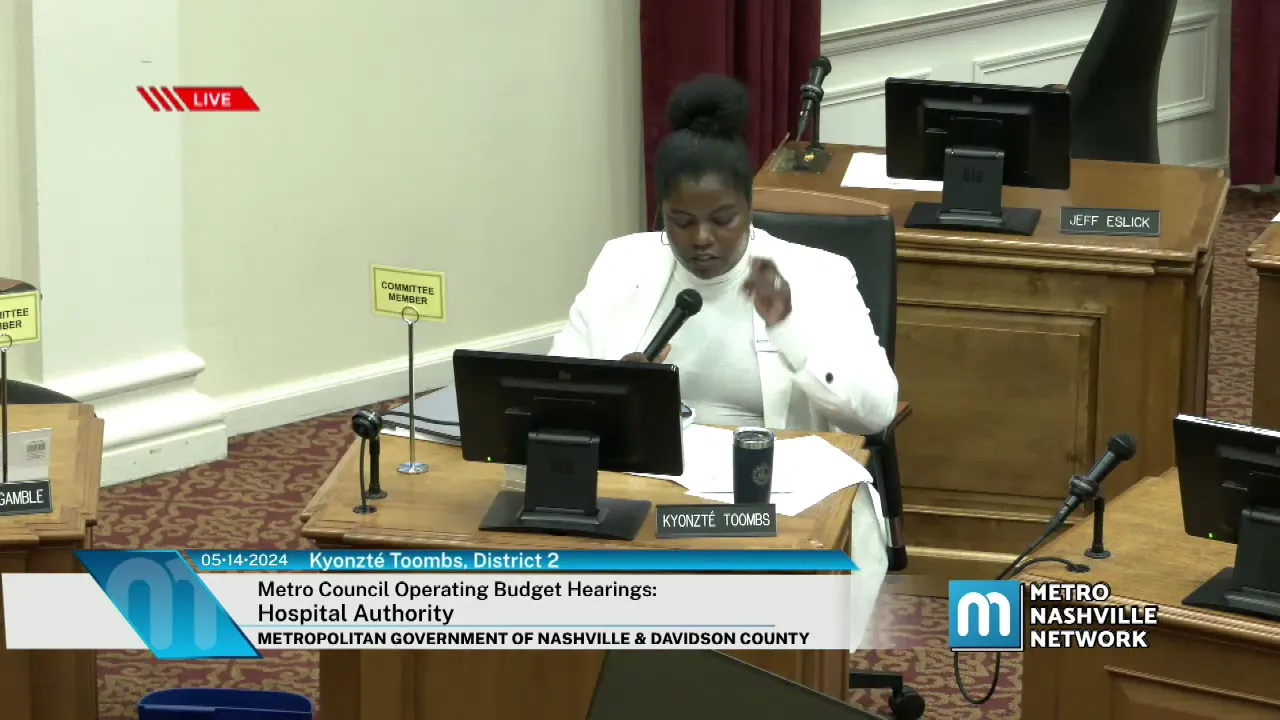
STREAMING COPY IN PREPARATION — RECORDING AVAILABLE FROM THE ORIGINAL SOURCE
Nashville General Hospital 2025 Budget Hearing - May 14, 2024
The Budget and Finance Committee of the Metro Nashville Council held a hearing on May 14, 2024, to review the proposed 2025 budget for Nashville General Hospital (NGH). Dr. Joseph Webb, CEO, and Dr. Bruce Naylmore, CFO, presented the hospital's financial outlook, challenges, and requested support from the city. The hearing focused on the hospital's role as a safety-net institution, its relationship with Meharry Medical College, and the impact of proposed funding levels.
Discussion Items
- Budget Request and Administration Recommendation: NGH initially requested $63.8 million in city support for its $154 million 2025 budget. The administration recommended $59.55 million, a 3% increase over 2024 funding. Dr. Webb noted that balancing the budget at this level would require painful cuts, including reducing contract labor, ending a recruitment contract ($513,000/year), and cutting a rheumatology contract ($230,000/year).
- Revenue and Expenses: NGH projects $152.4 million in total revenue for 2025, including $61.1 million in self-generated patient revenue and $31.7 million from state/federal sources. Salary expenses are expected to rise 6.9%, partly due to hiring new physicians (obstetrician, cardiologist, oncologist) and a 5% annual increase for current staff. The hospital faces a projected $320,000 loss.
- Historical Funding Levels: Dr. Naylmore showed that city support dropped from $52 million in 2018 to $43.1 million in 2020, then rose to $47.6 million in 2022 and $57.8 million in 2024. The average annual increase from 2018 to 2025 would be 1.9% if the $59.55 million is approved.
- Challenges with Meharry Medical College: Dr. Webb discussed the strained relationship, including inaccurate information reported at a previous board meeting. They have scheduled biweekly meetings to work through issues. A major issue involved Meharry failing to provide resident rosters on time for the state's graduate medical education (GME) funding, costing NGH $1.1 million in 2024. Dr. Webb now has the rosters for 2025 and expects to recover the funding, but an amendment to the provider services agreement (PSA) is needed to share funds with Meharry.
- Legacy Pension and Security Costs: NGH pays $2.4 million annually for a legacy pension related to closed Bordeaux and Knowles facilities. Additionally, the hospital now pays $1.3 million for private security after Metro stopped providing sheriff's deputies, though NGH continues to provide free healthcare to Metro inmates. Council members expressed concern about this inequity.
- Staff Retention and Recruiting: Dr. Webb noted high turnover among nurses due to travel contracts offering $70/hour versus NGH's $35-40/hour. NGH has 60 open nursing positions and 75 total vacancies. Contract labor costs rose from $2 million in 2019 to $13.2 million projected for 2024.
- Food Pharmacy Program: Dr. Webb highlighted the hospital's food pharmacy, which provides healthy food to patients. It has reduced emergency department visits and improved cancer survivorship rates.
- Facility and Capital Needs: Councilman Toombs questioned why capital repairs (e.g., $400,000 roof repair) are included in the operating budget. Dr. Webb noted the hospital is responsible for all repairs in its leased building (a triple-net lease) and has a $20 million deferred capital needs list. The city provided $1.8 million from the 4% fund and $7 million in surplus funds for FY24.
- Relationship with Meharry: Council members urged collaboration. Dr. Webb explained that the two institutions have different missions: Meharry teaches, NGH treats patients. They are seeking a balanced relationship and exploring a new state-of-the-art teaching hospital.
Key Outcomes
- No formal vote was taken; the hearing was informational for the budget committee.
- Council members requested an itemized list of deferred capital needs from NGH.
- The committee will follow up with the Sheriff's Office regarding the security cost imbalance.
- NGH will continue biweekly meetings with Meharry and work on amending the PSA to share GME funds.
- The budget hearing series continues the next day with Fire/EMS, Sheriff, Police, and Public Defender.
Meeting Transcript
And Dr. Webb, whenever you all get settled in, you are recognized and are good to go. Presentation. When you're ready. Good afternoon. I am Joseph Webb, CEO of Nashville General Hospital. And I have here with me Doc Bruce Naylmore, who is uh Chief Financial Officer. Uh we'll be going through the uh budget items with some commentary and uh after which I assume we will engage in some QA. So um we'll go ahead if that's okay. Good evening. Um thank you guys uh for joining us um this evening. Our initial 2025 budget and support request was approved in February by our um hospital authority board, and we anticipated there could be some changes uh from that request before we got final approval uh by the board in May or June when we get there, um, in partnership, obviously, with Mayor O'Connell and the administration. We had requested 63.8 million of a 154 million dollar budget to be supported in furtherance of our mission to serves as a city safety net hospital. Uh the current recommendation from administration came in at 59.55, so that's about a three percent increase over what we receive or will receive in 2024. And um we're working diligently. We've we think we've found as best we can uh the way to make that budget balance at the 59.55 threshold, but not without a good bit of pain. So we'll get into that. Um so let me see if I hit this. So the Metro Charter, I know we have a lot of tenured council members here that know what the the Safety Net hospital is, but we also have some newer members on council. And I just want to say the charter still requires the city to operate a hospital to care for Davidson County residents who don't have access to medical care or our charity or uninsured patients. Now eight years ago we were about 50 percent insured and 50 percent uninsured, and uh this past year or the year we're in, we're at about 61 percent insured patients and 39 percent uninsured, and that you know that off-site clinic growth has helped attract insured patients to the system. We are celebrating, or we just celebrated our 134th year in operation, believe it or not. I started uh with one doctor and seven nurses 134 years ago. Um, we are still the index teaching hospital for four of my hair medical colleges residency programs. We also host residents and faculty from Vanderbilt and some other schools in the region. Um what's cool about the hospital is our patient population is extremely diverse, as is our workforce, and that makes us pop, you know, popular with um research entities, whether it's Vanderbilt Maharry or pharmaceutical companies, um, which is a really nice part of having a diverse population at the hospital. So this is just a brief review. The budget that we had approved last year, we were gonna generate $58 and a half million dollars of our own patient collections, and then $57.8 million coming from the city's support of our mission, and so a total budget of $133 million. Now in 2024, the hospital we finally cracked the code, and we were able to, we got a very substantial supplemental pool payment, which is a program the hospital has been in for many years with the other public hospitals in the state. But we also, for the first time, are receiving um state disproportionate share funds in substantial amounts. So that's what really helped float us this year. We also, if you see under the 10 care MCO, that number five, this year we got 3.5 million over the course of the nine months for the managed care organizations under 10 care that made payments to all hospitals, not just Nashville General, because they understood that Medicaid payments had not risen in a long time, and hospitals were all experiencing extremely high costs. And so that was something, I'm sure this it was federal funds, but the state sort of pressed for them to do that. And we did benefit from that one-time funding from each of the MCOs, it was around seven or eight hundred thousand each from each of the plans. So that helped us in the year we're in currently. So the budget for 2025, I just put it in three columns there. The first was where we plan, where we project to finish for this year. Um, and you can see it about 151.7 million of revenues. And then the budget for 25 that we submitted um back in March was 155.5 million. That presumed a 63.8 million dollar support payment from Metro. Um, and then we've had to modify that based on the recommended numbers from the administration. Um we believe we'll still bring in $61.1 million of our own money uh self-generated, and then $31.7 million from state and federal sources. I did add back graduate medical education. Um we did receive it in 2023, which was the first year that the state paid graduate medical education directly to hospitals. And um so we received $1.1 million in 2023, but unfortunately, in 2024, we were unable to qualify. We were unable to get the uh resident rosters that we needed from the Maharry Medical College in time to qualify. Um we do believe we have them to file this July 1st, and we do expect that we will recover in 2025 budget that 1.1 million. Understanding though, that with that 1.1 million, it is at least part of it will end up being paid back to the medical college in support of residency programs. Requires an amendment to the PSA, but we do expect to get that revenue, and we expect that we will pay a substantial portion of it out to the college. And this is just a brief look because I think when you hear you get $59.5, how much of it really is available to take care of patients that present to us.
openpublica.com