Budget and Finance Hearing for Fire and EMS Department - May 15, 2024
STREAMING COPY IN PREPARATION — RECORDING AVAILABLE FROM THE ORIGINAL SOURCE
Budget and Finance Hearing for Fire and EMS Department - May 15, 2024
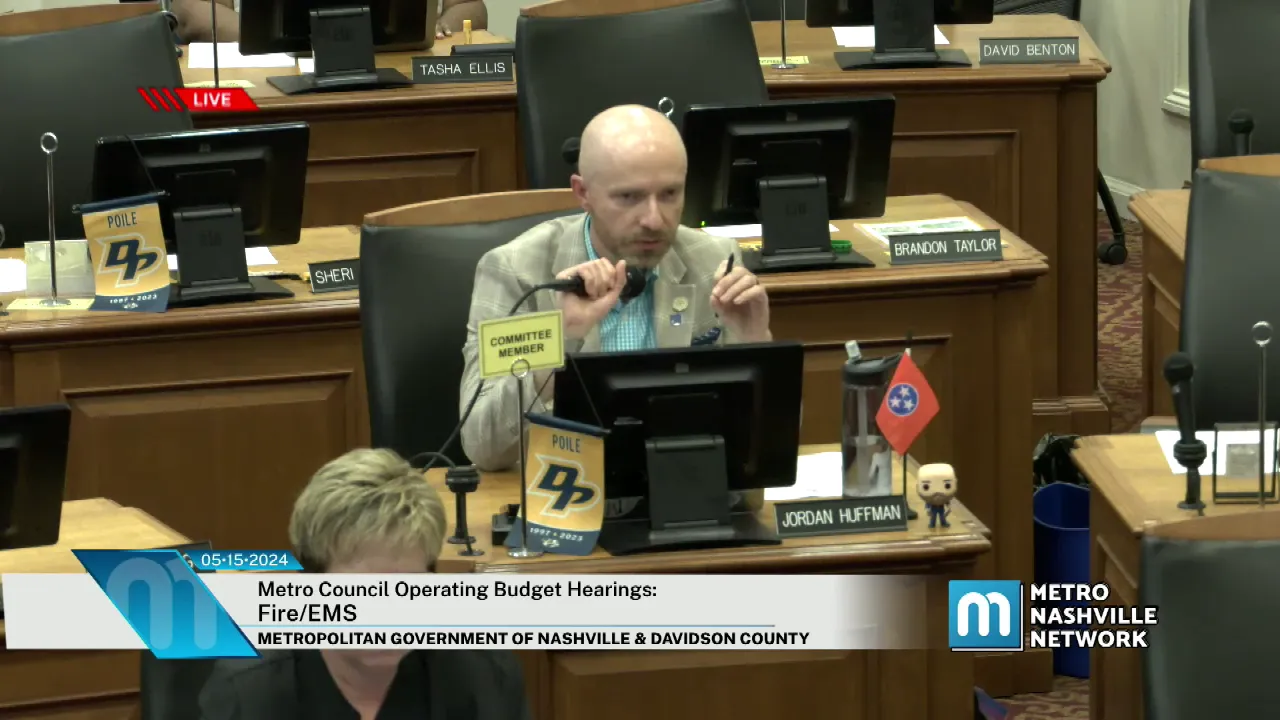
The Metropolitan Council Budget and Finance Committee, chaired by Councilmember Porterfield, convened a hearing on May 15, 2024, to review the proposed Fiscal Year 2025 budget for the Nashville Fire Department (NFD) and Emergency Medical Services (EMS). Chief Keith Swan presented the department's achievements, challenges, and funding requests. The meeting began with procedural clarifications regarding budget discrepancies between the ordinance and budget book.
Budget Process Clarifications
- Aaron Pratt, Budget Officer, explained that variances between the mayor's recommended budget ordinance and the operating budget book arise because pay plan funds are centrally budgeted until council approves the final amount, then distributed to departments in July/August. Councilmember Allen confirmed that the total appropriation includes a $41.7 million pay plan improvements account that is later debited to departments.
Fire and EMS Department Presentation
- Chief Swan emphasized the department's high call volume: nearly 160,000 incidents with 321,000 responses in the past year. He highlighted property saved through aggressive firefighting, lives saved through rapid EMS intervention, and extensive training (over 3,000 hours weekly). The department has achieved state and national leadership in special operations, including a team deployed to Texas for storm response.
- Staffing: 187 new hires in the last year (three recruit classes), 82 departures due to attrition. All trucks are now fully staffed with four firefighters. The department introduced eight squad trucks to reduce wear on expensive apparatus.
- Key budget requests included: a staffing office, expansion of the REACH program, a special operations response team, and additional crisis counselor positions.
Discussion Items
- REACH Program: Currently operates Tuesday–Friday, 10 a.m. to 8 p.m., with two vehicles, two medics, and two clinicians. Expansion to weekends and later hours (up to midnight) would require 5 FTEs at a cost of $753,900. Current funding maintains service levels, with about 70% of patient contacts resulting in non-ER dispositions (either diversion to mental health facilities or leaving at home with a safety plan). No bill is generated for REACH transports.
- Unfilled FTEs: The department has 47 vacancies even after upcoming recruit classes. Unspent salary funds can be used for one-time needs (e.g., medical supplies) with finance approval; remaining funds revert to the general fund at year-end. Bonuses are currently prohibited for all general government departments, a policy that has been in place for several years.
- Ambulance Billing: Current rate is $650 per transport plus $13 per loaded mile. This flat rate applies regardless of treatment. However, Medicare, Medicaid, and indigent populations reduce actual collections. The last rate evaluation was in 2015; a new evaluation is planned due to rising costs.
- South Nashville Truck Company: A request for a new aerial truck company in South Nashville/Antioch to address growing call volumes and slower response times. Chief Swan noted the area is overdue for a new station.
- Downtown Fire Services: Stations in the downtown core are at maximum capacity, with the busiest fire station in the nation (Station 9). The department is using creative approaches (ATVs, fast car processes) and is in planning discussions for the East Bank development, which will require additional resources.
- Mental Health Support for Staff: NFD onboarded its first crisis counselor this year, who works with a peer support team. Additional counselors are needed to address the mental health toll on first responders.
- Special Operations Response Team: A request for 18 FTEs to create a dedicated team for hazmat, swiftwater, and other statewide response, preventing the need to pull personnel from regular beat coverage.
Key Outcomes
- No formal votes were taken; the committee will consider requests during budget work sessions (starting May 28) and the public hearing on June 4.
- Councilmember Evans requested that the health, fire, and police departments provide publicly available data on the effectiveness of the REACH program and Partners in Care to ensure continued funding is justified.
- Chief Swan expressed appreciation for the proposed 3.5% cost-of-living adjustment (plus steps, totaling at least 6.5% for most employees) but noted retention remains a nationwide challenge.
- The committee confirmed that salary savings from vacancies cannot be used for ongoing pay increases, and bonuses remain prohibited for general government employees.
Meeting Transcript
I think it's today Tuesday. Wednesday, just kidding. Yesterday was Tuesday. Today is May 15th, 2024, and I call this budget and finance hearing to order. Thank you all for being here today. We do have a quorum. So thank you for your patience. We did want to ensure that we had a form today. And then we will have some again tomorrow. We also have some next week. Your wish list will be due on May the 23rd. And you can also uh turn in your amended wish list by June the 6th. We do have budget work sessions that will be starting on May the 28th. And we have community listening sessions. So thank you for those of you who joined the Bellevue session on Monday the 18th. The remaining sessions will be held on uh Saturday, May the 25th at the Southeast Community Center, located at 5260 Hickory Holler Park Parkway at 10 a.m. and the Hermitage Library located at 3700 James K Lane at 2 p.m. And I'm sorry, I missed the one on the 18th. The one on the 18th is at the Northwest YMCA, located at 3700 Ashland City Highway at 2 p.m. So this Saturday at the Northwest Y and then the following Saturday at the Southeast Community Center in the Hermitage Library. We also have the public hearing on Tuesday, the June June the 4th at our regularly called council meeting. So please encourage your constituents to come out to that as well. And uh as we did yesterday, um, we will go to uh the other committee member, uh, excuse me, the committee chair of the associated committee. So all of today's committee um committee hearings, excuse me, department hearings are all under the umbrella of also public health and safety. So after we go through the department uh presentation when it's time for QA, I will start with uh Chair Evans, who's here with us uh since she is the chair of public health and safety, and then we will recognize other members. Um, lastly, for any citizens or constituents that are watching. Um, if you have questions about the budget, I did want to make sure that you know that we do have the citizens guide to the budget available on Nashville Nashville.gov. It's an amazing tool that will answer uh a lot of the questions that you may have about the budget and process to our colleagues. Um the questionnaires that we are going over today, you will find them in the SharePoint in our SharePoint that's on Nashville.gov. You can go to the council page and then go to council resources and under operational budget. And under that, the third link will be the questionnaires, a folder um containing the questionnaires uh for our hearing. So please make sure that you are referencing that. Um, with that, uh, we will start with fire, and before we call fire up, I am going to uh go to finance for one moment. There's a question that I keep getting from people in the community, and I want to make sure that finance has the opportunity to explain um discrepancies that people may see between the the ordinance that has been filed and the numbers that we see in the budget book. So uh Mr. Aaron Pratt, you are recognized. Thank you. Um, Aaron Pratt, budget officer, um department of finance. There's a description, there's always gonna be a variance between the ordinances that are produced. So the mayor's recommended budget ordinance, the budget and finance chair ordinance, and the final council approved ordinance and the operating budget book. If you looked at the fiscal year 2024 budget book, operating budget book, um, there would be a variance between those ordinances and the amounts that departments are distributed. That's based on the pay plan. Pay plan is centrally budgeted during the budget process until the final pay plan amount is approved by council. Once that pay plan amount is approved, we then work over July and August to distribute and reallocate those funds specifically to the departments. So department A will would be at a certain amount, a base amount throughout the budget process, plus any approvements that were approved by council during that time that was added to the budget. And final piece of that is the compensation amount that's then added to the budget for that department as instructed by council. So we do that operation in uh July and August based upon the final approved budget. So for instance, a department like finance would have had a budget of $50,000, and the pay plan that would have probably been approved was two percent. So we would have added that additional two percent um to that department's budget in the July August time frame, and that would show up in the fiscal year operating budget book, which we produce in September slash October and submit to GFOA. Thank you for that, Mr.
openpublica.com