Phoenix City Council Meeting - June 18, 2025: Budget, Housing, Building Code, and Policing Petition
STREAMING COPY IN PREPARATION — RECORDING AVAILABLE FROM THE ORIGINAL SOURCE
Phoenix City Council Meeting - June 18, 2025: Budget, Housing, Building Code, and Policing Petition
The Phoenix City Council convened a formal meeting on June 18, 2025, preceded by the Assisted Housing Governing Board. The council adopted the final 2025-26 operating and capital budgets (8-1), approved multiple affordable housing projects, adopted the 2024 Phoenix Building Construction Code with inclusive design amendments, and denied a citizen petition (Resolution for Thriving Communities) regarding police-ICE collaboration and data transparency (8-1). The meeting included extensive public testimony on immigration enforcement, police practices, and housing needs.
Consent Calendar
- Approved meeting minutes of March 5, 2025 (unanimous).
- Approved board and commission nominations (unanimous).
- Approved items 3 through 30, except item 17, on liquor licenses (unanimous).
- Approved items 31 through 153 with exceptions (e.g., items 46-53, 67, 68, 76, 78, 82, 83, 94, 102, 107, 148, 149, 150, 153) (unanimous). Item 17 (liquor license) received a vote of no recommendation (8-0).
Public Comments & Testimony
- Budget & Public Safety (Item 46): Orla Bobo opposed the tax increase, stating it would not address fire response deficits and criticized city spending on lawsuits and NGOs instead of public safety.
- Liquor License (Item 17): Shirley Deakin (O’Hambert Neighborhood Association leader) and Michael Rain (applicant’s attorney) testified in support, citing neighborhood outreach and community benefits.
- Helen Drake Village (Item 83): Diane Barker (District 7 resident) urged city oversight and sustainability requirements for third-party housing operators.
- 2024 Building Construction Code (Item 149): Multiple speakers expressed strong support for inclusive design amendments: Will Green (SWEEP) backed electric vehicle readiness provisions; Dana Kennedy (AARP Arizona) urged universal design for aging and disability; Josh Munoz (First Place AZ) highlighted benefits for individuals with developmental disabilities; Daryl (disability advocate) called it “my ADA moment”; Nicole Anderson (Mayor’s Commission on Disability Issues) shared a personal story about the need for accessible homes; Frances Haynes (Schindler Elevator) and Kevin Brinkman (National Elevator Industry) supported the code with removal of an elevator amendment.
- Citizen Petition (Item 153): Over 20 speakers testified in favor of the Resolution for Thriving Communities, describing fear of deportation, racial profiling, police violence, and family separation. Speakers included Estella Varela (Dist. 5), Nadia Morales, Natasha Chavez, Saida, Liz, Yolanda, Monica, Isabel, Jenny, Olivia, Elsa (BLM Phoenix Metro), Maximilian, Ben (citing 3,000 postcards), Jose (brother killed by police), Patricia, Maria (mother of son with disabilities), Mark, Frank Urban (Fund for Empowerment), Elizabeth Venable, Laura Medina (indigenous speaker), Harrison Redmond (ACLU of Arizona), Megan, Ellie Samson, Joseph, Tina, Rebecca Denis (citing AZ Central article), Carmen, Yesenia, Nicole Rodriguez, Stacy Champion, April McHugh, and Karen Olsen. One speaker (Ann Ender) opposed the petition, arguing it misrepresents police roles and is outside city purview.
- Citizen Comment: Additional comments addressed homelessness services (Mark Schaefer, Frank Urban), concerns about uranium mining near Colorado River (Elizabeth), accessibility of posted agendas (Diane Barker), police violence (Roland, Marty Winkler), historic preservation (Julia Taggart thanking council for Hanson Mortuary historic status), and public records request delays (Stacy Champion).
Discussion Items
- Assisted Housing Governing Board (pre-meeting): Unanimously passed four resolutions: allocation of 40 HUD Section 8 vouchers to Helen Drake Village (227), asset management budget (228), amendment for Wild Rose Flats vouchers (229), and RAD program operating budgets (230).
- Budget Adoption (Items 46-53): Council held public hearings and adopted the final 2025-26 operating budget (8-1, Councilwoman Guardado dissenting citing insufficient investment in vulnerable communities, police alternatives, and DOJ concerns), capital budget (8-1), reappropriated budget (8-1), and year-end reallocation amendments (9-0). The 2025-26 operating budget totals approximately $1.2 billion for police and includes $46 million extra payment to PSPRS pension fund.
- Pension Policies (Items 67-68): Adopted annual pension funding policies for COPERS (city employees) and PSPRS (public safety). PSPRS is 45% funded; city aims to fully fund by 2041-42. Councilwoman Stark and Councilman Robinson abstained respectively.
- Keys to Change Contract (Item 76): Vice Mayor O’Brien moved to continue to July 2nd, citing concerns about financial transparency (a reported $5 million deficit), unpaid security vendors leading to staff walk-off, and the city’s inability to secure a board seat despite three meetings. Councilmembers supported continued negotiation for oversight.
- Housing Projects: Unanimously approved:
- Item 78: Maryville Parkway Terrace (shade ramada, asphalt refinish, dog run for seniors) — Councilwoman Guardado highlighted improvements.
- Item 82: Moorland Affordable Housing Development with project-based vouchers for return residents — Councilwoman Hodge Washington praised equitable planning.
- Item 83: Helen Drake Senior Center redevelopment (80 affordable senior units) — Councilwoman Guardado recognized neighborhood support.
- Item 94: Consolidated Plan 2025-29 and 2025-26 Annual Action Plan (HUD submission) — Passed 8-0 (Pastor abstaining).
- Item 107: Wild Rose Flats — 72 affordable units in partnership with Isaac School District — Councilwoman Pastor highlighted 50-year ground lease.
- Item 150: Zoning amendments for multifamily housing conversion (HB 2297/2110 compliance) — Councilwoman Hodge Washington clarified state mandate.
- Public Art Plan (Item 102): Adopted $24 million plan funding 45 projects citywide, including $160,000 for Eswenio Park (Dist. 4) and $300,000 for McDowell Road Revitalization — Councilwoman Pastor celebrated community input.
- 2024 Building Construction Code (Item 149): Adopted with inclusive design amendments (appendix NE for EV readiness, universal design features) after extensive public support. Councilwoman Stark emphasized balance between affordability and accessibility.
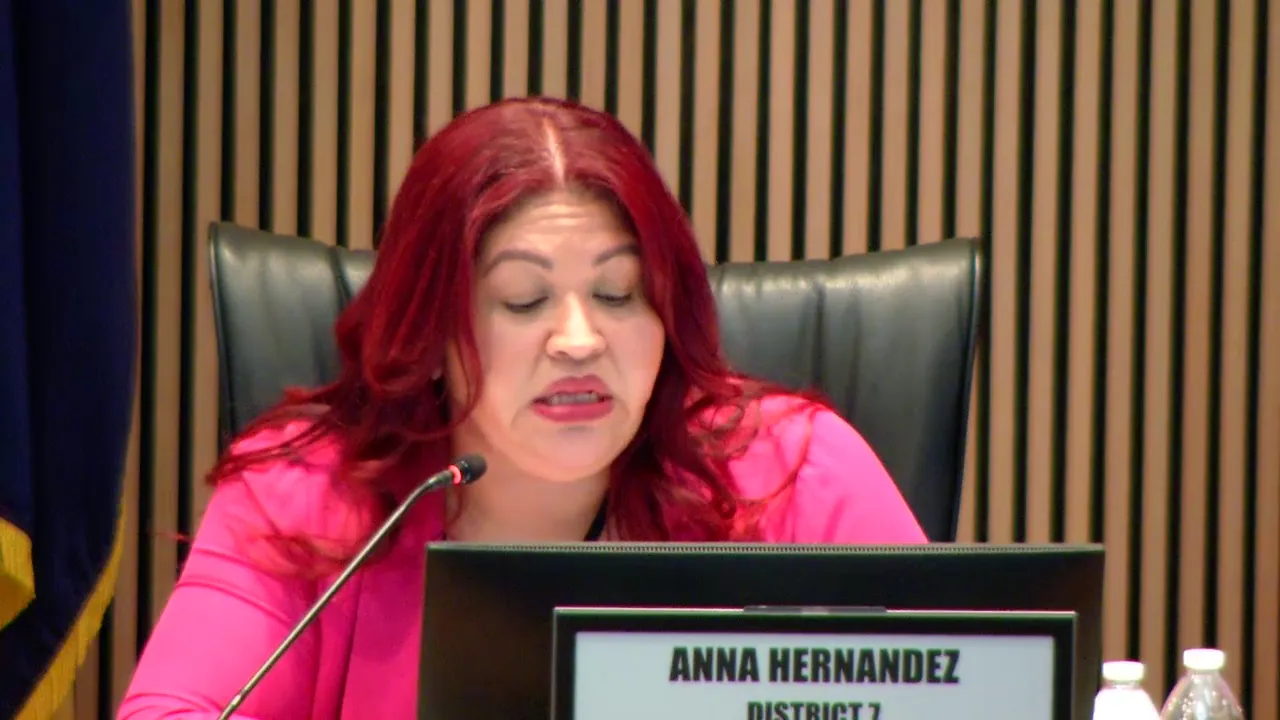
- Citizen Petition (Item 153): Extensive council discussion. Chief Orender stated PPD does not cooperate with ICE, does not have 287(g) agreement, and does not arrest for civil traffic violations. Data collection improvements via new records management system (RMS) were highlighted. Councilwoman Hernandez requested detailed monthly reports on stops, citations, transfers to MCSO/ICE, and park ranger referrals. Councilwoman Guardado spoke in favor of the petition, citing lived experiences and need for transparency. The motion to deny the petition passed 8-1 (Guardado voted no on the motion, i.e., in support of the petition).
Key Outcomes
- Budget Adopted: Final 2025-26 operating budget, capital budget, and reappropriated budget were adopted (8-1). A special meeting was convened and adjourned for this purpose.
- Pension Policies Adopted: COPERS and PSPRS funding policies adopted (8-0 each, with abstentions).
- Keys to Change Contract Continued: To July 2, 2025, for further negotiation on board representation and oversight.
- Housing Projects Approved: All proposed housing and planning items (78, 82, 83, 94, 107, 150) passed unanimously (9-0 or 8-0).
- Public Art Plan Approved: $24 million plan passed 9-0.
- Building Code Adopted: 2024 code with inclusive design amendments passed 9-0.
- Citizen Petition Denied: Resolution for Thriving Communities denied 8-1; Councilwoman Hernandez committed to pursuing enhanced data reporting.
- Liquor License (Item 17): No recommendation vote (8-0).
- Consent Agenda: All other consent items approved unanimously.
Meeting Transcript
They helped with my birth certificate. After a few months there, they moved the City of Phoenix Hotel Shelter, a stop for people as they transitioned to permanent housing. And they help you here too. They have water case vendors that will work with you. And be on a next journey. Sophia, also a mom, says now she has a lot to look forward to. Getting my son back plus for one goal. Getting my own place. They will help you if you actually try. Up until 1889, the majority of the water that was used by Phoenicians came from the actual original canal that went through town. In 1889, a man named John Gardner started the first city water works, which is where we're standing today. Water was delivered to this very spot in Bertie Park by a redwood tunnel that extended for 30 miles to the east and the northeast. Part of the city water works in 1938 was this pump house. It was built with the intention of being an emergency pump house. Water has always been an important element of thriving in the Valley of the Sun. This pump house represents one of the few remaining structures that show how that water was transported in the early 20th century. And it's a wonderful piece of architecture here in the southwest corner of the Garfield Historic District that we can all continue to enjoy here at Bertie Park. One of the things we find is individuals with a lot of property, their possessions. We want to assist them in having that not be a barrier for them entering an indoor sheltered situation. The Office of Homeless Solutions partnered with our public works department to get brand new garbage and recycling containers to utilize as storage containers for individuals' properties. And the reason we like these containers is they're lockable, they're brand new, they're large, they have a lot of capacity. Finally, they have a unique code. Each uh container has a unique code that we can identify with that individual. They have lots of property, we will assist them with multiple containers. When we're out in the community and we come across an encampment that there aren't people at that encampment, we have a notification process. We will leave notification that we will be back to store that property. We come back 48 hours later. If that property is still there, we will store all of that property for 45 days. We'll leave a second notice so that individuals, if they come back and their property is missing, they have a way of getting in contact with us. From there, if they do call us, we will bring them their property and we will help them connect to an indoor sheltered location. We understand that this uh these are people's assets. This is their possessions, things they don't want to necessarily part with, and so we try to accommodate that in any way that we can make it, I think. Good afternoon and welcome. Before today's formal city council meeting, we will convene the assisted housing governing board. I'll ask the clerk to call the roll. Board member Guardado. Here, board member Nandez. Board Member Hodge Washington. Here. Board Member Maggard. Board Member Maggard. Here. Thank you. Board Member Pastor. Board Member Robinson. Here. Board Member Stark. Here. Board Member Warren. Vice Chair O'Brien.
openpublica.com