Rock Springs City Council Meeting on Utility Rate Study - August 13, 2026
STREAMING COPY IN PREPARATION — RECORDING AVAILABLE FROM THE ORIGINAL SOURCE
Rock Springs City Council Meeting on Utility Rate Study - August 13, 2026
The Rock Springs City Council met on August 13, 2026, to receive a presentation from Todd Cristiano of RAF Tellis on the water, wastewater, and stormwater financial plan and rate structure study. The presentation summarized a 10-year financial forecast, proposed changes to water and sewer rate structures (shifting from declining to increasing block rates for water), and a conceptual stormwater fee analysis. Council members asked questions about equity and implementation, and expressed general support for moving forward with rate restructuring.
Discussion Items
- Water Utility Financial Forecast: Council had previously approved a 7% annual revenue adjustment. The study funded $40 million in capital improvements with cash (no SPT funding), achieving target reserves of 90 days O&M and meeting debt service coverage over 10 years.
- Wastewater Utility Financial Forecast: A 9% annual revenue adjustment was included, with similar reserve and debt service coverage targets met.
- Rate Structure Objectives: The study evaluated pricing objectives: revenue sufficiency, defensibility, revenue stability, proportionality between customer classes, conservation, essential-use affordability, customer understanding, and administrative feasibility. The proposal aimed to balance competing objectives.
- Proposed Water Rates: Residential rates change from a declining block to an increasing block structure (tiers: 0-268 cf included in service charge; 268-670 cf at $0.0305/cf; over 670 cf at $0.042/cf for residential). The service charge varies by meter size (e.g., $22.77 for 5/8" and 3/4" meters). 55% of residential bills use ≤535 cf (4,000 gallons) or less. Larger customers may see slight initial decreases due to the change, but future increases will follow the annual revenue adjustment.
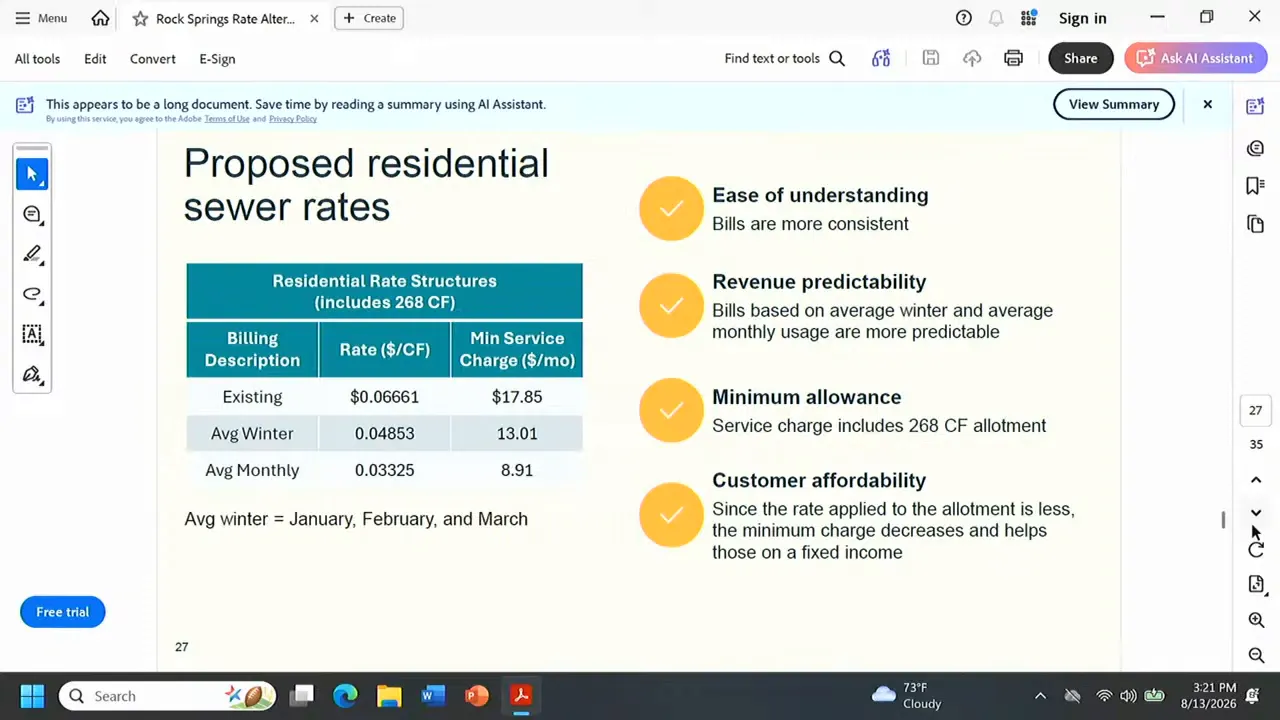
- Proposed Sewer Rates: For residential, options include a minimum charge of $13.01 with $0.048/cf based on average winter consumption (AWC) or $8.91 with $0.033/cf based on average monthly consumption (AMC). Commercial sewer rates use actual usage to avoid undercharging seasonal businesses (e.g., restaurants) and to improve cost proportionality.
- Stormwater Conceptual Analysis: Identified ~$15 million in capital projects over 10 years. A simplified flat-fee approach was presented: $3.04/month for residential and $33.74/month for non-residential, based on assumed impervious area. Councilor Zotti questioned the equity of a flat commercial fee (e.g., downtown businesses with small rooftops vs. large retailers). Cristiano acknowledged that an impervious-area-based fee would be more equitable but requires additional data and analysis.
- Council Comments: Councilor Zotti emphasized the importance of changing the rate structure to support conservation, particularly due to the Upper Green River water compact. Mayor Mickelson agreed that higher water users should pay more, stating it was "common sense."
Key Outcomes
- No formal vote was taken; the presentation was informational.
- Council expressed consensus to proceed with transitioning from declining to increasing block water rates.
- Staff will prepare an ordinance and resolution to implement the new rate structures, targeting adoption before the next fiscal year to allow sufficient deliberation.
- For stormwater, further study is needed before any fee is proposed; the presented flat fee was only a conceptual starting point.
Meeting Transcript
Public is that we've said the Pledge of Allegiance, and we're now on to the roll call. Counselor Thompson, Malonus. Here. Demas. Here. Vickerson. Zavi. Here. Hansen. Here. Pedri. Here. Bingham. Mayor Mickelson. Here. And with that, uh, I would invite Raf Tellis up to give us their presentation. Uh, Mayor, members of council, good afternoon. My name is Todd Cristiano with RAF Tellis. And today's discussion is a summary of what we've been working on over the past year since we came to you back last August to talk about the water, wastewater, and stormwater financial plan cash flow and rate study. Uh today's focus is about um the rates or the rate design, the rate structures. But we're going to take a little trip down memory lane here. How do I get this thing to move? Does the maybe it's a lot. Oh, there's the okay. Um as we get started, there was really three components to this study. Um we had our financial plan, which is developed in the cash flow, tells us what amount of revenue do we need each year to fund our capital improvement program, our operations and maintenance expense, meter reserve targets, and all the other financial metrics. Um the second and third part here is kind of what we're talking about today, this cost of service and rate design. Really, we wanted to make sure that these two processes tell us uh how we can uh assign cost proportionally to the various customer classes you have, and then from that design rates are going to recover those costs both in water and and wastewater. Um whoops, I'll have to go back up. Um so a quick summary on the water utility financial forecast. Um council approved a 7% annual re uh 7% annual revenue adjustment at the previous meeting. We're funding about 40 million dollars in um capital improvements with cash. We don't have any uh SPT funding in our scenario analysis. Um we're able to, with those revenue adjustments, able to meet our target reserve of 90 days of operations and maintenance expense and our capital reserve as well, and obviously meets our debt service coverage requirement for any debt that we're going to issue over the study period. So this just um was a way of adjusting revenues to make sure we sustained our financial health over the 10-year period for the water utility. And this is what this looks like from a graphical standpoint. Uh the bars here, the different colored bars uh just represent the type of expenditures you have. Um the light blue bar just indicates if you did not have any revenue adjustments, and what that shows us is that your expenditures would be higher uh than the revenue you're taking in, and that's why we had proposed those revenue adjustments, and that's what the black line shows that over the 10-year period, those cumulative impacts of those revenue adjustments will help fund those annual expenditures and meet your uh debt service coverage and and reserve targets. Um here's a quick survey of where we are with Rock Springs. Um this 6131 here for water is based off of 1200 cubic feet, three-quarter inch customer, very typical customer. Um this is the $61.31 cents resulting from the new rate structure that we have developed. And I'll go into details about what that rate structure is. So still kind of in the middle there. Um, of course, we have other communities that might be adjusting their rates for 2027 that are not published yet. So it's possible that you know the rockspurn rock springs bar could could move down or or up a little bit. Uh sewer utility financial forecast, very similar story to water. Um the only difference here is it's a nine percent annual revenue adjustment. Again, no uh SPT funding. We're achieving all of our reserve targets, both OM and capital. Um, and we're able to maintain our uh debt service coverage retarget during the 10-year period.
openpublica.com