Aggie Square EIFD Public Financing Authority Meeting - December 1, 2020
STREAMING COPY IN PREPARATION — RECORDING AVAILABLE FROM THE ORIGINAL SOURCE
Aggie Square Enhanced Infrastructure Financing District Public Financing Authority Meeting - December 1, 2020
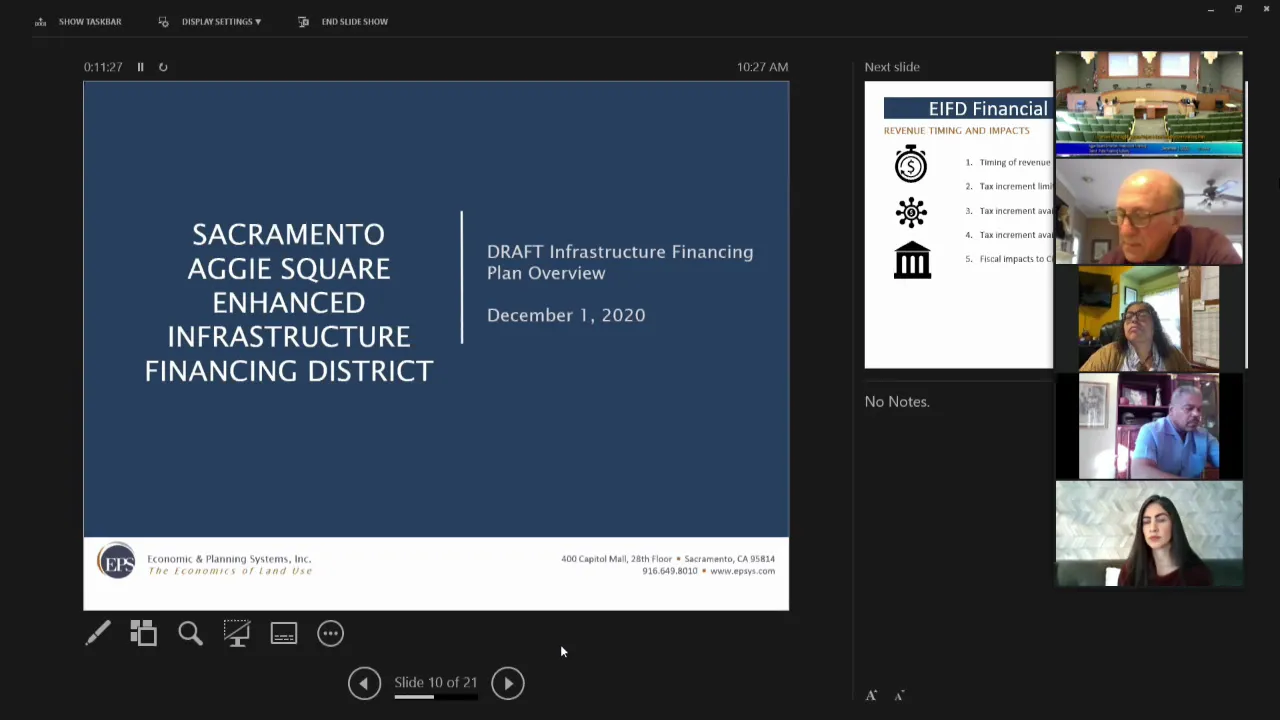
The Aggie Square Enhanced Infrastructure Financing District (EIFD) Public Financing Authority met on December 1, 2020, at 10:00 a.m. via teleconference to receive an overview of the Aggie Square project and review the draft Infrastructure Financing Plan (IFP). The meeting focused on financing mechanisms, fiscal impacts, community benefits, and next steps for the proposed development on the UC Davis Medical Center campus.
Discussion Items
- Project Overview & Draft Financing Plan: City staff (Leslie Fritzsche, Eric Frederick) and consultant Jamie Gomes (EPS) presented the Aggie Square project, which includes four buildings totaling approximately 1 million square feet, a parking garage, and public infrastructure. Phase 1 investment is estimated at $1 billion, expected to generate $2.6 billion in one-time construction benefits, 5,000 construction jobs, and 3,500–4,000 ongoing jobs (25,000 regionally). The draft IFP proposes dedicating 100% of the city’s property tax and vehicle license fee increment to the EIFD, with 20% set aside for city-led affordable housing investments. Tax increment revenues are projected to reach about $2 million annually after Phase 1A completion, $50 million cumulative by 2037, and $100 million by 2046.
- Project Labor Agreement (PLA): Board members questioned the PLA details. Staff (John Dangberg) reported that negotiations are ongoing and that the PLA will include targets: 60% regional contracting, 20% small business subcontracting, 60% regional journeyperson hours, 70% regional apprentice hours, and targeted apprenticeships for disadvantaged workers (homeless veterans, ex-offenders, etc.).
- Community Benefits & Gentrification: Chair Shineer and Councilmember Jennings raised concerns about displacement and rising costs. Staff noted that a gentrification study is planned as part of the Stockton Boulevard Specific Plan but will not be completed before the EIFD adoption. Board members requested that the analysis be accelerated and that best practices from other cities be presented at the next meeting. Councilmember Eric Guerra emphasized the need for workforce development, adult education, internships, childcare, tree canopy, traffic calming, and affordable housing—both on-site and in the neighborhood.
- County Tax Increment Participation: Chair Shineer and Councilmember Jennings suggested approaching Sacramento County (Supervisors Phil Serna and Patrick Kennedy) to contribute county property tax increment to the EIFD, which could double available revenues. Staff agreed to prepare a briefing packet for that discussion.
- Fiscal Impact Analysis: The draft IFP includes a preliminary fiscal impact analysis comparing city revenues and costs for serving the new development. The analysis shows a net fiscal gap if property tax revenues are redirected to the EIFD. Final results are pending.
Key Outcomes
- The board directed staff to schedule the next meeting in January 2021 (instead of February) to discuss: (1) updated IFP details, (2) progress on the community benefits agreement, (3) gentrification/displacement analysis and best practices, and (4) workforce connection measures including a job center.
- Staff will prepare a briefing packet for meetings with Sacramento County Supervisors to request potential tax increment participation.
- The draft IFP remains under review; additional public hearings and council presentations will follow before adoption.
- No public comments were received on matters not on the agenda.
Meeting Transcript
Video stream, give me 10 seconds and then proceed with the presentation, please. Okay. Okay, Leslie. Okay, great. Thank you very much. Um, thanks for giving me a little bit of extra time on my technology. Uh good morning. I'm Leslie Fritschie with your Office of Innovation and Economic Development. And I'm joined today by Eric Frederick of the City Team and Jamie Goyames of EPS to share with you an overview of the uh transformative project. We've been calling Aggie Square. And today's focus really is to walk through the draft infrastructure financing plan for the project. So the presentation will give a brief overview of the project, the economic context, the EIFD process and timeline, and the next steps and questions in the infrastructure financing plan will be part of the EIFD process and time. Leslie, how long do you think the presentation is? Um 10 minutes. Okay. You're on. Okay. Oh, you know what? I think I actually have this the wrong presentation. Bear with me just a second. I have the wrong presentation up on the screen. Started out. So the goals of the project as outlined by UC Davis are to advance innovation and entrepreneurship propelleconomic development, contributing to building more resilient communities and create shared public space. Here is the site location, as you're probably all familiar with it, with Aggie Square being in the center of the UC Davis campus. And the EIFD will take in all of this area as well as a few extra community public privately owned parcels at Broadway and Stockton in along second half. So this is a picture of the Aggie Square project. It will actually contain four separate buildings equaling about a million square feet. The last building the building here located along Stockton Boulevard will be food and health, including a prospective Alice Waters Institute for Edible Education. And the other part as part of phase one will be the quarter at Aggie Square, which will include advancing health care equity, multilingual education, and biomedical engineering. So partners Leslie, I'm sorry, could you go back for a second? Certainly. The garage is also part of phase one. Yes, that's correct. So that's not actually marked on here. Yeah, it should be located here in the public infrastructure. Okay, so we should we should add that in. Just when we do these presentations. I want to be a hundred percent transparent on everything that's happening. Um partnering with UC Davis on this project is Wexford Science and Technology, and they have uh made as part of their office um focus really is partnering with universities on these uh technology campuses. They have done it with Duke, Penn States, Grexel University, and really provided um in the case of 15 knowledge communities. They've been in business 15 years, and they have provided opportunities for lifelong learning on each of these campus settings that they've developed across the country. We're pleased to have Wexford as a partner in this section. The economic benefits of the project is with uh the phase one, it will be approximately one billion dollars in a capital investment, which will lead to about five billion in annual economic benefits for the region. $2.6 billion will be a one-time benefit from the construction aspects of the project, leading to 5,000 construction jobs. On an ongoing basis, it's envisioned that it will create about 3,500 to 4,000 ongoing jobs with 25,000 jobs in the region. And this project fits very nicely and very fits into the long-term strategy for Sacramento, known as Scale Up Sacramento, and then the region wide prosperity strategy policy framework. And we have the opportunity through the Aggie Square project in this partnership with UCD and Wexford to create a national model for the biomedical field. So I'll briefly touch on community benefits. Certainly there is work that is going on now that is looking at what the focus of the current employment composition of PUC Davis campus is and deploying a UC Davis small business first program and looking at how they can better target and more bring some community benefits in the job area, even on their existing campus settings. So during construction, as I mentioned, they will be providing about 5,000 construction jobs.
openpublica.com