Sacramento Metropolitan Arts Commission Meeting, February 12, 2018
STREAMING COPY IN PREPARATION — RECORDING AVAILABLE FROM THE ORIGINAL SOURCE
The Sacramento Metropolitan Arts Commission held its regular meeting on Monday, February 12, 2018, at 2:00 p.m. The commission heard a special presentation, approved the consent calendar, discussed legal counsel and planning updates, received committee reports, and bade farewell to two key figures. No public comments were offered.
Special Presentation
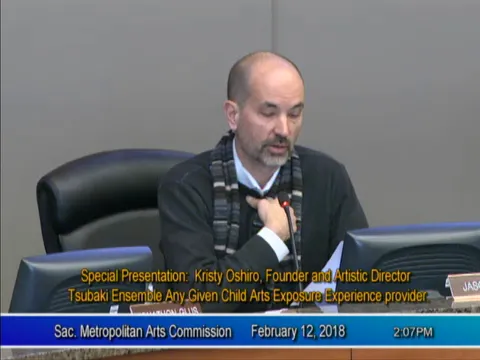
- Kristy Oshiro, founder and artistic director of Tsubaki Ensemble and Any Given Child Arts Exposure Experience provider, addressed the commission. She described her background in taiko and praised SMAC's Any Given Child program, which provided free arts assemblies and professional development workshops in partnership with the Kennedy Center. She noted that while with Portland Taiko, the organization's budget surpassed $500,000. She contrasted Any Given Child with the costly and creatively limiting "Young Audiences" model used elsewhere, saying Any Given Child is a strong alternative. She expressed gratitude to SMAC for supporting artists and helping freelance artists become full-time professionals.
Consent Calendar
- Motion to approve the Sacramento Metropolitan Arts Commission Special Meeting Minutes of January 8, 2018. Motion by Commissioner Wallace, second by Commissioner Mertz; passed unanimously.
Discussion Items
- Legal Counsel for SMAC Meetings: Staff explained that since SMAC is a joint city-county entity, the City Attorney's Office cannot provide legal services unless requested by the commission. The commission passed a motion (Mertz motion, Wallace second) to support actions needed for the City Attorney's Office to provide legal counsel, including amending Ordinance No. 2011-052 or executing an agreement between the City and County for legal services. The motion passed unanimously.
- Cultural Plan Update: Director Jonathon Glus reported that the final site visit with the cultural planning group occurred in late January. Recommendations are expected in March, with a special SMAC meeting to review them sometime in March, a town hall meeting the first week of April, followed by presentation to elected officials. He also noted a community meeting requested by Councilmember Ashby for District 1 would be held Monday, February 26 at Natomas Charter School. The commission received and filed the report.
- Strategic Division/SMAC Assessment Update: Glus said the assessment is on track to bring recommendations to the Outreach and Advocacy Committee in March. The need to align the cultural plan and strategic plan was noted. The commission received and filed the report.
Committee Reports
- Outreach and Advocacy Committee: Commissioner Wallace (Maya) reported in place of Doni Blumenstock. Covered discussion of city attorney recommendation, strategic planning, and Creative Edge; bylaws review deferred to March; 2018-19 budget augmentation connected to cultural equity work; staff budget review to improve advocacy; potential ballot-box advocacy for long-term funding.
- Grants and Education Committee: In Commissioner Marion's absence, Glus reported that the Creative Economy Grant program has been formally moved from economic development to the Arts Commission. It is a one-time grant program, not annual. Grantees are new to the city and need help with permitting and contracts. Contracts are staggered through November 2019. Staff will assess the program's impact and lessons learned.
- Art in Public Places Committee: Commissioner Ishmael introduced new project manager Donald Ginsler, whose background includes community arts and land use law. The committee discussed projects, emphasizing project management and policies. Three fire station projects were described: Fire Station 14 (artist Doug Cornblatt), Fire Station 15 (artist Michael Stutz), both new; and Fire Station 43 restoration (artist Goggin). One commissioner requested exploring interior art in fire stations and policy on removal/relocation of public art; the chair said it would be taken up next meeting. Box wrap projects continue, with possible SMUD sponsorship and placemaking opportunities. The Royal Chicano Air Force artwork at Golden 1 Center is on schedule; a private event is set for March 1 with a public event to follow.
- Friends of the Arts Commission: No report due to Commissioner Winlock's absence.
- Director's Report: Glus discussed internal systems, database and communications improvements, and an open RFQ for graphic design services for the Creative Edge document. He thanked grants coordinator Anya, whose last day was the following Friday; Anya announced she is leaving to run grant programs for the California Department of Transportation.
- Chair Person's Report: Chair Jason Silva spoke about the Creative Edge process and welcomed Donald Ginsler. He announced Commissioner David Sobon is stepping down from the commission to focus on Wide Open Walls and other ventures. Sobon expressed gratitude and said he would continue to seek the commission's guidance.
Key Outcomes
- Approved the January 8, 2018 special meeting minutes unanimously.
- Passed a unanimous motion supporting the City Attorney's Office providing legal counsel to SMAC.
- Received and filed updates on the Cultural Plan, Strategic Division/SMAC Assessment, and all committee reports.
- Acknowledged the departure of staff member Anya and the resignation of Commissioner David Sobon; commission members offered thanks and farewells.
Meeting Transcript
All right, let's let's uh get started today, and I want to call to order our um uh February twelfth, two thousand eighteen meeting of the Sacramento Metropolitan Arts Commission. Uh thank you all for joining us today. Um we've got uh a few people in the audience here that uh and we are also we are live now, are we not? Yay. Okay, I think this is my first time. And actually the last I want to thank uh my uh vice chair Steve Winlock for chairing the meeting last month uh in my absence. That was uh uh are we expecting uh Steven today? Okay, no, that's right, he's out. So uh if we can do roll call, Leslie. Donnie, uh Commissioner Blumenstock, Commissioner Silva. Uh here. Commissioner. Commissioner Mertz. Commissioner Wallace. Commissioner Marion, Commissioner Garrison. Here, Commissioner Sabone. Here. Commissioner Winlock. Commissioner Ishmael. Here. And do we have a quorum? We have a quorum. Wonderful, thank you. And so to kick off our uh wonderful Monday here, we have a special presentation. Uh Christy Oshiro, uh, who is the founder and artistic director for the Subaki Ensemble uh is here to give us a uh uh a brief presentation, and let me give you a um uh a lead-in to her. Uh Christy Oshiro is a professional taiko uh artist based in Sacramento and San Francisco Bay Area. She started playing Taiko at age nine in Kona, Hawaii for the Kona Daifukugi uh Taiko, uh Kuji, sorry, Daifukuji Taiko, uh, and was an instructor and touring ensemble member for the Portland Taiko from 2001 to 2007 while getting her bachelor's degree in music performance in percussion at Portland State University. She's also an inst an instructor and youth programs director at Sacramento Taychodon from 2007 to 2014. Christy is currently the artistic director of the Subaki Ensemble, creative director of Placer Ume Taiko, instructor for San Mateo Buddhist Temple Taiko, a touring member of Tycoza, and has performed and given Taiko workshops across the US and in Canada, Japan, Switzerland, Italy, Russia, Australia, and New Zealand. She's also a vendor of Visions in Education in Sacramento and specializes in educational ensembles and teaching youth. So Christy, welcome. Thank you very much. I'd like to thank all the commissioners for inviting me to speak today. I wanted to touch on my experience with the Sacramento Metropolitan Arts Commission and how uh the organization has affected and helped me as an artist. While I was studying for my music degree in Portland, um being a professionally involved with a Tyco group there called Portland Tyco. Um I was with them as their as their budget surpassed the 500,000 uh dollar mark and was really involved and learned a lot with them about how uh they performed and organized their organization and uh presented school programs to youth, which is what I do a lot with now in the any given child program with SMAC. Um since moving to Sacramento in 2007, I first became involved with uh Sacramento Tyco Dunn, the big taycho group here. Um at the time, Sacramento Taiko Dunn was heavily funded by SMAC grants, and so I was very familiar with with this organization and how it supported the arts in the Sacramento community. Uh we also, when the any given child arts program started providing free arts assembly programs to the um neighboring school districts, I I became involved with that at the time, it was headed by Erica Kraft and um uh Ray Nani, um who are excellent, and uh they were really great with um helping to provide the artists that participated in that assembly program with supplemental materials like the partnership with the Kennedy Arts Center, uh bringing in professionals uh who had experience provide constructing these types of programs for youth, and to help those of us who are providing these programs for youth uh youth in Sacramento to help us kind of enrich our programs, make them better, more flexible, and help with our creative process, which I thought was really amazing, and those workshops were completely free, and I I just um really appreciated having that kind of support from uh from the Sacramento Metropolitan Arts Commission. And also after leaving Sacramento Taycho Dan and forming you know my own small ensemble that then we created a new program to um present to schools the those workshops that I had participated in with the folks from the Kennedy Center really helped me in kind of branching out on my own to become a freelance performing artists, both here in Sacramento and in the larger San Francisco Bay Area. And so what was what's really great about the any given child program is also I wanted to note that when the uh when Erica Kraft and Ray Nani left and then Laura and Rachel and Heather and Leslie uh stepped in, the transition was really seamless, and they were all continue to be very supportive of us artists, and I thought that was really great. And what the Any Given Child Program does for Sacramento, specifically from an artist perspective, is that in San Francisco Bay Area and in other parts of the country, there's a young audiences program. If you're not familiar with that, they they helped artists uh book assembly programs in various schools in their in their neighborhoods. Um but that program is very costly and it's limiting creatively because your program has to be exactly the same every single time you perform it. Um but it's great in that it does provide lots of performing opportunities for those arts organizations. However, that program does not exist in the Sacramento in the Sacramento area. And um and so the Eddie Given Child program has been like a great um alternative, I think, to the Young Audiences program. Um in closing, I'd like to again thank everyone for having me here to uh share my experiences with you. I'll take questions if you have any, but I also wanted to thank you all again just for the work that you do in providing the just the city of Sacramento for higher quality arts in in general, because what uh the funding that you provide and the programs and and things that that um you provide for the city help to um create more opportunities for more freelance artists to become full-time professional artists, creating thus creating higher quality art and a better arts environment for everyone in the community. So thank you very much.
openpublica.com