Sacramento Metropolitan Arts Commission Meeting – January 14, 2019
STREAMING COPY IN PREPARATION — RECORDING AVAILABLE FROM THE ORIGINAL SOURCE
Sacramento Metropolitan Arts Commission Meeting – January 14, 2019
The Sacramento Metropolitan Arts Commission (SMAC) held its regular meeting on Monday, January 14, 2019, beginning at 2:00 p.m. and adjourning at approximately 3:35 p.m. The meeting featured a special presentation from Sacramento State’s College of Arts and Letters, updates on the equity audit and equity convening, the Cultural Plan implementation, and committee appointments. Commissioners discussed the transition of SMAC from a city-county agency to a city-only agency, and heard public comments on outreach and arts education.
Consent Calendar
- Approval of December 10, 2018 Meeting Minutes – The commission approved the minutes by a motion from Commissioner Mertz, seconded by Commissioner Wallace, with unanimous consent.
Special Presentation
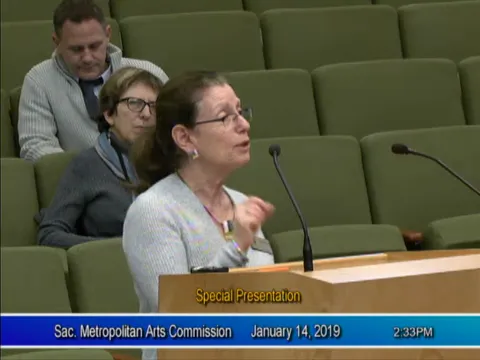
- Sheree Meyer, Dean, College of Arts and Letters, California State University, Sacramento – Dean Meyer presented an overview of the college’s programs, including the Festival of New American Music (over 40 years), Sacramento Black Art of Dance (over 25 years), new BFA programs in interior design, graphic design, and a BA in design studies. She highlighted two neighborhood-based projects in District 6: the #Poppy public art project (a 16-foot Stegosaurus with California poppies) and the CREATE demonstration grant (the only four-year public institution to receive a city grant). Future plans include a “creative compact” for community collaboration, an artist-in-residence program, a certificate in arts entrepreneurship, and a visual and performing arts center. Commissioner Lou Vismer emphasized the need for music appreciation programs in schools, sharing a personal story about symphony tickets. The commission requested periodic updates from the college.
Discussion Items
-
2019 Standing Committee Appointments – Chair Steven Winlock appointed Jason Silva as chair of the Advocacy and Outreach Committee (with Maya Wallace and Winlock), William Ishmael as chair of the Art in Public Places Committee (with Maria Mertz), and Veronica Delgado, Dr. Louis Vismer, Michael Marion, and Winlock to the Grants and Education Committee. The motion to approve passed unanimously.
-
Equity Audit Update – Arts Program Coordinator Melissa Cirone reported that the equity audit, a key action from the Creative Edge Cultural Plan, will be conducted by Margie Reese of MJR Partners over a three-month period (January–March 2019) at a budget of $25,000. The audit will review policies, programs, and stakeholder perspectives to produce recommendations for embedding equity into Metro Arts and the commission. Reese will attend the upcoming equity convening and meet with commissioners and staff. Commissioner Winlock requested that progress be posted on the website.
-
Equity Convening (From Idea to Action: Advancing Cultural Equity in the Arts) – Cirone announced the convening on Wednesday, January 16, 2019, at the Clunie Community Center, co-hosted with the Sacramento Region Community Foundation. The event is at capacity with 150 attendees. Goals include sharing best practices, exploring solutions, and fostering collaboration. A separate afternoon session (3–5 p.m.) for funders will be led by Ted Russell of the Kenneth Raymond Foundation. Commissioner Cirone invited commissioners to attend. Commissioner Maya Wallace commended the collaborative process.
-
Arts Consortium Update – Chair Winlock reported that the Sacramento Arts Consortium continues to work on arts education goals. The consortium received a $1 million educational arts grant through the Sacramento County Office of Education to support arts plans in school districts, teacher training, and capacity building for 14 arts organizations. Commissioner Vismer requested that the Elk Grove School District be included.
-
Update on Cultural Plan – Director Jody Ulich presented the status of Creative Edge implementation. Current activities include the equity audit, equity training, an RFQ for a film office consultant (to be released that week), and a creative economy grant assessment. For the upcoming budget year, SMAC is requesting six new positions and funding including: $200,000 for arts education/consortium, $500,000 for cultural equity grants, $50,000 for film office capacity, $300,000 for creative economy grants, $120,000 for a public art master plan, $220,000 for neighborhood temporary projects, $185,000 for arts in neighborhoods ($20,000 per district), and unspecified “angel funding” for arts and culture. The budget request deadline is Friday, January 18. Commissioner Matthew Gillam asked about aligning with Project Prosper.
-
Committee Reports –
- Outreach and Advocacy: No report; goals to be shared at next meeting.
- Grants and Education: Commissioner Michael Marion noted a meeting next week. Goals include redefining the committee’s role, supporting the cultural plan and consortium, and overseeing grants. The Youth Summit is scheduled for April 1, 2019, at Beat Street Theater.
- Art in Public Places: Chair William Ishmael was absent due to a family matter; the meeting calendar will be clarified.
-
Director’s Report – Ulich announced the opening of the Cultural Services and Creative Economy Manager position (likely that week). The transition of SMAC from a city-county to a city-only agency is underway; new bylaws are being drafted by the city clerk’s office, proposing one appointee per council member plus two at-large. The transition will dissolve the current commission; all members must be reappointed. Timeline is 3–5 months. Commissioners discussed the need for expertise in areas like equity, disability, and film on the new commission. Ulich noted that the city clerk has pushed back on designated seats, but that the commission may advocate for them.
-
Chairperson’s Report – Chair Winlock had no report as this was his first meeting.
Public Comments – Matters Not on the Agenda
- Deepak Sharma (Managing Editor, Talent Magazines) – Stated that SMAC does not effectively promote events or raise awareness, citing the lack of details in the newsletter and the full capacity of the equity convening. Suggested working with existing publications and proposed an artist-in-residence program similar to the Netherlands’ model.
- Jade Nicole (Talent Magazines) – Expressed hope for the structural changes under the equity program. She advocates for hiring people with disabilities and offered to collaborate with SMAC, noting her support for Wide Open Walls.
- Rick Gott (Teacher, Natomas Charter School, film advocate) – Introduced himself and his plan to open the world’s first educationally based movie studio after retiring. He wants to provide training and opportunities to keep young filmmakers from being discouraged by Hollywood.
Key Outcomes
- Votes: All motions (consent calendar, committee appointments) passed unanimously.
- Directives:
- The equity audit progress will be posted on the SMAC website.
- An ad hoc committee on communication strategy, under the Advocacy and Outreach Committee, will be formed to improve website and outreach.
- The Director’s Report will include an update on the Metamorphosis mural restoration at the next meeting.
- The Friends of the Arts board will be invited to give a special presentation at a future meeting.
- Next Steps:
- The equity convening will take place January 16, 2019.
- Budget requests for the next fiscal year are due January 18, 2019.
- The transition to a city-only commission will proceed with bylaws review and meetings with county officials over the next 3–5 months.
- The Cultural Services and Creative Economy Manager position will be posted for 30 days.
Meeting Transcript
City Council meeting and excuse me. Yeah, you know, where we are Sacramento Metropolitan Arts Commission. I open the meeting, and I'd like to have a roll call, please. Okay. Um Jason Silva. Here. Louis Vismer. Marie Mertz. Maya Wallace. Here. Michael Marion. Stephen Winlock. Here. William Ishmael. Veronica Delgado. Matthew Gillam. Thank you. For all of you that are here. What do I have to do next? I think we have a quorum. We have a quorum. Yes, we do. Thank you. Meetings open. Special presentation. Great. We have a special presentation next. So Sheree Mayer. Dr. Mayor from our Dean of the College of Arts and Letters. Dr. Mayor, please. All right. Hi. I see a lot of good friends. Again, for those of you whom I don't know, my name is Sherry Meyer. I'm actually the Dean of the College of Arts and Letters at Sacramento State, and I'm really grateful to start off the new year. Ah, perfect. Okay. To start off the new year with all of you. I've I've met and shared some of our vision, my vision with a few of you informally, but this is an opportunity to give you an update on what Sacramento State has is doing, and also to give you some sense of what our hopes are for the for the future. I also am going to invite up in a few minutes my colleague Bernice Bastomartinez, who is a special assistant to the dean, and in particular is directing our Creative Economy Pilot Project Grant Create. So she's going to chat very briefly with you today about that. As you can see from your overview or your handout, I'm going to give you a little bit of a sense, especially for those of you who aren't familiar with our college of who we are and what we're doing. I'd like to repeat many of the shared goals you already know, but give you a sense of the ways in which we share it. Talk specifically but quickly about two of our neighborhood-based projects. And then tell you a little bit about our future plans and dreams. Please interrupt me at any point if you have any any questions as well, or I'll take questions at the end. One of the things that I think it's important to do before I tell you a little bit about the College of Arts and Letters, is that recently, this past fall, President Robert S. Nelson, president of the university, has announced that we are to become or to continue to become an anchor university in the Sacramento region.
openpublica.com