Sacramento Metropolitan Arts Commission Meeting - September 9, 2019
STREAMING COPY IN PREPARATION — RECORDING AVAILABLE FROM THE ORIGINAL SOURCE
Sacramento Metropolitan Arts Commission Meeting - September 9, 2019
The Sacramento Metropolitan Arts Commission met on Monday, September 9, 2019, at 2:00 p.m. to consider a new Artist Initiated Projects Program, receive updates on the Cultural Plan and Arts Consortium, and hear committee reports. Commissioners approved the new program and received several informational reports.
Consent Calendar
- Approve the Sacramento Metropolitan Arts Commission Meeting Minutes dated August 12, 2019.
Public Comments & Testimony
- No public comments were made under 'Matters Not on the Agenda.'
Discussion Items
Artist Initiated Projects Program
- Staff (Lennee Eller and Donald Gensler) presented a new pilot program funded at $25,000 per city council district for temporary public art projects across eight districts.
- Artists may apply for a specific district or at-large; projects may last up to two years.
- The RFQ process will use a portfolio-based review, with up to 10 images and a 500-word project description; artists may include up to three files.
- The budget is inclusive; up to 20% of the $25,000 may go to the artist's fee, with the remainder for materials, fabrication, permitting, etc.
- Staff noted the program is meant to attract emerging artists and encourage diversity; at least two community engagement events are required per project.
- Commissioners asked about selection criteria, outreach to new artists, and whether the program aligns with broader themes; staff responded that it is a public art grant and supports Creative Edge Plan Goal 5.
- A motion to approve the program was made by Commissioner William Ishmael (on behalf of the Arts in Public Places Committee), seconded, and passed.
Cultural Plan Update
- Director Jody Ulich reported that new grants (Creative Economy, Artists in Residence, Cultural Equity) are open, with informational workshops scheduled for September 10, 17, and 18.
- The film office transition to the city began September 1; the city is now handling permitting, and the film office manager position is open.
- The Arts Commission is transitioning from a city-county entity to a city entity; council approved the new Arts and Creative Economy Commission, and the county will vote on dissolution in about two weeks.
- Applications for the new commission are expected to open soon; appointments will include one per council member and three at-large from the mayor; the deadline for council member recommendations is November 8, with council confirmation scheduled December 10 and the new commission beginning in January.
- Ulich clarified that ad hoc committees may include non-commissioners, and that the county will not create its own arts commission but will contract with SMAC as the local arts agency.
Arts Consortium Update
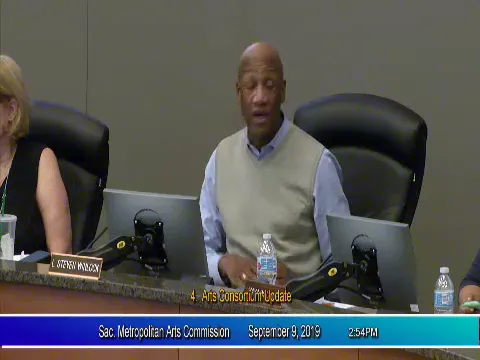
- Dr. Steven Winlock reported on arts education work tied to Creative Edge Plan Goal 1, including a funder collaborative, an arts education program directory, and district arts coordinators.
- A $1 million arts education grant from Sacramento County will be fully expended by September 30; funds included $27,500 per school district (with $2,500 earmarked for an arts organization partner) and $22,000 for 14 local arts organizations.
- A final grant meeting will be held on October 10 at the Sacramento County Office of Education (one speaker reference mentioned October 9); commissioners were invited.
Outreach and Advocacy Committee Report
- The committee discussed accountability for Measure U funding and the need to demonstrate grant impact quickly.
- Concerns were raised that the grants are not prominently featured on the city's website; suggestions included a front-page banner and using the Engage SAC blog.
Grants and Education Committee Report
- The committee did not meet but focused on promoting the upcoming grant workshops and social media outreach.
Arts in Public Places Committee Report
- The committee reviewed the Artist Initiated Projects Program, public art tours (with 20 volunteers recruited from the Creative Arts League), and the next phase of convention center art, which will focus on smaller, portable works by local artists.
Director's Report
- Jody Ulich announced that a recruiter for the Cultural Services and Creative Economy Manager position will be chosen by next week; the film office manager search is being conducted locally with assistance from a consultant.
Chairperson's Report
- The Chairperson praised staff and commissioners for the synergy and collaboration around arts education and the Creative Edge Plan.
Key Outcomes
- Approved the Artist Initiated Projects Program.
- Approved the August 12, 2019 meeting minutes.
- Received and filed the Cultural Plan Update, Arts Consortium Update, and committee reports.
- Next steps: RFQ for the Artist Initiated Projects Program deadline is November 2019; the Cultural and Creative Economy Manager recruiter will be selected by September 16; applications for the new Arts and Creative Economy Commission are expected to open the week of September 9.
Meeting Transcript
Side of the county. Artists can, when they apply, they don't have to live in the specific district that they're applying for. But they need to either identify the district where they see their artwork being realized, or they can apply at large. In which case the panel may then recommend them for a specific district. Ultimately, the council members' office will have the opportunity to help make a final decision based on the panel's review and recommendations. So again, they can apply for a specific district if they feel that the project sh needs to go in a particular location, or they have a general concept, or they can apply at large. Or could last up to as long as two years. Projects that won't necessarily be required to use materials that are uh extremely durable over a series of years in the outdoor environment. Um, and also that artists can take a little more risk potentially in investigating ideas and materials that they might not be able to with longer uh permanent uh projects. It's also a great opportunity for artists to break into the public art field, which is really important uh as well. Oh, that's easier. Thank you. Here's an example of another project that really was very low budgeted, and it was done in Minnesota, thus the snow, and um it was a basically a mini traveling museum, but a lot of things happen with that little museum. They had a pop-up gallery where they would have exhibits in it, and they had didactic art activities and they had certain happenings that it attended, and it was um basically very mobile, and it created a lot of fun in that community. Next one so the RFQ process will we are referring to it as an RFQ because the artists pass work is really uh paramount uh so that they can show um their experience, the opportunities that they've worked on in the past, and then also very importantly, they'll be able to write up to 500 word project description so they can give a sense of what their project is, which may change uh a bit throughout the process. We've also given the opportunity to uh include uh up to three files, but this is really much more of uh just a preliminary conceptual idea that we would we would understand the artists then further realizing once they were um once they were selected. Um the selection panel will follow our general format, which will include a number of different professionals from artists to uh art administrators to curators to a community representatives in making that uh uh selection process and then recommendations to the to the districts. Okay. That's it. So here's another example that was done in Kentucky, and it was in a neighborhood specifically, and the artists worked with the neighborhood, asked lots of questions, wanted to know who they were, how the what kind of things they wanted. And this particular project came from the idea that this was a community of homes, and what was in everybody's home was a doorknob, and she had this c and she collected these wonderful porcelain doorknobs, which which she turned into a flower garden. And it was um well, it was visited a lot and was very well received. Another project that deals with waterfronts, which we particularly have, was quite fun. It's basically the name was SOS, Safety Orange Swimmers, and it was done in the Boston Harbor. And what was really unique about this was a social conscious work in which she was really talking about the 21 million refugees worldwide that faced the peril of seeking safety and freedom every day. And so she had 21 swimmers, I believe she said 22, which is interesting, so she had that extra in there, um, that represented one million people, and they floated, they were tied together and they floated around into the water and really did some sort of dynamic fun stuff as the ties changed and whatnot. And it was actually very well engaged, and people really enjoyed seeing it out there. One because it was entertaining in the beginning, and then it became oh, that's what it's about. So a nice surprise afterwards. The budget is 25,000 per district. Um if more money comes in from the council's office, I'm sure we would on that, but at this point, we're just looking at the 25,000 dollars. Or if the artist has other ways they want to add uh additional funding to the project, they're welcome to do that as well. But that the project itself is funded at 25,000 per district. And another example that is a temporary piece that happens, uh, there's a canal convergent program in Scottsdale, Arizona that happens annually, and they do a lot of temporary work this way. And these pieces do not cost a lot of money, but they create a lot of interest and a lot of bustle and a lot of attention to the area. So this was a lightweight kinetic sculpture that activated by the wind went over the canal system. They don't have we don't have water in Arizona, we just have canals. But so they take advantage of whatever they can get. The 25,000 is it to cover the materials, is it to cover the pay to the artists? How how are we looking at the same thing? Yeah, so the 25,000 is inclusive of the entire budget. Um, and um, we can get into that. We're almost we're almost wrapped up here with the presentation, but um the idea being that as a part of it, ultimately, if the artist is selected, the artist will submit a budget that totals 25,000, 20% of which can be set aside for their fee. Um, and then the rest of the money needs to be allocated to different aspects of the project, which may include materials, which may include fabrication, which may include permitting, which may include any number of different uh things that the artist would need to implement that particular project. And sometimes the artist doesn't fabricate their own piece, and that's why over the years in public art, we've always separated the idea part, which is the 20% artist fee for the idea and concept of the work, and that's the 25%, I'm sorry, to 20%. And then the rest of it goes to the construction, fabrication, the budgeting, the insurance, the all the stuff that you pays to do these kind of projects, permitting any of that kind of stuff that has to happen as well. Just to round this out, um, the calendar, as you can see here, we really are ready to implement this and allow people to begin to apply as soon as possible and with uh an idea that they that we'd have an RFQ deadline uh for November of this year. Um at that point, we would review organize the submissions, and then uh convene our selection panel uh to make some the the recommendations for each district, uh as you could see the project start date, and I think it's important to recognize a full year then uh when the that when the project should be completed and uh and then that exhibition afterwards, which we're still trying to determine the exact location, but the idea being that we then celebrate all eight projects in one location through the documentation that the artist has provided, um, which I think is a pretty exciting element to the project and an important component so that people can kind of holistically see what happened throughout the city. As we start doing more temporary works, one of the things that we want to start doing is really archiving those works. So we have a collection, and that gives us a you know of all the pieces we own, but we've done a lot of public artwork that's just temporary throughout the years, and this is the ability now to really sit down and say these are all the great ideas we had and what they impacted the community with, and we have a list of them, and you can go and research them.
openpublica.com