Arts, Culture, and Creative Economy Commission Special Meeting - November 2, 2020: CARES Act Round 2 Grant Allocation
STREAMING COPY IN PREPARATION — RECORDING AVAILABLE FROM THE ORIGINAL SOURCE
Arts, Culture, and Creative Economy Commission Special Meeting - November 2, 2020: CARES Act Round 2 Grant Allocation
This special meeting of the Arts, Culture, and Creative Economy Commission focused on the review and allocation of $4.1 million in CARES Act Creative Economy Recovery Program Grants (Round 2). The commission received 266 applications requesting a total of $8.5 million. After reviewing staff presentations, panel recommendations, and discussing equity and district distribution, the commission voted to approve final grant allocations.
Discussion Items
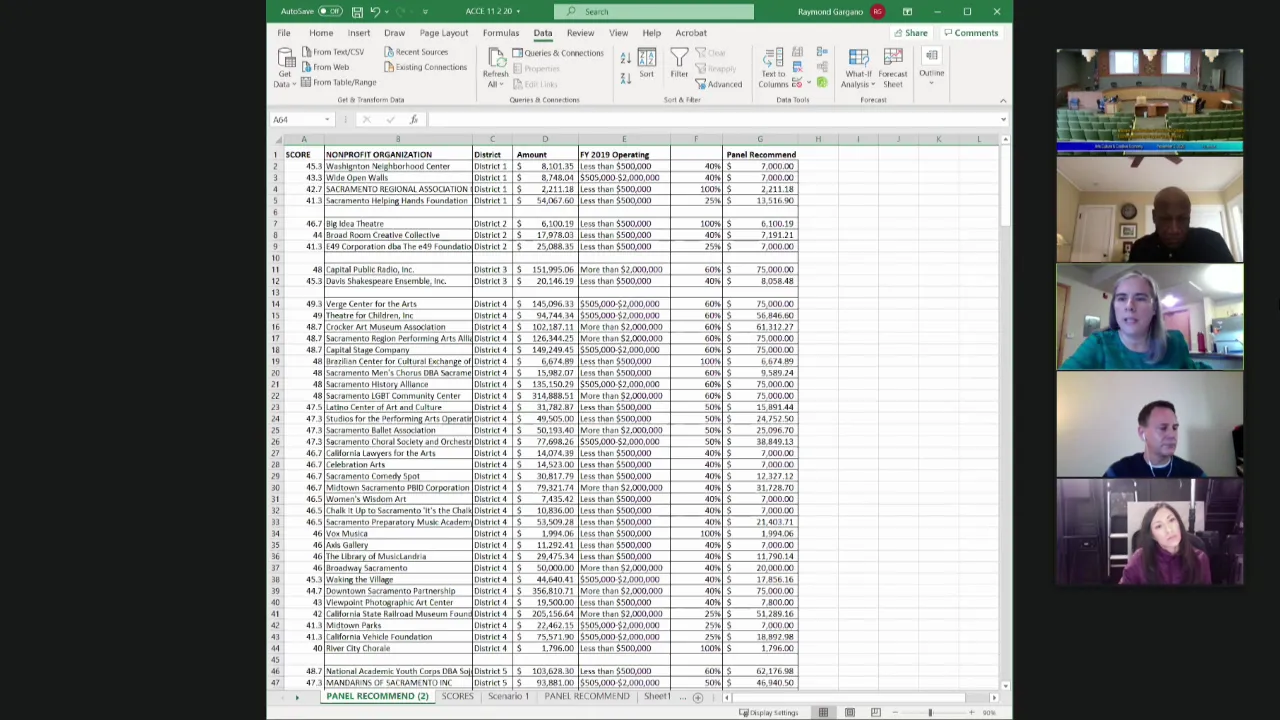
- Staff Presentation (Raymond Gargano): Staff provided an overview of Round 1 outcomes (approx. $7.5 million distributed) and detailed Round 2 processes, including outreach, workshops, and panel scoring. Total requests: $8.5 million from 266 applicants (68 nonprofits asking $3.8M, 71 creative businesses asking $3M, 127 individual artists asking $1.5M). Available funds: $4.1 million (after $1.8M for cultural assets fast-track and $1M for Sacramento Heart Healthy Heart and Mind Collaborative).
- Panel Recommendations: Each category panel proposed scoring cutoffs, caps, and tiered funding percentages. For nonprofits: score below 40 = no funding; requests $7,000 or less fully funded; cap $75,000; tiered percentages. For creative businesses: score below 35 = no funding; requests $15,000 or less fully funded; cap $75,000; tiered percentages. For individual artists: score below 30 = $1,000 flat; requests $2,000 or less fully funded; no cap; aim to fully fund if possible.
- Commissioner Discussion: Commissioners debated equity, district representation, and honoring panel work. Key points: Maya Wallace and others emphasized the need to examine district breakdowns and mean scores to ensure equitable distribution. Donnie Blumenstock noted that service population is more relevant than business address. Steve Winlock proposed using scenario 2 (which incorporates panel recommendations for lower-tier full funding and tiered percentages) to ensure fairness. He also advocated for consistent tier percentages across categories. The commission discussed the importance of using data for future advocacy.
- Amendments: Maya Wallace suggested giving staff the ability to redistribute any remaining funds to the next tier of unfunded nonprofit applicants, focusing on those just below the cutoff. This was accepted as a friendly amendment.
Public Comments & Testimony
- David Drellinger (District 6 resident, individual artist): Expressed gratitude for the commission's thoughtful process and emphasized the importance of arts funding for the community. He noted that the commission's careful consideration was appreciated.
Key Outcomes
- Motion and Vote: Commissioner Steve Winlock moved to adopt scenario 2 (as outlined by staff) with the amendment that any remaining funds after initial allocations be distributed to the next tier of unfunded nonprofit applicants. The motion was seconded by Donnie Blumenstock. The vote passed unanimously (all commissioners present voted yes).
- Next Steps: Staff will finalize the allocation list, send to city council for approval (November 17, 2020), and begin contracting. The commission will receive a district-level data analysis for future advocacy. Next meeting scheduled for November 9, 2020.
Meeting Transcript
I opened the meeting for the special meeting of the uh arts, culture, and creative economy commission. Malin, would you please take role? Okay, good morning, everybody. Rick Gott. If he's not here. Maya Wallace. Here Andrea Lapor. Isela Perez. Here. Donnie Blumenstock. Luisa Lavulo. Here. Dr. Steven Winlock. Here. Priscilla Enriquez. Here. Dr. Melinda Wilson Raimi. Here. We have a quorum. Thank you for that. Thank you, Melan. Welcome, commissioners and also uh panel members that have helped us so much in the work that hasn't been happening with these great grants. So we really want to thank you for your time and being a part of this. And with this, our agenda item is to review the allocation of CARES Act Creative Economy Recovery Program, ground uh grants round two. And I will uh turn it over to uh Ray Gorgano, our arts and program coordinator. All right, thanks, Steve. Thanks everyone for being with us today. So before we get started on looking at the allocation, I just want to do a review of where we've been and uh make sure everyone knows where to find the information and how we'll be updating everything. So, first of all, um our website, arts.city of sacramento.org forward slash grants. We will get all of the updated information as we go. So um if you're emailing or trying to find and you don't get an immediate answer, go there and we'll we're trying to keep that updated for you. All right, so it round one. If you remember, um, in July, we had our first round of creative economy recovery grants. We were uh allocated about $7.5 million. And you can see here through the categories of how the first round of reimbursements happened. So creative businesses got about 1.1 million, individual artists got just over half a million, nonprofits under 400,000, cultural assets, which are our the city's uh cultural buildings that uh organizations that manage lease or occupy cultural buildings, uh got about 1.5 million and grantees that had been familiar with us already got um about three quarters of a million. We additionally had program grants in the first round, which are up and running and amazing right now. So that was almost three million. So that's something to keep in mind as we look forward to round two. Part of round one was also some professional development and some organizational development for all of the um artists and nonprofits who are who are able to join our two mentors that we hired for this, um, Estella Sanchez and Katie McClearly have been running these. We have two full sessions left. Um anyone is available or is invited to join us. You can go to our website for this link, but you can sign up to it. Uh sign up there. Additionally, we've added some additional um non-sequential workshops for everyone to join. You can also find this on our workshop from mastering your money mindset to tech to HR and management structures. So we recommend that everyone join these because they are a virtual, um, they are accessible to everyone. And you can register up at our website.
openpublica.com