Sacramento Budget and Audit Committee Meeting - October 4, 2016
STREAMING COPY IN PREPARATION — RECORDING AVAILABLE FROM THE ORIGINAL SOURCE
Sacramento Budget and Audit Committee Meeting – October 4, 2016
The Sacramento Budget and Audit Committee met on October 4, 2016, at 2:00 p.m. in City Hall Council Chamber. The meeting, chaired by Vice Mayor Rick Jennings, covered a consent calendar of routine items, a major discussion on a proposed citywide development impact fee ordinance, and an audit of the Department of Utilities labor reporting. The meeting adjourned at 2:48 p.m.
Consent Calendar
- Item 1: Approved the minutes of the September 6, 2016, Budget and Audit Committee meeting.
- Item 2: Accepted the City Auditor’s Activity Report for the 4th Quarter of Fiscal Year 2015/16 and forwarded it to City Council for final approval.
- Item 3: Accepted the City Auditor’s June 2016 Recommendation Follow-up Report (covering January 1 to June 30, 2016).
- All three items were approved unanimously by a 3-0 vote.
Public Comments & Testimony
- Greg Thatch (representing Kern Schumacher’s LLCs and Delta Shores) spoke on Item 4. He expressed concerns that the proposed development impact fees would inappropriately apply to existing projects with development agreements, particularly in North Natomas and Delta Shores. He argued that the fee lacked a proper nexus under AB 1600 for vested projects and that the change in parkland dedication from 5 acres per thousand residents to 3.5 acres would create a funding shortfall for parks already planned at the higher ratio. He noted that the transportation fee (TDIF) should not apply to Delta Shores due to a 10-year agreement and that credits would exceed any fee owed.
Discussion Items
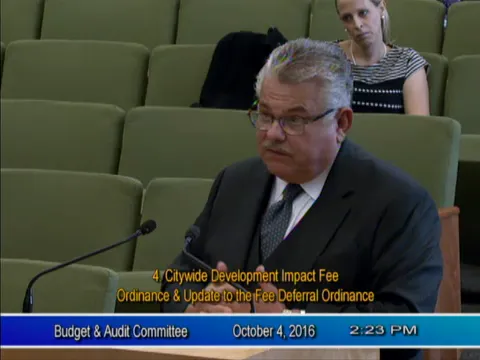
- Item 4 – Proposed Citywide Development Impact Fee Ordinance and Update to the Fee Deferral Ordinance: Ryan DeVore (Community Development Director), Lucinda Wilcox (Public Works), and Raymond Costantino (Parks and Recreation) presented the proposal. Key elements: streamlining fee administration, introducing a fee deferral program (from building permit to certificate of occupancy), promoting infill development, establishing localized infrastructure finance districts (65th Street, River District, Jacinto Creek), and adjusting park impact fees (reducing the neighborhood/community park level of service from 5 to 3.5 acres per thousand residents, adding a citywide park component, and creating an incentive zone with a 40% reduction in park fees). A new transportation development impact fee (TDIF) was proposed, set to take effect April 1, 2017. Staff noted that the fees are currently below the regional median and that the nexus study supports the increases. The schedule included forwarding to the Law and Legislation Committee and Planning and Design Commission on November 10, 2016, and to City Council on November 22, 2016. Councilmember Schenirer asked for a response to Mr. Thatch’s concerns by the November 10 meeting. The motion to forward the item passed 2-0-1 (Members Jennings and Schenirer yes, Member Warren abstained).
- Item 5 – City Auditor’s Audit of the Department of Utilities Labor Reporting: City Auditor Jorge Oseguera presented the audit, which reviewed labor reporting for calendar years 2013–2015. The audit identified four findings with 23 total recommendations: (1) lack of proper interfund reimbursements (e.g., $149,000 overpayment to Underground Service Alert program, $36,000 annual misallocation of a supervisor salary); (2) non-compliance with labor agreements (24 employees overpaid by $87,000, potential $48,000 annual savings from renegotiating out-of-class pay and overtime); (3) excessive system access controls leading to segregation-of-duties issues; (4) complex payroll codes and calculation methods not aligned with agreements or tax laws. The Department of Utilities agreed with the recommendations and funded an additional year of audit work for a top-down inventory audit. The committee voted 3-0 to accept the audit and forward it to City Council for final approval.
Key Outcomes
- Consent Calendar: Approved unanimously (3-0).
- Item 4 (Development Impact Fee): Motion passed 2-0-1 (Warren abstained) to forward the ordinance to the Law and Legislation Committee, Planning and Design Commission, and then to City Council. The schedule set November 10, 2016, for committee/commission reviews and November 22, 2016, for council approval. The effective date is February 1, 2017, except for the TDIF (April 1, 2017).
- Item 5 (Utilities Labor Audit): Motion passed 3-0 to accept the audit and forward to City Council. The auditor will conduct follow-up reviews every six months and report back to the committee.
- Introduction of New Auditors: Senior Auditor Chow Gao and Auditor Sean Arnold were introduced to the committee.
Meeting Transcript
Okay, okay. I want to welcome everybody to the City of Sacramento Budget and Audit Committee. Will the city clerk please take the roll? Yes, we'll start with Member Warren and Member Shaneer. I would be here. Okay, and Mayor Johnson. And then our our Vice Mayor Rick Jennings. I am here. We do have a quorum. If there's anyone in the audience that wishes to speak, please complete a speaker slip that's located in the back of the room. Turn it in to the assistant clerk at the front. If you have a cell phone, please turn it to the silent position. And I believe that that takes care of it. Welcome to our city manager. It's good to see you, sir. Thank you. Fantastic. All righty. We will move to our consent calendar. Okay, we have items one through three on the consent calendar, and I have no changes or corrections. Any speakers? No speakers. Okay. Item has been moved. Seconded by Member Warren. All in favor, say aye. Opposed, abstain. Let the record know we are unanimous. Okay. Discussion calendar item number four is the proposed citywide development impact fee ordinance and the update to the fee deferral ordinance. Mr. DeVore. Hello. Good to see you, sir. Good to see you. Screens are up. These are up. Good afternoon, Chair and members of the budget and audit committee. Ryan DeVore, Director of Community Development. I'm here to sit today to present to you an item on the citywide development impact fee program, which is something that we have been working on for more than three years. We had four primary goals with this effort. The first was to provide for a streamlined fee administration and incentives. You may have heard from some of your constituents that our fees are spread throughout the city code in many different sections. It's difficult to understand them. It's difficult to apply certain provisions consistently. So one of our primary goals was to ensure that the administration was streamlined, it was efficient, it was easy to use. And then secondly, the incentives. We want to introduce some incentives such as the fee deferral program. We'll go into more details on that and others in a few minutes to make development easier. Second, we want to promote in-field development and support priority neighborhoods.
openpublica.com