Sacramento Budget and Audit Committee Meeting – May 4, 2017
STREAMING COPY IN PREPARATION — RECORDING AVAILABLE FROM THE ORIGINAL SOURCE
Sacramento Budget and Audit Committee Meeting – May 4, 2017
The Budget and Audit Committee met on May 4, 2017, at 2:02 p.m. in City Hall Council Chamber. The committee reviewed the City Auditor’s Whistleblower Hotline Activity Report, the FY2017/18 Proposed Budget Overview, the Independent Budget Analyst’s High Level Review, and the annual Master Fee Schedule. All items were forwarded to the full City Council for further action. The meeting adjourned at 2:40 p.m.
Consent Calendar
- Item 1 – Approval of Meeting Minutes (March 7, 2017): Approved unanimously (3‑0, Jennings absent).
Public Comments & Testimony
- David Jenest spoke on multiple items. On the Whistleblower Hotline, he expressed concern that no tips were marked urgent or important and questioned whether the hotline allowed citizens to communicate with their elected representatives. On the Proposed Budget, he criticized the lack of community input before the budget was drafted and the failure to add dispatcher positions to the 911 center. During public comments on non‑agenda matters, he again urged the committee to fund 10 additional dispatcher positions, noting that a request from the communications center had not been brought to the council.
Discussion Items
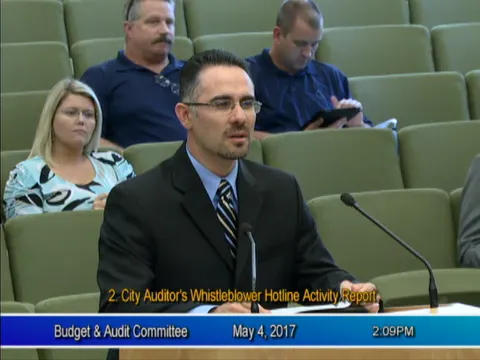
- Item 2 – City Auditor’s Whistleblower Hotline Activity Report: Auditor Jorge Oseguera reported 70 tips received during the six‑month period (October 2016 – March 2017), with 10 substantiated. Annual activity (160–170 tips) has been consistent. Committee member Ashby asked whether the auditor follows up on departmental corrective action; Oseguera said they do not currently report on confirmation but could do so. The committee accepted the report and forwarded it to the City Council (motion 3‑0).
- Item 4 – FY2017/18 Proposed Budget Overview: Budget Manager Dawn Holm presented a $1 billion budget, with the general fund at approximately $450 million (45% of total). The budget adds only $422,000 in ongoing general fund costs without fiscal offsets. General fund revenues are projected to grow 5% ($30 million) from the current year. Key challenges include CalPERS pension costs doubling over five years (from $78 million to $150 million) and the expiration of Measure U in March 2019, which could create a $55 million deficit by FY2020 without renewal. Mayor Steinberg emphasized that Measure U is effectively general fund money and called for a functional merger. He also highlighted the need for a dedicated discussion on PERS, marijuana revenue, and economic development hiring. Public commenter David Jenest criticized the lack of community input before the budget was drafted and the absence of new dispatcher positions. The committee received the overview and considered it for final budget adoption.
- Item 5 – Independent Budget Analyst’s High Level Review: IBA John Silva noted a $14 million general fund surplus and a 10.1% economic reserve (above the 10% goal). He presented charts showing structural deficits beginning in FY2018‑19, growing to $23 million by FY2022 if Measure U is not renewed. Silva indicated that the full review, due May 23, would include department‑by‑department analysis and revenue assumption checks. The committee forwarded the review to the City Council (motion 3‑0).
- Item 3 – FY2017/18 Master Fee Schedule: Jason Bader presented 186 fee changes (9 new, 176 modified, 1 eliminated) across seven departments, generating $121,000 in new general fund revenue and $85,000 for other funds. No controversial items were noted. The committee forwarded the fee schedule to the City Council (motion 3‑0).
Key Outcomes
- Whistleblower Hotline Report: Accepted and forwarded to City Council (3‑0).
- FY2017/18 Proposed Budget Overview: Received and considered for final budget adoption.
- IBA High Level Review: Forwarded to City Council as updated (3‑0).
- Master Fee Schedule: Forwarded to City Council for a public hearing (3‑0).
- Next Steps: The full City Council will hold a budget workshop on May 11 (at the Clunie Center), a public hearing on May 23 (including discussions on PERS, marijuana, and economic development), and final adoption on June 13.
Meeting Transcript
Good afternoon, everybody. Welcome to the budget and audit committee. Uh, please call the role. Let's establish a quorum. Okay, we'll start with Member Ashby. Here. Shaneer. Jennings. And our Chair Steinberg. We do have a quorum. Here, a quorum is established. We have a number of items today. Uh we have items one, two, and three, which are sort of related to the to the budget. Uh, but when we get to items four and five, we will begin really the process, the multi-week process of considering, debating, and ultimately passing uh the two thousand seventeen eighteen city budget. So let us begin with uh the consent calendar calendar in file item one. Do we have any public testimony? We do not. Any questions from members? If not, um uh take a motion by Councilmember Shineer, a second by Councilmember Ashby. Uh please call I'm sorry. There's nobody signed up on public comment. I am speaking. What's your name, sir? David Janae. David Janae, you signed up for file item two, which is the whistleblower item, not this item. I'm sorry, your honor. I thought it was talking to the calendar. No worries. Okay. So uh let's call the role to establish a unanimous roll call. Okay, member Ashby. Yes. Shineer. Jennings. And Chair Steinberg. Hi. It's three to nothing. That'll serve as our unanimous roll call. Okay. Uh now we move to file item two. Let's get uh a presentation first, and then uh we will take the public testimony. I'm Jorge Sageta, your city auditor. The recommendation that is before you is to accept the city auditors whistleblower hotline activity report and to pass a motion forwarding the report to the city council for final approval. Given the items that are scheduled to be discussed today, I will be brief in my presentation. This report covers the six-month period of October two thousand and sixteenth to March of two thousand and seventeen. As shown in exhibit one, quarterly call volumes vary. However, annual activity has been relatively consistent over the last three years, ranging from 160 to about 170 tips per year. Due to the complexity of some of the investigations and my office's limited resources, the timeliness of some of our performance audits may be negatively affected by the investigation workload. During this reporting period, we received 70 tips. Of those 10 tips were substantiated and submitted for further consideration and corrective action.
openpublica.com