Budget and Audit Committee Special Meeting: Medical Marijuana Dispensaries Audit - October 3, 2017
STREAMING COPY IN PREPARATION — RECORDING AVAILABLE FROM THE ORIGINAL SOURCE
Budget and Audit Committee Special Meeting: Medical Marijuana Dispensaries Audit - October 3, 2017
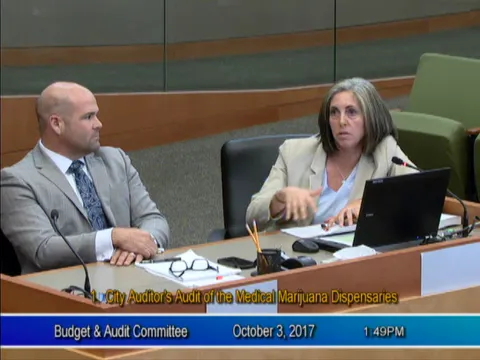
The Budget and Audit Committee met in a special session on Tuesday, October 3, 2017, at 1:00 p.m. in the City Hall Council Chamber to review and discuss the City Auditor's audit of medical marijuana dispensaries. The meeting included public testimony, extensive committee deliberation, and a unanimous vote to accept the audit and forward it to the full City Council as a discussion item.
Public Comments & Testimony
- Michael Hawkins (registered lobbyist for All About Wellness): Expressed the client's unhappiness with the audit and the auditor's conduct. He argued that the auditor arrived unannounced with an armed police officer, which intimidated patients, and claimed the auditor refused a reasonable offer for inspection. Hawkins stated that All About Wellness has paid $1.3 million in fees and taxes over seven years and operates as an honest business. He also defended the revenue department, calling the report harsh on staff.
- Lanette Davies: Welcomed the audit as overdue but criticized the city for failing to use the $12,600 per month per dispensary (totaling $378,000 annually) for enforcement. She suggested the city should examine its own departments' roles in enforcement failures, citing a code enforcement officer who told her the revenue department had authorized certain non-compliant activities.
Discussion Items
- City Auditor's Presentation: Auditor Jorge Oseguera presented findings from the audit of 30 dispensaries. Key points:
- Many dispensaries did not provide requested financial records within 24 hours as required, hindering analysis.
- Using observational techniques, the auditor estimated that one dispensary (Dispensary A) may have underreported gross receipts by approximately $643,000 vs. $273,000 reported, equating to a potential underpayment of $176,000 per year in taxes.
- Missing data in the city's BOT tracking system (Bislink) obscured revenue issues; after adjustments, an apparent overpayment was corrected to show a $7,000 underpayment.
- Site inspections found that none of the six sampled dispensaries were in full compliance. Observed violations included sales to a patient with an expired recommendation, employee consumption on site, and selling over 50 marijuana plants to a single patient (exceeding state guidelines of 12 immature plants).
- One dispensary (All About Wellness) refused access to auditors on three occasions, though it had allowed other city staff access.
- Staff Response: Joe Devlin, Office of Cannabis Policy and Enforcement, thanked the auditor and noted that the city is a leader in cannabis regulation. He stated that the audit comes at a good time as the office builds enforcement capabilities, and that many recommendations are already being implemented, including enforcement checklists, improved record-keeping, and permitting standards.
- Committee Deliberation:
- Councilmember Schenirer: Commended the audit, emphasized the need for accountability, and motioned to accept the report and forward it to council.
- Councilmember Ashby: Expressed deep concern about insufficient regulation, cited the auditor's independence, questioned potential interference by city staff, and asked the city manager to clarify staff interactions with the auditor. She also proposed a ballot measure to make the auditor a charter officer and fold in the Independent Budget Analyst's office. She requested the item go to council as a discussion, not consent.
- Mayor Steinberg: Praised the auditor's independence but agreed broader strategic planning is needed. He advocated for regular audits (every three years) and a strategic plan to address enforcement, revenue tracking, and community impacts. He supported using outside resources for cannabis enforcement planning.
- City Manager Howard Chan: Clarified that staff interactions with the auditor are normal coordination and not interference. He committed to bringing an enforcement plan to council on October 31 and discussed the challenge of finding specialized auditing firms.
Key Outcomes
- Motion: Councilmember Schenirer moved to accept the City Auditor's Audit of the Medical Marijuana Dispensaries and forward it to the City Council. Councilmember Ashby seconded, with the amendment that it go to council as a discussion item (not consent). The motion passed unanimously (4-0), with members Ashby, Jennings, Schenirer, and Steinberg voting yes. Mayor Steinberg arrived at 1:16 p.m., after the meeting began.
- Committee Comments: Councilmember Ashby suggested exploring a ballot measure to enhance auditor independence and resources. Mayor Steinberg called for a strategic plan covering cannabis enforcement resources, staffing, and community outreach.
- Next Steps: The City Manager will present an enforcement plan for illegal cannabis and legal dispensaries at the October 31 council meeting. The audit will be considered by the full City Council as a discussion item at a future date.
Meeting Transcript
I want to thank you and welcome you to the budget and audit committee meeting. Uh will the city clerk please call the roll. Councilmember Ashby here. Councilmember Shaneer. Vice Mayor Jennings. Here. We expect the mayor momentarily. Okay. But we have a quorum. Correct. Okay, our first agenda item, please. No, we're going to start. We have a quorum, and the mayor would like for us to start. He'll be here shortly. Good to see you. Good to see you as well. Good afternoon, members of the budget and audit committee. My name is Jorge Osagueta, and I'm your city auditor. With me today is Lynn Bashaw and Chow Gao, who were primarily responsible for completing the audit. The recommendation that is before you is that you accept the auditor's audit of the city's medical marijuana dispensaries and to forward this to the full city council for final approval. The objective of the audit of the city's medical marijuana dispensaries was to assess the controls surrounding the operations of the dispensaries and to identify areas of risk and opportunities for improvement. Our scope included a review of medical marijuana dispensary permit applications, business operation tax, and site observations. Registration, phase one, and phase two. This process ended up taking several years to complete due to uncertainty in federal marijuana laws. In order to assess whether the dispensaries were in compliance with city code, we requested that dispensaries provide their financial and membership records to help identify instances of under-reporting of gross receipts and to obtain reasonable assurance that the medical marijuana dispensaries were obtaining and distributing only to their members. City code requires that the dispensaries provide the information we requested within 24 hours. The figure shows that the dispensaries did not provide us with all requested documents. As a result, we were unable to perform our analysis of the selected dispensaries' financial records. Dispensaries in the in this area provided their own financial documents, may identify instances of underreporting of gross receipts. In addition, we were unable to assess if the dispensaries are acquiring and distributing only to their members. To develop our methodology for testing of gross receipts, we reviewed the IRS cash-intensive business audit techniques and contacted auditors from Muni services and the California Board of Equalization that have performed marijuana audits. Based on the BOE's methodology disclosed in a sales and use tax appeals hearing of marijuana dispensaries, the agency obtained the average sales per customer from a dispensary and determined the average sales per hour by observing the people entering and leaving the dispensary for four hours. The BOE then multiplied the average sale per customer and the average sale per hour to obtain the taxable sales per hour. This data is extrapolated to obtain the annual taxable sales. While this methodology appeared reasonable, we acknowledge that it is possible for dispensaries to provide inaccurate average sales per customer amounts. As a result, we obtained more accurate sales per customer information as we observed and recorded the actual dispensary sales transactions for 10 to 12 hours and used this information to estimate the expected gross receipts. To assess if the dispensaries are reporting their gross receipts accurately to the city, we performed observations at four different dispensaries and recorded the sales transactions. The figures show the comparison between our estimates and the average self-reporting gross receipts for the four dispensaries. Based on our estimates, we would expect dispensary A to have reported approximately $643,000 in gross receipts. However, it has been reporting approximately $273,000. If our estimates were used to calculate the tax, dispensary A may be under-reporting to the city by approximately $14,000 per month or approximately $176,000 per year. Our estimate for the other three dispensaries were slightly higher than what they reported to the city, which is consistent with our intent to be conservative in our estimate. We reviewed the revenue division's BOT records to assess if the department is accurately accounting for BOT amounts owed and BOT payments collected. This data was extracted from Bislink, which records the self-reported gross receipts and payments. We found gaps or missing gross receipt data, which caused Bislink to register no BOT for certain months. This caused the appearance of a BOT overpayment. However, by adjusting for the missing gross receipts, we found that the underpayment was non-existent. The figure shows the unadjusted data or missing gross receipts on the left and the adjusted gross receipts on the right. With the unadjusted data, it appears that dispensary A overpaid the city by approximately $96,000. However, based on our adjusted estimate, this would correct the information to reflect an uh underpayment of approximately $7,000.
openpublica.com