Budget and Audit Committee Meeting - September 4, 2018
STREAMING COPY IN PREPARATION — RECORDING AVAILABLE FROM THE ORIGINAL SOURCE
Budget and Audit Committee Meeting - September 4, 2018
The Budget and Audit Committee met on Tuesday, September 4, 2018, at 2:00 p.m. in the City Hall Council Chamber. The meeting was chaired by Mayor Darrell Steinberg, with members Rick Jennings and Jay Schenirer present (Angelique Ashby absent). The committee approved the consent calendar, forwarded proposed cannabis distribution business fees to the City Council, and received and filed the Sacramento Housing and Redevelopment Agency (SHRA) mid-year budget overview and the 2017 Comprehensive Annual Financial Report (CAFR). The meeting adjourned at 2:34 p.m.
Consent Calendar
- Item 1 – Meeting Minutes: The committee approved the minutes from the May 29, June 12, and June 26, 2018, Budget and Audit Committee meetings by a 3-0 vote.
Public Comments & Testimony
- No public comments were heard on matters not on the agenda. However, near the end of the meeting, Jeffery Tardaguila requested to speak but was directed by the Mayor to return for the evening City Council session. (Note: The agenda listed a public comment from Mr. Tardaguila under Item 4, but the minutes state no public comments were taken. The transcript indicates his comment was deferred.)
Discussion Items
- Item 2 – Proposed Business Operating Permit Fees for Cannabis Distribution Businesses: Joe Devlin, Chief of the Office of Cannabis Policy and Enforcement, presented the proposed fee schedule. The fees range from $9,000 to $30,000 per permit, based on gross receipts, and are intended to be cost-recovery for enforcement of both regulated and illicit markets. The city collected $3.7 million in cannabis tax revenue in the prior fiscal year, and non-dispensary cannabis tax revenue for the first half of the current fiscal year was approximately $800,000. The committee forwarded the fee schedule to the full City Council for adoption (motion by Schenirer, second by Jennings; vote 3-0).
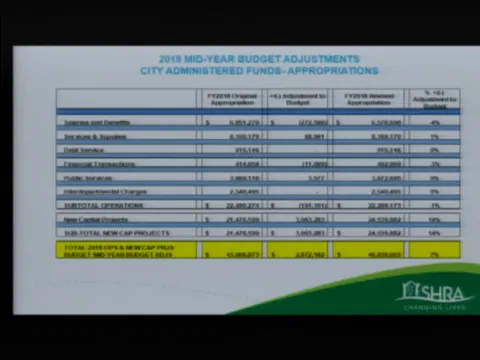
- Item 3 – SHRA 2018 Mid-Year Budget Overview: Russell Robertson, SHRA Director of Finance, presented the mid-year budget. The original 2018 budget was $190 million, with 84% ($160 million) from federal sources. The largest expenditure was housing assistance payments (53% of total). The agency’s funding sources are independent of the city or county general fund. Revised appropriations through June increased by $2.9 million (7%) to $47 million for city-administered funds, driven by $3 million in additional capital project grants. The committee received and filed the report.
- Item 4 – SHRA Comprehensive Annual Financial Report (CAFR) for the Year Ended December 31, 2017: Robertson also presented the CAFR, noting that the agency received an unmodified (clean) audit opinion for the 26th consecutive year. The agency earned the Certificate of Achievement for Excellence in Financial Reporting from the Government Finance Officers Association. The committee received and filed the report.
Key Outcomes
- Approved Minutes: Consent calendar (Item 1) approved 3-0.
- Forwarded Cannabis Fees: The committee voted 3-0 to forward the proposed cannabis distribution business permit fees to the City Council for adoption.
- Received and Filed Reports: The SHRA mid-year budget overview (Item 3) and the 2017 CAFR (Item 4) were received and filed.
- Committee Request for Housing Trust Fund Reconciliation: During discussion of the SHRA budget, members noted a discrepancy between the $8.83 million in city housing trust funds shown in the budget and the previously cited unencumbered balance of approximately $2.5 million. The committee requested that SHRA provide a reconciliation showing encumbered vs. unencumbered balances, project by project, and that future budget presentations clearly delineate these amounts. The committee also requested that such information come before the Budget and Audit Committee before being presented to the full City Council.
Meeting Transcript
Ephraim, can we have a gavel, please? No, I don't need one. I take that back. Thank you. Good afternoon, everyone. The City Council committee, budget and audit committee will uh please come to order. Uh let's call the roll and establish a quorum. Councilmember Jennings. Here. Councilmember Shineer. Mayor Steinberg? Here. And for the record, Councilmember Shink Bullab to be absent today. Okay. Thank you very much. We do have some important but I hope brief uh items here on the agenda. I think uh item one is approval of the last committee uh minutes if we moved second. Moved and seconded. All in favor, please say aye. Aye, opposed abstain. That measure passes three to nothing. We now have the proposed business operating permit fees for cannabis distribution businesses. Mr. Devlin. Welcome to you, sir. Good afternoon, Mr. Mayor, members of the committee. Um Joseph Devlin with your Office of Cannabis Policy and Enforcement. Always happy to be here with an item that doesn't draw a mass of people. Today's item is really the establishment of the distribution fees. Um if you recall on August 9th, we amended the city's distribution permit to be based on on gross receipts. And this item establishes those permit fees uh for those gross receipts. Um the permits range from 9,000 to uh $30,000 in nature and uh gets us closer to mirroring what the state has. So if there are any questions for it, if you is about is you as you recall, distribution is that middle um uh business sector that performs um the testing and tax collection tax collection uh for the cannabis industry here in Sacramento and is vitally important. Mr. Devlin, just in terms of the big picture, uh this fee schedule does what in terms of cost recovery for the program and or uh uh quote additional dollars for enforcement related activities. Put it into context for us, please. So our permit fees uh are intended to be uh cost recovery in nature. We have built in um uh enforcement of both the regulated and illicit markets into our permit fee schedule. Um these fees will go towards ensuring that there's compliance again within the the legal cannabis industry as well as um revenue for uh illicit enforcement as well. So we don't make any more money. We don't make any more money, but are they sufficient to uh allow us to not have to borrow or grant resources from our general fund to pay for the cost of the program? So this year, last fiscal year we collected $3.7 million in in revenues. I went over in the workshop. Um because there's a going to be a time delay in the issuance of our business operating permits, we will have a an operating um permit operating deficit um in in this current fiscal year until it normalizes in we will catch up. And then of course, by um by adding the distribution uh business to our city regulated cannabis industry, we hope to attain significant tax revenue uh over time, correct? Well, that certainly is um uh an ancillary benefit of a healthy. It ain't ancillary to me. And I don't think to the the to the kids who want us to expand our pool hours and library hours and park hours and all the other things that come with increased revenue. Cannabis business uh operating tax revenue uh is up from the year over.
openpublica.com