Budget and Audit Committee Meeting - March 5, 2019: Parking Meter Audit and FY2019/20 Workplan Approved
STREAMING COPY IN PREPARATION — RECORDING AVAILABLE FROM THE ORIGINAL SOURCE
Budget and Audit Committee Meeting - March 5, 2019
The Sacramento City Council, sitting as the Budget and Audit Committee, met on March 5, 2019, at 3:00 PM in City Hall. Vice Mayor Eric Guerra chaired the meeting in the absence of Mayor Darrell Steinberg and Councilmember Angelique Ashby. The committee approved the consent calendar, accepted an audit of on-street parking meters, and approved the City Auditor’s proposed workplan for Fiscal Year 2019/20. All actions were forwarded to the full City Council for final approval.
Consent Calendar
- Approved the minutes of the December 4, 2018 and January 29, 2019 Budget and Audit Committee meetings.
- Accepted the Fiscal Year 2017/18 Transportation Development Act Fund Audited Financial Statements and Compliance Report for forwarding to City Council.
- Accepted the City Auditor’s Activity Report for the 2nd Quarter of Fiscal Year 2018/19 for forwarding to City Council.
- All items were passed by a single motion without discussion.
Public Comments & Testimony
- Mac Worthy spoke on Item 4 (parking meter audit) and Item 5 (auditor’s workplan). He expressed concerns about the arena parking revenue, the city’s transparency, and the prevalence of nonprofit organizations. He urged audits of the arena and nonprofit funding, and called for greater accountability. No other public testimony was offered.
Discussion Items
-
Item 4: City Auditor’s Audit of On-Street Parking Meters – City Auditor Jorge Oseguera presented findings from a follow-up audit. Key findings included:
- Vehicle detection sensors had an accuracy rate of 83.5%, below the contracted rate of 95%.
- Low batteries caused cyclical reliability issues impacting revenue and customer service.
- Nearly 87% of failed mobile payment transactions in the sample period were from meters in event zone B, due to a configuration change.
- Data management system entries were inconsistent, hindering analysis.
- 60% of metered spaces near the Capitol along I Street were occupied by vehicles displaying disabled placards, limiting the city’s ability to manage parking turnover.
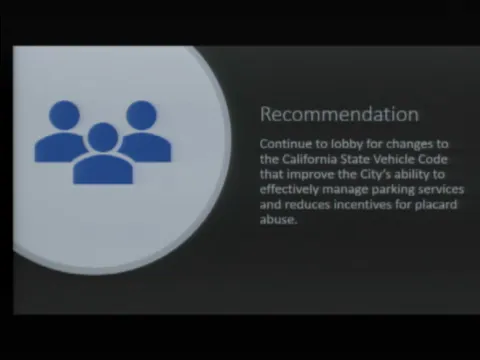
- Recommendations included working with vendors, improving data entry, and lobbying for state law changes to allow better regulation of disabled parking.
- Councilmember Steve Hansen, who requested the audit, thanked staff for a collaborative process and noted that most issues were already resolved. Councilmember Jeff Harris praised the audit’s value.
- A motion to accept the audit and forward it to City Council passed unanimously.
-
Item 5: City Auditor’s Proposed Workplan for Fiscal Year 2019/20 – Oseguera introduced new staff and listed audits in progress (retiree benefits, 911 emergency communications, city-owned lease property, Department of Utilities vehicle fleet) and proposed audits (code enforcement, animal care, recycling/solid waste, fire EMS, IT, green efforts, public works maintenance, police investigations, and youth parks and community enrichment). The Research and Analysis Division’s projects included a citywide innovation assessment, citizen survey, diversity assessment, storm drainage fund review, revenue risk assessment, ethics commission assessment, police review commission review, and a financial condition analysis.
- Councilmember Harris suggested prioritizing the EMS audit over animal control services.
- A motion to accept the workplan and forward to City Council passed unanimously.
Key Outcomes
- Consent Calendar (Items 1-3): Approved by a 7-0 vote (Councilmembers Ashby and Mayor Steinberg absent).
- Item 4 (Parking Meter Audit): Motion passed 7-0 to accept the audit and forward to City Council.
- Item 5 (FY2019/20 Workplan): Motion passed 7-0 to accept the workplan and forward to City Council.
- The meeting adjourned at 3:25 PM (with a closed session scheduled for 3:30 PM).
Meeting Transcript
We're gonna call this uh budget and audit committee to order on uh Tuesday, March fifth at three oh one p.m. If the clerk please call the roll. Councilmember Hansen. Here. Councilmember Jennings, Councilmember Carr, Councilmember Shaneer and Vice Mayor Guiara. Here. Councilmember Harris. Very good. All right, we'll uh we'll kind of move through this pretty quickly. Uh we've got uh items on the consent calendar one through three. I'll move it. We got a motion by motion and a second. Uh any discussion on the consent calendar. Do we have any public comment on the consent calendar? No comments from the public or the board or the dais. Uh, all those in favor, please signify by saying aye. All those opposed. Okay, consent calendar passes. We'll move on to discussion item number uh four. Our auditor. Um the audit of on street parking meters is a follow-up to our preliminary assessment of on street parking meters. The recommendation that is before you is that you pass a motion accepting the city auditor's audit of on street parking meters and forward it to the full city council for final approval. The city of Sacramento has been going through a modernization effort, which began in the mid uh two thousand and twelve, in which they upgraded approximately forty-five hundred parking meters so that they would be considered smart parking meters. These smart parking meters now accept credit card payments, they're solid-powered, they have pay-by-phone capabilities, and they have vehicle detention sensors. However, with the changes in technology also comes a learning curve and the potential for errors. Many of the single space parking meters are equipped with vehicle detection sensors that use radar to detect vehicles in the parking spaces. When we evaluated these sensors, we found that vehicle detention sensors fell short of the contracted accuracy rates, that low batteries may negatively impact the revenue and customer service experience, and that the number of incoming disputed citations could be slowed by improving the reliability of meter technology. In conducting our testing, we looked at over 400 parking meters and found that the accuracy rate was approximately 83.5% for the sensors. This is in contrast to the contract accuracy rate, which was 95%. In an effort to reduce the chances of issuing an erroneous citation due to sensor issues, the parking division instituted a double blink function on the meters that tells enforcement officers when a meter has reset itself. This was done in an effort to try to reduce the possibility of an erroneous citation being issued. This figure shows the number of meters that reported a critical battery each day from January 2017 to August of 2018. As you can see by this graphic, there appears to be a bit of a cyclical pattern to the number of reported critical battery issues. And as a result, that impacts our ability to manage these parking meters. Of course, if we're able to improve upon the reliability of these batteries, that would improve upon our ability to manage and receive revenue from our parking meters. With the goal of improving customer service experience and reducing the number of incoming disputed citations. It is important to note that the payments were successfully recorded in the data management system. What we are referring to here is the meters not reflecting the acceptance of the payments. The parking services division determined in October 2017 that a change to some of its meter configurations to allow for event pricing in event zone B prevented those meters from receiving mobile payment signals. As a result, nearly 87% of the failed transactions in our sample period were from meters located in event zone B. In order to reduce the chance of erroneous citations being issued, enforcement officers call dispatch to verify if a mobile payment was made prior to issuing a ticket. We recommend that they continue to work with the vendor to ensure consistent customer service experience when using our mobile payment app. Our third finding was that some meter configurations in the data management system user interface are not reliable. We recommend that the parking division work with the vendor to ensure that the information in the data management system is accurate and up to date. As shown in this graphic, uh we have gone from uh data which has uh very limited number of ways of describing the potential issue related to the contested citation to one that has much greater detail. By having the greater detail, this affords us an opportunity to identify and pinpoint potential areas of concern so that those areas can be addressed. We made recommendations to require enforcement officers to enter citation data in a consistent format to aid in data aggregation and analysis to continue to optimize the data fields and to conduct regular review of citation data to identify trends and correct anomalies. Our last finding, finding five, is that the prevalence of disabled parking placards may have an adverse effect on the availability of disabled parking spaces and the city's ability to effectively regulate parking through demand-based pricing. State law per uh permits those with disabled parking placards to park at metered spaces for free for an unlimited amount of time. During our field research, we noted a striking number of disabled placking uh disabled placards in use in the downtown core.
openpublica.com