Budget and Audit Committee Special Meeting on FY2019/20 Proposed Budget, April 30, 2019
STREAMING COPY IN PREPARATION — RECORDING AVAILABLE FROM THE ORIGINAL SOURCE
Budget and Audit Committee Special Meeting – April 30, 2019
The Sacramento City Council, sitting as the Budget and Audit Committee, held a special meeting on April 30, 2019, from 2:00 p.m. to 5:24 p.m. to review the City Auditor’s reports, the FY2019/20 Proposed Budget, and the Master Fee Schedule. The meeting featured a major policy address by Mayor Darrell Steinberg proposing to separate the second half‑cent of Measure U revenue into a dedicated inclusive economic development fund and to securitize $25 million annually for 25 years to create a capital equity fund. Over 25 members of the public testified, with strong advocacy for arts funding, child care, affordable housing, and neighborhood investments. Council members expressed diverse views on the mayor’s proposal, and the committee took the following actions.
Consent Calendar
- Item 1 – City Auditor’s Activity Report for the 3rd Quarter of FY 2018/19 (File ID: 2019-00539): Accepted unanimously and forwarded to City Council for final approval. The report reviewed audit activities and findings for the quarter.
Discussion Items
-
Item 2 – City Auditor’s Whistleblower Hotline Activity Report (October 2018–March 2019) (File ID: 2019-00540): City Auditor Jorge Oseguera reported that the hotline has received over 1,000 tips since inception, with an estimated benefit of over $1 million. During the reporting period, 69 cases were closed, five substantiated: two involved speeding by city employees, one involved sick leave abuse by a fire employee, one involved overloaded solid waste trucks, and one involved supplemental employment arrangements by the Sacramento Police Department (SPD). SPD Deputy Chief Kathy Lester stated that the department had already corrected the matter by increasing contractual rates and is collaborating to explore state law amendments. The report was accepted and forwarded to City Council (motion by Schenirer, seconded by Harris; passed unanimously with 7 yes, absent Eric Guerra and Allen Warren).
-
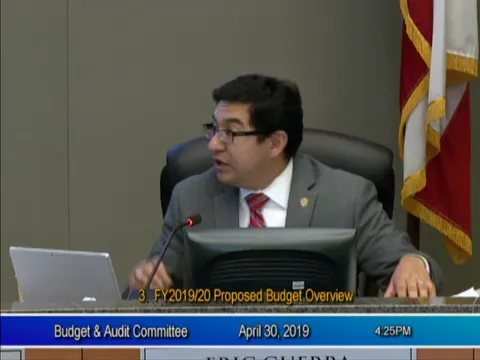
Item 3 – FY2019/20 Proposed Budget Overview (File ID: 2019-00505): City Manager Howard Chan presented a balanced $1.2 billion budget (6% increase from FY 2018/19) that includes Measure U revenue (full cent, projected $97 million annually), $23.5 million in new augmentations, and 162 new positions across general and Measure U funds. Mayor Steinberg delivered a statement urging the committee to remove the second half‑cent from the general fund and place it in an inclusive economic development fund, proposing to securitize $25 million/year for 25 years to create a $400 million capital equity fund. He argued that without such action, the budget’s five‑year forecast shows that pension obligations ($39 million by 2025) and labor costs ($15–20 million/year from FY 2021) will consume all new revenues, leaving no sustainable funding for core services or economic equity. No motion was made on the item; it will be forwarded to the full City Council without a recommendation.
-
Item 4 – FY2019/20 Master Fee Schedule (File ID: 201-00511): The committee reviewed proposed adjustments to citywide fees and charges and forwarded them to the City Council for a public hearing (motion by Schenirer, seconded by Hansen; passed unanimously).
Public Comments & Testimony
Multiple speakers addressed the committee on Item 3. Key themes included:
- Child care: Kate Karpilow and Nolice Edwards (Women and Girls Advancement Coalition) requested a full‑time child care coordinator and inclusion of child care as a foundational economic development priority.
- Arts and creative economy: Over a dozen speakers (e.g., Dan Brunner, Stacey Shelnut-Hendrick, Linda Beech Cutler, Dr. L. Stephen Winlock, Liv Moe, Shira Lane, Gail Hart, Chet Hewitt) urged funding at least $2.2 million for the Creative Edge Cultural Plan, noting that arts contribute $800 billion annually to the U.S. economy and that the arts sector grows faster than the overall economy (4.2% vs. 2.2% annual growth). Several speakers highlighted that Sacramento’s arts funding ranks dismally low compared to peer cities.
- Neighborhood investment: Mervin Brookins, Kevin Daniel, and others asked the council to keep promises to historically underserved communities (Del Paso Heights, Oak Park, Meadowview) by dedicating Measure U funds to inclusive economic development.
- Public safety: Timothy Davis (SPOA president) supported the city manager’s proposed budget but warned against securitizing revenues, calling it “dangerous” and potentially crippling the city during downturns. He noted that the police department has only 530 filled officer positions out of 740 authorized.
- Other: Fabrizio Sasso (Sacramento Central Labor Council) cautioned against outsourcing and urged a thoughtful plan before committing funds; Pat Fong Kushida (Asian Pacific Chamber) and Richard Dana (Sierra Health Foundation) emphasized the need for long‑term capacity building in low‑income neighborhoods.
Key Outcomes
- Item 2 (Whistleblower Report): Approved unanimously and forwarded to City Council.
- Item 3 (Budget Overview): No committee motion; forwarded to City Council without a recommendation. Mayor Steinberg’s proposal to separate the second half‑cent of Measure U will be discussed further at upcoming hearings (May 14, May 21, June 4, and June 11).
- Item 4 (Master Fee Schedule): Approved and forwarded to City Council for a public hearing.
- The committee scheduled additional budget hearings for May 14, May 21 (two sessions), June 4, and June 11 (target adoption date).
- Council members expressed openness to examining alternative strategies to the mayor’s securitization proposal, including pay‑go approaches, leveraging downtown revitalization corps models, and exploring multi‑year project commitments. The legality of securitizing Measure U revenue remains under discussion with the City Attorney and Treasurer.
Meeting Transcript
Good afternoon, everyone. The City Council's budget and audit committee. We will please come to order. This is a committee of the whole. Would the current clerk please call the roll and establish a quorum? Councilmember Harris. Councilmember Hansen. Councilmember Carr. Councilmember Jennings. Councilmember Shaneer. And Mayor Steinberg. Here. Let us all rise, please, and uh I would ask Councilmember Hansen lead us in the Pledge of Allegiance. And to the Republic for which it stands one nation under God, indivisible with liberty and justice for all. I want to uh welcome all of the members of the public and say just how happy and gratified I am to see so many people in the audience for a budget hearing. Doesn't that doesn't always happen, and I think it speaks to the importance of the issues that we will be discussing here, not just today, but over the weeks, months, and the years ahead when it comes to our city budget. Um we do have a consent calendar. And then we are going to get into the whistleblower report. Okay, we'll do that briefly if we can, because I want to get to the main item here today. But let's take the consent calendar. Is there any question? Is there any public testimony on the consent calendar? Moved and seconded. All in favor, please say aye. Aye, oppose, abstain. That passes unanimously. Now we go to item two, which is city auditors whistleblower hotline activity. And again, um, we want to get to the proposed budget overview. So welcome. You kind of took the wind out of my sail. I thought all these people had shown up for the whistleblower hotline. Very good. I guess if it's for budget, it's for the budget. I'll try to be brief. So good afternoon, Mayor and members of the budget and audit committee. My name is Jorge Osagueta. I'm your city auditor. The recommendation that is before you is that you accept the city auditor's whistleblower hotline activity report for the period of March 2019. Uh for the period of October 2018 through March of 2019, and to forward the full report to the City Council. Since establishing the whistleblower hotline, the city has received over a thousand uh tips and has uh an estimated benefit of over a million dollars. During the most recent six-month period, we closed 69 cases, of which five were substantiated. Two of the substantiated cases involved speeding by city employees, one involved sick leave abuse by a fire employee, one involved overloaded solid waste trucks, and one involved supplemental employment arrangements by the Sacramento Police Department. In regards to the Sacramento Police Department, uh that's the one that I wanted to spend a little bit of time on. Uh we were able to look at this issue, and while this activity generally is allowable under California law, we substantiated that several of the police department's practices under this program appear to violate the state government code specifically. The police department regularly enters into long-term contracts to provide continuous ongoing services at private businesses while the government code appears to allow contracts with private entities or individuals only for special events or on an occasional basis. Very good. Good afternoon, Mayor and Council, City Manager. Um I'm Kathy Lester, I'm a deputy chief with the police department, and I'm here really to provide a progress report very quickly and an update on what we're doing uh to address this issue that was identified by the city auditor. I also like to thank the city auditor for really the work on this topic because it's fairly complex. Uh like most law enforcement agencies in the state, SAC PD allows its officers to engage in supplemental or auxiliary employment that can take the form of either overtime work or off-duty work.
openpublica.com