Sacramento Budget and Audit Committee Special Meeting - June 4, 2019
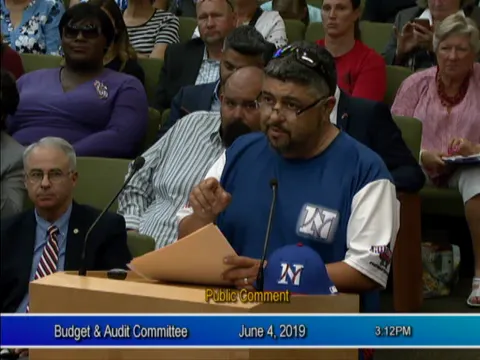
STREAMING COPY IN PREPARATION — RECORDING AVAILABLE FROM THE ORIGINAL SOURCE
Sacramento Budget and Audit Committee Special Meeting - June 4, 2019
On June 4, 2019, the Sacramento City Council, sitting as the Budget and Audit Committee, held a special meeting to consider the adoption of the Inclusive Economic Development Framework and Mayor/Council Budget Priorities for FY2019/20, the FY2019/20 Operating Budget and 2019-2024 Capital Improvement Program, and an audit of the Department of Utilities Vehicle Fleet. The meeting featured extensive public testimony from 106 speakers, spanning over three hours, and culminated in a split vote on the budget priorities and a unanimous vote to forward the operating budget. The audit item was continued to a future meeting. The committee also recognized Sutterville Elementary School for winning the Greg Purcell Trophy basketball championship.
Public Comments & Testimony
- 106 speakers addressed the committee, with each speaker limited to one minute. The majority of speakers supported projects in the mayor's budget memo, while a significant number from Districts 1 and 3 (North Natomas, South Natomas, Gardenland, Northgate) expressed strong opposition to the exclusion of their communities from the proposed priorities.
- Supporters included representatives from the North Sacramento Community Development Corporation, Friends of the Sacramento River Parkway, Sacramento City Unified School District, Twin Rivers Unified School District, Sacramento Regional Transit, Youth Forward, Parks and Community Enrichment Commission, Fairytale Town, Sacramento Housing Alliance, Mutual Housing California, Sacramento LGBT Community Center, Sacramento Metropolitan Chamber of Commerce, Greater Sacramento Urban League, and many others. They praised investments in youth programs, free transit passes, parks, arts, climate commission, childcare manager, and the LGBT center relocation.
- Opponents and those seeking inclusion included residents and community leaders from North Natomas (Natomas Aquatic Center), Gardenland-Northgate, and South Natomas. They argued that the mayor's budget priorities left out approximately 120,000 residents (Districts 1 and 3) and that projects like the Natomas Aquatic Center (68% privately funded), Northgate Boulevard improvements, and the Garden Arts Center were shovel-ready and deserved immediate funding. Speakers noted the 90-day bid deadline for the aquatic center and the risk of losing $3 million already spent on planning.
- Several speakers urged the city to authorize bonds for affordable housing, citing the urgent need for safe, affordable homes.
Discussion Items
1. Adoption of the Inclusive Economic Development Framework and Mayor/Council Budget Priorities (Item 1) Mayor Darrell Steinberg presented the framework, emphasizing that the budget sets aside $40 million annually for five years for inclusive economic development, with $16 million in immediate projects. He stated that no projects were removed from the city manager's proposed budget and that the list focused on "early wins" under $2 million. He acknowledged the exclusion of large capital projects like the North Natomas Aquatic Center and libraries but committed to working with the community to fund them through future bond revenues and the investment committee process.
Councilmember Steve Hansen moved the item, offering a commitment to work with Districts 1 and 3 to bring back a funding plan for the aquatic center within 90 days and to develop a Northgate package. Councilmember Jeff Harris offered a substitute motion to abandon the mayor's priorities, direct the city manager to bring back a list of time-sensitive projects only, and require all other projects to be vetted by the Measure U Community Advisory Committee. The substitute motion failed 3-6 (Ashby, Carr, Harris in favor; Guerra, Hansen, Jennings, Schenirer, Warren, Steinberg opposed).
Councilmembers debated the process. Councilmember Jay Schenirer supported the mayor's approach as a balance between immediate wins and honoring the Measure U advisory process. Councilmember Allen Warren noted that District 2 received the most funding but still needs more. Councilmember Rick Jennings expressed discomfort with pitting projects against each other and called for better policy and process. Councilmember Larry Carr seconded the substitute motion, arguing that only time-sensitive items should be approved now and others should go through the Measure U committee.
After the substitute motion failed, the main motion passed 8-1 (Harris opposed).
2. Adoption of the FY2019/20 Operating Budget and 2019-2024 Capital Improvement Program (Item 2) Dawn Holm, Finance Director, presented the updated financial model incorporating the mayor's priorities and Councilmember Hansen's alternative proposal. The model includes $40 million for inclusive economic development, funded by $7.5 million for debt service on a capital investment program, $15.5 million for the mayor/council priorities, and the remainder from the city manager's base budget. The item was moved and seconded, and passed unanimously (9-0).
3. Audit of the Department of Utilities Vehicle Fleet (Item 3) Item was continued to the next Budget and Audit Committee meeting without discussion.
Key Outcomes
- Item 1 (Budget Priorities): Passed 8-1 (Harris opposed). The motion approved the Inclusive Economic Development Framework and Mayor/Council Budget Priorities, transmitting them to the City Manager as direction for the FY2019/20 Budget. The motion included direction to staff to return within 90 days with a funding plan for the North Natomas Aquatic Center and to work on a Northgate improvement package.
- Item 2 (Operating Budget and CIP): Passed unanimously (9-0). The motion forwarded the FY2019/20 Proposed Budget, the 2019-2024 Capital Improvement Program, the proposed General/Measure U Fund Economic Uncertainty Reserve Policy, and rescinded the Measure U Financial Management Policy to the City Council for consideration at its June 11, 2019 meeting.
- Item 3 (Audit): Continued to the next meeting.
- Special Presentation: The committee recognized Sutterville Elementary School for winning the Greg Purcell Trophy championship.
- Information Request: Councilmember Hansen requested that a funding plan for the Natomas Aquatic Center be brought back to the City Council before the end of July 2019.
Vote Tallies:
- Substitute motion (Harris): Failed 3-6 (Ashby, Carr, Harris yes; Guerra, Hansen, Jennings, Schenirer, Warren, Steinberg no).
- Main motion Item 1: Passed 8-1 (Ashby, Carr, Guerra, Hansen, Jennings, Schenirer, Warren, Steinberg yes; Harris no).
- Item 2: Passed 9-0.
Meeting Transcript
You know, we uh didn't bring it to the end. Good afternoon, everyone. Good afternoon. If we can get some quiet in the chambers, please. Thank you, thank you. When you're done, wonderful. Allow me. Councilmember Warren, Councilmember Harris, Councilmember Hanson, Councilmember Carr, Councilmember Jennings. Councilmember Guerra. Councilmember Schneer. All right, can we all rise, please? And I will lead us in the Pledge of Allegiance. Ready to begin. First is the adoption of the inclusive economic development framework, the mayor council budget priorities for fiscal year 2019-20. Second is the uh adoption of the operating budget and the capital improvement program for the city, and third is the an audit of the Department of Utilities Vehicle Fleet file fleet issues. This again, just for those who haven't been following this, following the passage of Measure U, I believe that this year's budget and subsequent budgets are so important to the city that we decided to constitute the budget and audit committee as the full city council. And so whatever decisions are made today will actually go to this same body next week for uh a final adoption of the 2019-20 budget. And that's how we intend to proceed. I want to begin with file item one, which again is the uh proposed adoption of the inclusive economic development framework and the mayor council budget priorities, and I have been designated to uh to present this item as the mayor of the city. So I I want to, and I'm gonna take a few minutes, hopefully not uh too many minutes, but I want to explain how it is we got here and the recommendations that uh I am making to the committee and ultimately the council this afternoon and next week. I begin with this. In February of uh this year, I gave my annual State of the City address at the Pennell Community Center in Meadowview. And in that speech, I told a story about the late Nathaniel Collie, who was Sacramento's first African American lawyer. And I told the story about how Sacramento, because of racially restricted covenants back in the 1950s and and beyond, and obviously prior to the 50s, was largely a segregated community. I told the story of Nat Collie passing on his experience of what it took for an African American family to buy a home in segregated Southland Park in the 1950s. His son Nat Jr. told the B reporter that white friends of the Collie family agreed to act as the actual purchasers for the collies, since no one would sell to them directly. When my mom would check on construction, Nat Jr. said, she would let them think she was the maid. After we moved in, there was a cross burning on the lawn, but it was a fairly quiet experience after that. I told that story, and though our problems may not be as stark, I reflected on a report that came out from the Brookings Institution just last March. Preceding that report in 2018, the Brooking Institutions institution, the nationally recognized uh foundation that studies economic development and the performance of cities. In 2018, they published a study which said that Sacramento ranks 84th out of a hundred cities in income growth for low and moderate income residents. This March, they updated their report. While the nation's median income increased 1.5 percent, Sacramento's median income decreased 3.8 percent. That single statistic, along with many other trends and statistics, capture why this budget debate has been so intense this year. We aim as a city to change the direction of those numbers. I want to explain the context of the mayor's budget memo. This is not anything brand new or something I made up. This is actually the fifth year that the mayor of Sacramento, and obviously it was preceded by Mayor Kevin Johnson, but this began in 2015 with council uh approval and acquiescence over the course of the last five years, where the mayor, as a citywide elected official, has the ability to lay out a framework in a city of prior and a and a statement of priorities. And then it's obviously up to the public and the full city council then to take those recommendations and approve them up or down or to modify them in any way that the council sees fit. This first item today is merely a continuation of the process that the City Council and the prior mayor put forward starting back in 2015. I would like to take a moment to describe my approach and my recommendations in the letter and memorandum that I put out last Thursday to my colleagues and to the public. First of all, I just want to say clearly, I removed nothing from the city manager's proposed budget. No projects were removed from the city manager's budget, and none of the $10 million or so that the city manager proposed for police and fire for public safety services was removed from my set of recommendations. They remain. The memo reflects the emergent consensus through our intensive public process to set aside 40 million dollars a year for five years for neighborhood investments, for job creation, for affordable housing, for youth, for the creative economy, for small businesses, and for active transportation. Not all, and this is an important point, not all of the 40 million dollars comes from the second half of measure U. In fact, thanks to the city manager and the creativity of the finance staff, they have worked endlessly, and I want to say thank you again on a series of spreadsheets that allow, for example, the innovation and growth fund dollars to be put into the economic development fund so that there isn't such a stress on the second half of measure U. But the commitment is 40 million dollars a year, and I believe that that is the correct number.
openpublica.com