Budget and Audit Committee Special Meeting - August 20, 2019
STREAMING COPY IN PREPARATION — RECORDING AVAILABLE FROM THE ORIGINAL SOURCE
Budget and Audit Committee Special Meeting – August 20, 2019
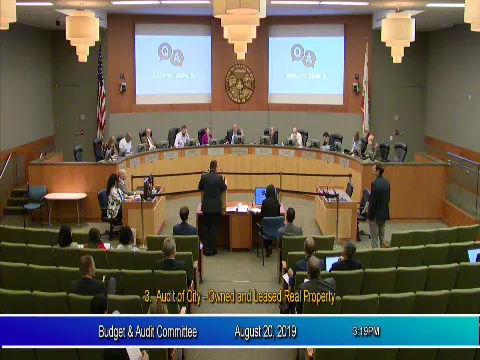
The Sacramento City Council, sitting as the Budget and Audit Committee, held a special meeting on Tuesday, August 20, 2019, at 2:00 p.m. in the City Hall Council Chamber. The committee reviewed and accepted multiple reports from the City Auditor, including the fourth quarter activity report, a fiscal impact analysis of the 2035 General Plan, an audit of city-owned and leased real property, an audit of the Department of Utilities vehicle fleet, and the results of the auditor's 2019 peer review. All items were approved with motions to forward to the full City Council. The meeting lasted from 2:02 p.m. to 3:40 p.m.
Consent Calendar
- Item 1: City Auditor’s Activity Report for the 4th Quarter of Fiscal Year 2018/19 – Accepted and forwarded to City Council. Motion passed unanimously (8-0, with Member Ashby absent at the time of the vote).
Discussion Items
- Item 2: City Auditor’s Fiscal Impact Analysis of 2035 General Plan Land Uses at Buildout – Amy Lapkin of Economic & Planning Systems presented the analysis, which estimated that buildout of the 2035 General Plan would generate a net fiscal surplus of approximately $30 million annually for the City’s general fund (based on FY2018-19 budget and Measure U rates). The model allows for scenario testing and identifies where revenues exceed expenditures geographically. Councilmembers Steve Hansen and Eric Guerra discussed the need to refine the tool to evaluate commercial corridor revitalization, multifamily housing sustainability, and shorter-term budget impacts. The item was approved (9-0) and forwarded to Council, with a commitment to develop a workplan for additional scope and cost.
- Item 3: Audit of City-Owned and Leased Real Property – City Auditor Jorge Oseguera presented findings: the City owns nearly 2,000 parcels; a sample review of 550 parcels identified 69 potential surplus parcels totaling 90+ acres, conservatively valued at $18 million. The audit recommended centralizing/standardizing real property management, improving tracking and maintenance, and leveraging surplus property for goals like affordable housing. Councilmembers discussed specific parcels (e.g., 22 acres in District 3 under negotiation for sale, remnant parcels, integration with SHRA properties). The item was approved (9-0) and forwarded to Council, with direction to return with strategies for monetizing vacant land and improving the real estate division’s capacity.
- Item 4: Audit of the Department of Utilities Vehicle Fleet – The audit found over 50 underutilized assets costing $854,000 annually, fuel control weaknesses (including potential fraud, unauthorized access), data quality issues in the fleet management system, and inconsistent employee licensure tracking. The Department of Utilities requested the audit and concurred with 26 recommendations; many are already being implemented (e.g., installing cameras, revoking manual fuel entries, developing underutilized vehicle criteria). The item was approved (9-0, with Mayor Steinberg absent for the vote) and forwarded to Council.
- Item 5: City Auditor’s 2019 Peer Review Results – Presented without additional presentation; accepted and forwarded to Council. Motion passed unanimously (8-0, Mayor absent).
Key Outcomes
- All five agenda items were accepted and forwarded to the full City Council for final approval.
- For Item 2, the Committee requested a follow-up scope and cost estimate to refine the fiscal impact model for shorter-term analysis and integration with economic development plans (Project Prosper, commercial corridor revitalization).
- For Item 3, the Committee directed staff to return with options to strengthen the real estate division, explore monetization strategies (including models from other cities), and coordinate with Council districts and SHRA on surplus/underutilized properties.
- For Item 4, staff confirmed corrective actions are underway with most recommendations to be completed by December 31, 2019.
- Councilmember Steve Hansen requested that the Committee revert to a regular Budget and Audit Committee (rather than a committee of the whole) due to the normal workload; the clerk noted the request.
Meeting Transcript
Committee, which of course is a committee of the whole will come to order. Would the clerk please call the role so that we might establish a quorum? Thank you, Councilmember Warren, Councilmember Harris, Councilmember Carr, Councilmember Jennings, Council Member Garrett. Councilmember Schneer and Mayor Steinberg. I am here. Very good. We do have a quorum, and um we'll think the other members will be here soon. So we have um several items here. Um and again, the way this works for members of the public is in large part because of the measure you uh the passage measure you and the extra importance of the budget. We made the budget committee, the committee of the whole. And so we meet now, and what we hear now may uh go to the consent calendar for the full city council, or it may be a discussion item for the full city council, depending upon what the what the requested report backs are and and and how we might want to continue the discussion. But this is not the full city council, it's the budget and audit committee, which is the full city council. And round and round we go. Okay. Are there any members of the public uh here to testify? Okay, what time is the next session? Move consent. The consent calendar has been moved. Uh the city auditors report for the fourth quarter, moved and seconded. Uh all in favor, please say aye. Aye. Aye, opposed abstain. That passes. We now move to item two, which is the auditors fiscal impact analysis of the general plan at build out in the year 2035. Thank you very much. All right. Good afternoon, Mayor Steinberg and members of the budget and audit committee. My name is Jorge Seguera. I'm the Sacramento City Auditor. With me today is um Amy Lapkin, uh, the project manager for uh EPS, who will be presenting uh this report. Uh their firm uh provided uh the analysis and work to create the model that you'll be hearing about today and to do the analysis. Uh the recommendation that is before you is that you pass a motion accepting the city auditors fiscal impact analysis of the 2035 general plan use at build out and to forward to the city council for final approval. With that said, I'm gonna have uh Amy come in and uh actually present the presentation okay. Good afternoon, Mayor and members of the budget and audit committee. As Jorge mentioned, my name is Amy Lappin, and I'm an executive vice president at Economic and Planning Systems. I served as project manager overseeing the day-to-day operations of this project over the last year. I am pleased to present this overview of the fiscal impact analysis of the 2035 general plan uses at build-out, and I'm happy to answer any detailed questions you may have at the end of this presentation. Following the an introduction of the team and city staff who contributed review and input, I'll provide an overview of the project background methodology and timeline and project deliverables, including the recently completed final report, the envisioned tomorrow fiscal impact analysis model, and the project website. The consulting team consisted of EPS as the lead consultant and Cascadia partners as a subconsultant to EPS. EPS is a full-service urban economics consulting firm with decades of experience in public finance, real estate economics, regional economics, and land use policy with an office here in Sacramento. Cascadia Partners, based in Portland, Oregon, is a firm whose staff has significant experience in the fields of planning, design, development, finance, and urban analytics. Cascadia Partners had developed a mapping tool which allowed for the use of evaluating the impacts of different land use scenarios called envision tomorrow. Envision tomorrow was customized with city-specific data and integrated with EPS's fiscal impact analysis model for this project. The EPS team collaborated closely with city staff throughout the duration of this project to review and inform assumptions contained in the analysis. We worked closely with the auditor's office, the mayor's office, council member Steve Hansen's office, and the city departments of finance, community development, police, fire, economic development, and information technology. EPS and Select City staff also met with the Sacramento Area Council of Governments as they are currently using a customized version of Envision Tomorrow to develop their 2020 MTP SCS and could be a resource to staff in their use of Envision Tomorrow. The impetus for this project was that the city desired the development of a fiscal impact analysis modeling tool that could be used as an input for evaluating discretionary land use decisions and prioritizing economic development investments while achieving economic sustainability in the city. The intention of the project for the city was to answer key questions, including where will the city's key revenues and expenditures be derived geographically. How do different areas in the city compare when tax revenues are normalized on a per acre basis? And what are the impacts of various land uses on the city's municipal budget?
openpublica.com