Sacramento Budget and Audit Committee Meeting Summary – September 3, 2019
STREAMING COPY IN PREPARATION — RECORDING AVAILABLE FROM THE ORIGINAL SOURCE
Sacramento Budget and Audit Committee Meeting – September 3, 2019
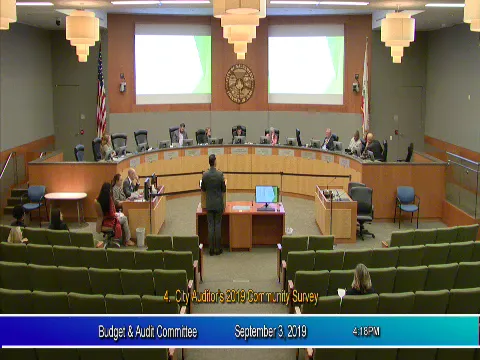
The Budget and Audit Committee (City Council sitting as the Budget and Audit Committee) met on Tuesday, September 3, 2019, at 3:00 p.m. in the Sacramento City Hall Council Chamber. The committee received presentations on the Sacramento Housing and Redevelopment Agency (SHRA) mid-year budget and comprehensive annual financial report, the City Auditor's recommendation follow-up report, the 2019 community survey, and the audit of the 911 Emergency Communications Center. During discussion of SHRA items, the committee directed SHRA to provide a written report on Capitol Park Hotel operations by the end of the week. The meeting adjourned at 4:38 p.m. to closed session.
SHRA Mid-Year Budget Review
- SHRA's 2019 budget totals almost $193 million, with 89% from federal sources and 11% from state and local sources. The largest funding sources include housing choice vouchers, public housing, and CDBG.
- Largest expenditures are housing assistance payments, capital projects, salaries and benefits, and services and supplies. SHRA funding does not originate from or affect the city's general fund.
- Mid-year adjustments show increased public services and capital project spending, largely due to the Capitol Park Hotel and HUD capital funds. Capital spending is estimated at about $39 million, approximately $4.2 million below budget.
- Action: Received and filed.
SHRA Comprehensive Annual Financial Report
- The 2018 CAFR, audited by Clifton Larson Allen, LLP, received a clean opinion. GASB Statement No. 75 related to post-employment benefits other than pensions was implemented.
- SHRA's overall financial position decreased by about 1.8% from 2017 to 2018. Revenues increased largely due to loan repayments from county CDBG and HOME funds; expenses increased due to planned project expenses.
- Action: Received and filed.
Capitol Park Hotel Discussion
- Mayor Steinberg said SHRA has owned the Capitol Park Hotel for about six weeks and John Stewart Company has operated it for about three weeks. He explained the hotel is being used as a triage shelter while it transitions to roughly 180 units of permanent supportive housing, with about $13 million in tax-credit redevelopment funding expected.
- Mayor Steinberg requested a full written report by Friday, September 6, covering elevator repairs, front desk staffing, relocation plan oversight and signatories, bed bug and roach treatment, triage bed availability, pace of relocation, and a payment structure ensuring the city pays only for the number of triage occupants actually served.
- He stated that no current resident will be asked to leave unless and until another safe place meeting their needs is available. SHRA Executive Director La Shelle Dozier confirmed this and said a relocation consultant has met with each resident; 15 residents have moved out voluntarily.
- Councilmember Hansen described a broken water pipe and asked about communication and expectations for the operator. Dozier acknowledged communication lapses and said pest management spraying is occurring weekly and will be followed by tenant education.
- Councilmember Carr asked about admission criteria. Dozier said assessments are coordinated with Sacramento Steps Forward and police department referrals, with wraparound services, and screening regarding addiction and mental health to ensure appropriate placement.
- Councilmember Warren asked about health assessments before people come indoors. Dozier said health assessments are part of the intake process. Councilmember Jennings requested weekly one-page updates on occupancy, relocation, and pest control for the first weeks or months. Councilmember Carr asked about resources; Dozier said the city entered into a services agreement with SHRA and staff worked through the weekend to open the shelter.
- No separate vote was taken; discussion occurred under the SHRA receive-and-file items.
City Auditor's Recommendation Follow-Up Report (January 1–June 30, 2019)
- City Auditor Jorge Oseguera presented highlights: more than 554 recommendations were tracked during the period; 75 made progress, 18 were implemented, four were dropped, and 106 did not make progress. The report includes new infographics and an online dashboard.
- Action: Motion to accept the report and forward it to City Council passed 6-0. Voting yes: Ashby, Carr, Guerra, Hansen, Jennings, and Mayor Steinberg. Absent: Harris, Schenirer, and Warren.
City Auditor's 2019 Community Survey
- This was the second National Community Survey. The city mailed 5,500 surveys to a random sample and received 895 responses, with a 95% confidence level and a margin of error generally no greater than plus or minus 3 percentage points citywide. An additional 4,039 residents completed the survey online; online results were reported separately.
- Key results: 62% rated overall quality of life as excellent or good; 75% rated Sacramento positively as a place to live; 51% rated it positively as a place to visit; the neighborhood-as-place-to-live rating fell from 75% in 2018 to 63% in 2019; 45% rated economic health positively; 43% rated overall feeling of safety positively, down from 54% in 2018.
- Homelessness-related items: 88% said providing homeless access to health care is essential or very important; 82% said creating affordable permanent housing and providing emergency shelter is essential or very important; 63% rated enforcing the no-camping ordinance as essential or very important.
- Top priorities for the next two years: safety at 90% and overall economic health at 88%. High-rated services included fire, libraries, and garbage/recycling; lower-rated services included crime prevention, street cleaning, street repair, and code enforcement.
- The auditor plans to update demographic questions (gender, sexual orientation, mixed race) and add a write-in section. Councilmembers noted the survey should inform budget priorities; Councilmember Jennings expressed concern that 54% of respondents identified as white and that response rates need to reflect the city's diversity.
- Action: Received and filed.
Audit of the 911 Emergency Communications Center
- The audit found the 911 Center answered 98% of incoming 911 calls within 15 seconds in calendar year 2018, exceeding the state-mandated 95% standard. Call volume increased by over 80,000 calls between 2017 and 2018 after wireless calls began routing directly to the city in October 2017.
- Recommendations include continuing to monitor call volume, improving the supervisor-to-dispatcher ratio, evaluating staffing for anticipated growth, implementing payroll controls, standardizing quality assurance, updating disaster preparedness and business continuity plans, and developing a succession plan.
- Councilmember Carr asked about system integration with other agencies; staff described a warm handoff but said full electronic integration has not been completed.
- Action: Motion to accept the audit and forward it to City Council passed 8-0. Voting yes: Ashby, Carr, Guerra, Hansen, Harris, Jennings, Schenirer, and Mayor Steinberg. Absent: Warren.
Key Outcomes
- SHRA mid-year budget and CAFR received and filed.
- City Auditor's Recommendation Follow-Up Report accepted and forwarded to City Council (6-0).
- 2019 Community Survey received and filed.
- Audit of the 911 Emergency Communications Center accepted and forwarded to City Council (8-0); Mayor Steinberg also directed the City Auditor to pursue a follow-up audit on 911 triage models to reduce call volume and better align fire and police resources.
- SHRA was directed to provide a full written report on Capitol Park Hotel by Friday, September 6, 2019, and to provide weekly updates for the first several weeks or months.
Meeting Transcript
Good afternoon, everyone. The City Council's budget and audit uh committee. The city council sitting as the budget and audit committee will come to order, please. Would the clerk please call the roll to establish a quorum? Councilmember Ashby, Councilmember Hansen. Councilmember Carr. Here. Councilmember Jennings. Here. Council Member Guerra. Here. And Mayor Steinberg. Here. All right, we do have a quorum. Members, um, I would like to group the agenda items here this afternoon. We have two items relating to SHRA. One is the mid-year budget review, the other is the review of the comprehensive annual financial report. Let's take those two together, and then we'll have our city auditor uh come up with three different items that uh we can um obviously take separately, but at least uh take them uh take them consecutively. All right. Let us begin with SHRA. And um how long is the presentation, if you don't mind me asking? Um, the first one could be about five minutes, the other one's like maybe two, two, three. Two or three. Okay, why don't you do both of them? Okay, and then we're gonna get into a discussion, and um I'm gonna use my time uh this afternoon to talk about the the present issues of the Capitol Park Hotel. Uh, and and to ask some questions into and to have some discussion here at the committee. All right. But why don't we go why don't we go first with the presentation? Thank you. To briefly recap our 2019 budget, it consists of almost 193 million in funding, of which 89% is from the federal government. While state and local make up the rest of the remaining total of the 11% of our total funding. A little more specifically, you can see that our largest funding source is housing choice vouchers, um, followed closely by public housing CDBG. So, where do these resources go? This chart represented all of the SHRA uh funding sources and not one specifically tied to the city and its oversight. As you can see by the graphic, our largest expenditure does also tie to the housing assistant payments, also known as HCV, followed by capital projects, salaries and benefits and services and supplies. It's important to note that these funding sources do not originate from nor have an impact on the city's general fund, but are mostly tied to the federal entitlement grants like CDBG, public housing, and the capital fund. Here you will notice a significant increase in the miscellaneous category. It includes revenues received and anticipated that are anticipated for the Capitol Park Hotel project. The estimated decrease in grants relates to our multi-year grants, and while the revenues may not be received this year, they are available for future periods. This slide shows the overall budget adjustments for anticipated expenditures based on the mid-year estimates. We estimate a slight decrease in salaries and financial transactions. Public services has an increase, and that was mostly again due to the services that will be provided at the Capitol Park Hotel. The increase in the capital projects is also mostly due to Capitol Park, also an increase of operating subsidy from HUD and the increased city public housing or excuse me, um, the capital fund money for the city public housing properties also received from HUD. Finally, our last slide shows that our budget to actual numbers showing actual expenditures through June 30, as well as estimating where the numbers will land at year end. For most categories, we estimate the amounts coming in at or just below what the revised budget amounts are. We do have a slight decrease in salaries and benefits and financial transactions again, which is mostly due to things such as reduced fees for investments and baking coming in lower than expected. Lastly, estimating capital projects is tricky because of all of the moving parts of planning and bidding. So these are estimated that we will spend mostly around 39 million, bringing it just about under maybe 42 4.2 million dollars lower than the budgeted amounts. So this is the end of my presentation, and I'm available for questions. Thank you for the presentation.
openpublica.com