Budget and Audit Committee Meeting – December 3, 2019
STREAMING COPY IN PREPARATION — RECORDING AVAILABLE FROM THE ORIGINAL SOURCE
Budget and Audit Committee Meeting – December 3, 2019
The Sacramento City Council sitting as the Budget and Audit Committee met on Tuesday, December 3, 2019, at 3:05 p.m. in the City Hall Council Chamber. Mayor Darrell Steinberg chaired the meeting, which adjourned at 3:56 p.m. The committee reviewed four items related to the City Auditor's office, all of which were forwarded to the full City Council for approval.
Consent Calendar
- Item 1: City Auditor’s Activity Report for the 1st Quarter of Fiscal Year 2019/20. The committee voted unanimously to accept the report and forward it to City Council. The motion was made by Member Harris and seconded by Member Warren. Members Ashby and Hansen were absent for this vote.
Discussion Items
- Item 2: Audit of Retiree Health Benefits. Assistant City Auditor Lynn Bashaw presented the audit. The audit found that the Human Resources department administers health benefits for approximately 3,500 retirees under SCERS or CalPERS. Key findings included: (1) the need to strengthen internal processes and IT data management to minimize data errors; (2) inadequate dependent verification processes – a 2017 contracted review by HMS found 27% of dependents were not successfully verified, with the Sacramento Police Officers Association having the lowest compliance rate at 39% and the Western Council of Engineers the highest at 96%; 1,362 dependents remained unverified. If 5% of unverified dependents were ineligible, the city could save $150,000–$200,000 annually; if 15%, savings could reach $450,000–$600,000 annually. For retirees, removing one ineligible dependent could save up to $780 per year based on a maximum city contribution of $65. The audit also found the city may have paid over $140,000 in dental benefits for deceased retirees dating back to 2006, and over $800,000 in retiree health benefit revenue should be reimbursed to the risk management fund. The committee accepted the audit and forwarded it to City Council; the motion passed unanimously.
- Item 3: City Auditor’s Whistleblower Hotline Activity Report for April 2019 through September 2019. The Auditor's office reported closing 73 cases and substantiating 6 during the period. The committee accepted the report and forwarded it to City Council; the motion passed unanimously.
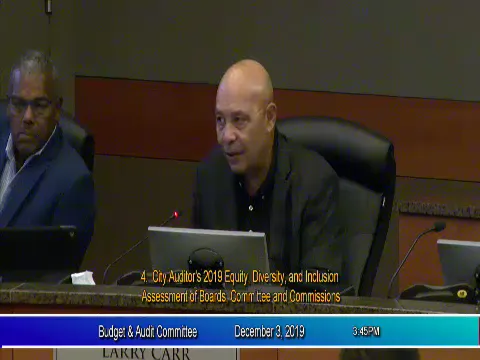
- Item 4: City Auditor’s 2019 Equity, Diversity, and Inclusion Assessment of Boards, Committees, and Commissions. City Auditor Jorge Oseguera and staff presented the assessment. The analysis covered 278 city and non-city appointed seats, of which 228 were city seats and 215 were filled. Comparing 2017 and 2019 data, the percentage of white non-Hispanic board members dropped from approximately 61% to 53.3%, while female representation stood at 47% in 2019 compared to 51% of the city population; 1% of members identified as nonbinary. Of 160 members responding, 18 (11.25%) identified as LGBQ+, compared to a 4.5% national Gallup estimate. Council District 4 had the most mappable members (44), followed by District 5 (25) and District 3 (16); Districts 8 (6) and 2 (9) had the fewest. 18 members lived outside the city. The presentation also introduced a new online ethnic and gender diversity dashboard for city employees using eCAPS data. Councilmember Ashby, Hansen, and others discussed the need for more outreach and recruitment to improve diversity, particularly for out-of-city appointees and underrepresented districts. The committee accepted the assessment and forwarded it to City Council; the motion passed unanimously.
Public Comments & Testimony
- No public testimony was offered on any agenda item.
Key Outcomes
- All four items were accepted by the committee and forwarded to the full City Council for final approval.
- For the Retiree Health Benefits audit, the Auditor's office will follow up every six months on recommendations until all are implemented.
- The committee discussed potential citywide recruitment efforts for boards and commissions, and the City Clerk's office was encouraged to explore additional outreach strategies, including leveraging planning academy graduates and offering board/commission training.
Meeting Transcript
Good afternoon, everyone. The city city council's budget and audit committee will please come to order. If we might uh please call the role so that we might establish a quorum. Thank you. Councilmember Warren, Councilmember Harris, Councilmember Shaneer, Councilmember Guerra. Councilmember Jennings and Mayor Steinberg. Thank you very much. This is, of course, a committee of the case. Council member car we have Councilmember Carr and I know uh I think we've got a full uh full roster here today. No, just saw Councilmember Hanson, I'm sure Councilmember Ashby will be here uh momentarily as well. Um, this is the committee of the whole. We do have uh consent item, which is the city auditors' activity report for the first quarter of fiscal year 1920. Very important. I see you remember the number of the auditors team out there in the audience. Thank you for your good work. Um there any questions on the consent calendar? Moved and second, there is no public testimony in the consent calendar. All in favor, please say aye. Aye. Aye. Opposed, abstain, that passes. We do have three uh hopefully brief items on the discussion calendar. Yeah. Right. Um we want to begin with the audit of the retiree uh health benefits. Who's presenting on that? Good afternoon, members of the budget not a committee. Lynn Bashaw, I'm the assistant city auditor. I'm here to present the results of the audit of retiree health benefits. The recommendation before you is that you pass a motion accepting the audit and forward to the city council for final approval. To provide a little background on the subject, the human resources department administers health benefits for approximately 3,500 retirees who are covered under either the Sacramento City Employees Retirement System, SCRS, or the California Public Employees Retirement System, CalPERS. These retirees and their dependents may be eligible to participate in city-sponsored health care plans, and the city may contribute towards some of the cost of medical, dental, and vision benefits. Qualification terms and contribution amounts are specified in the city's labor agreements. Data discrepancies in health benefit reports could create inefficiencies, and management of some retirees health benefits could be modernized. In finding one, we recommended the HR department strengthen internal processes and work with the IT department to evaluate how personnel and benefit data are obtained, stored, and managed in order to minimize data errors and improve general data management. Finding two, performing dependent verifications ensures qualified dependents are enrolled in health plans. Providing benefits to dependents that are no longer eligible drives up costs for the city and diverts resources from other programs. Our audit found that the city does not have an adequate process to ensure all dependents enrolled in city sponsored health care plans are eligible, and that not all documentation used to substantiate dependent verification at the time of enrollment was retained. Failure to require all active employees to comply with a recent dependent verification review could be costing the city up to $600,000 annually, and a dependent verification review has not been performed for retiree dependents. Covering ineligible dependents can be costly. Therefore, it is essential to have a process in place to ensure only eligible dependents are enrolled in city-sponsored health plans. A dependent eligibility verification review involves requesting plan participants to provide documents that prove their relationship to the dependents and to verify that the relationship meets the definition of an eligible dependent under the plan guidelines. Industry best practices suggest private and public employers perform dependent eligibility verifications to ensure compliance with plan guidelines and to reduce health benefit costs. In 2017, the city contracted with Health Management Systems Inc., HMS to perform a dependent eligibility verification for active employees. 27% of dependents were not successfully verified. Employees failed to comply with the request by either not responding or by not submitting sufficient documentation. This figure shows the results of the dependent verification review by labor unit. The Sacramento Police Officers Association, or SPOA had the lowest compliance rate of 39%, while the Western Council of Engineers had the highest compliance rate of 96%. As of right now, 1,362 dependents remain unverified. We inquired with HR regarding its plans to complete the process of identifying and removing ineligible dependents from city sponsored health plans.
openpublica.com