Sacramento Budget and Audit Committee Meeting on FY2021/22 Budget, June 8, 2021
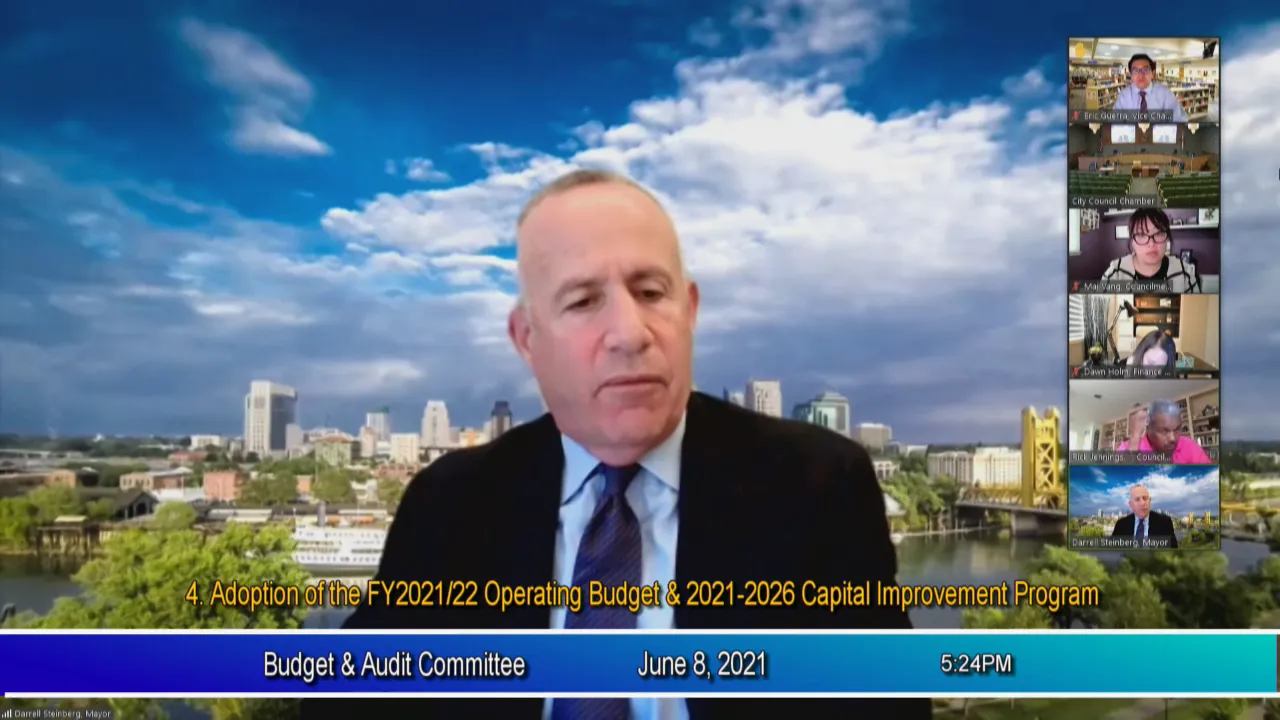
STREAMING COPY IN PREPARATION — RECORDING AVAILABLE FROM THE ORIGINAL SOURCE
Sacramento Budget and Audit Committee Meeting Summary
The Sacramento Budget and Audit Committee met on June 8, 2021, at 4:00 p.m. via teleconference to review and forward the Fiscal Year (FY) 2021/22 Operating Budget and the 2021-2026 Capital Improvement Program to the City Council. The committee also considered the City Auditor's reports, the Asset Forfeiture Master Plan, and received public testimony on the budget. All votes were unanimous.
Consent Calendar
- Approved the City Auditor's Assessments of Revenues and Expenses Associated with the City's COVID-19 Response - Report No. 3, forwarding it to the City Council for approval.
- Received and filed the City Auditor's 2021 Community Survey.
- During discussion, City Auditor Jorge Oseguera noted the survey was offered in about 100 languages via Google Translate and included oversampling in underrepresented communities.
Public Comments & Testimony
- Patricia Burnsight (caller) expressed support for funding the 4th R after-school program, emphasizing the need for childcare so parents can return to work.
- PJ (District 4) urged the committee to follow Measure U committee recommendations and Councilmember Valenzuela's "people's budget," citing survey results showing higher support for community-based services over police (e.g., 91% for community-based mental health, 85% for affordable housing) and requested keeping the police budget at FY2019/20 levels to fund other programs.
- Resident of District 2 (speaker) opposed police budget cuts, citing rising crime in the district.
- Tina Eccles (District 2) opposed police budget cuts, stating police are underpaid, underbudgeted, and understaffed.
- Joanne Myrie (District 2) opposed defunding police, stating more funding is needed.
- Sandra Betoncourt (District 2) urged rejection of any police budget reductions, describing the district as "lawless and dangerous."
- Mary Cappel (District 2) emphasized the need for police backup during park cleanups for safety.
- Daniel Oakenfuss (District 4) supported funding for 4th R, calling it a "godsend for working families."
- Gatal (District 7) supported alternatives to 911 and reduced police funding, arguing that visible police indicate less safety and calling for investments in community services and equitable recovery.
- Brenda Ruiz (Sacramento Food Policy Council) requested that ARPA funds include a healthy and resilient food systems fund during the upcoming ARPA discussion.
- Anonymous caller supported participatory budgeting, arguing that budget authority belongs to the people and should be shared.
Discussion Items
Item 3: FY2021/22 Asset Forfeiture Master Plan
- Police Chief Daniel Hahn presented the plan totaling $597,740, including $108,000 for community-based anti-drug and anti-gang programs ($83,000 from state asset forfeiture, $25,000 from federal equitable sharing).
- Councilmember Guerra expressed the desire to shift future asset forfeiture spending away from ongoing operations toward one-time capital expenses and increased drug/gang prevention programs.
- The committee forwarded the plan to the City Council with direction to explore that shift.
Item 4: Adoption of FY2021/22 Operating Budget and 2021-2026 Capital Improvement Program
- Finance Director Dawn Holm presented the budget, recommending additions: a fully offset position for cannabis policy/youth outreach, $500,000 for the Fuel Network, $680,000 for women and children shelter funding, and changes to the budget resolution to address the American Rescue Plan (ARP) fund, potential 4th R shortfalls, and an equity analysis for the Capital Improvement Program (CIP).
- The budget is largely a "status quo" budget, but the city anticipates $112 million in ARP funds over two years.
- Committee members discussed the housing trust fund, noting the $680,000 transfer for shelters would be replenished; Mayor Steinberg promised to replace it and aim for larger investments in housing/homelessness.
- Councilmember Guerra suggested allocating additional funds (e.g., $2 million) to the CIP to cover construction cost overruns and prioritize projects in under-resourced communities.
- Councilmember Vang raised concerns about the timeline for developing a racial equity tool, noting an 18-24 month plan via Race Forward was too long; she urged an interim tool by January.
- Councilmember Jennings requested a workshop on violence prevention and discussed participatory budgeting and police/fire reduction plans.
- Mayor Steinberg stressed the need to properly attribute Measure U investments to build trust, noting $119 million in spending above pre-Measure U levels.
Key Outcomes
- Unanimously approved the Consent Calendar.
- Unanimously forwarded the Asset Forfeiture Master Plan to the City Council.
- Unanimously forwarded the FY2021/22 Operating Budget and 2021-2026 CIP to the City Council with amendments and direction, including to explore shifting asset forfeiture use, add $680,000 for shelters, and consider additional CIP funding.
- Directed staff to provide an interim equity tool by January 2022.
- Scheduled a workshop on violence prevention for June 29, 2021 (if possible).
- Requested the City Auditor to conduct a performance audit of Advanced Peace.
- The City Council will consider the budget and police/fire reduction plans on June 15, 2021.
Meeting Transcript
Good afternoon. The meeting of the city council's budget and audit committee will come to order with clerk. Please call the role. Councilmember Jennings. Here. Councilmember Getta. Here. Councilmember Vang. Here, Mar Steinberg. I'm here. Good afternoon, everyone. Today we've got two consent items. Report on the asset forfeiture master plan. And then a recommendation to adopt the 2122 operating budget and the 21 to 26 capital improvement budget. So let us begin please with the consent calendar. Are there any questions on the consent calendar or any public testimony? I have no public testimony on the consent calendar. Okay. Motion to approve consent calendar, mayor. Thank you. Dives for lack of a second. No, I was I was about to say it with a comment. Just uh quick question for the city auditor on the uh community. Um is uh I know we had discussed this issue uh many times before, uh, but what what what uh what efforts did we use and uh ensuring that we had um uh access points to different languages and getting input on some of uh some of the inputs. Sure. So for this project, we did work with uh our public information officers to get the word out through social media. Uh we did make the survey when it was available online uh compatible with uh Google language translate so that it could be translated into I want to say uh it's close to like 100 languages that it can be translated into. Um we also um uh did oversampling in some of our communities that we know uh don't participate in the survey as uh high of a rate as some of our other uh council districts. Uh that way we could have more participation that's on par across all council districts. Um the overall response that we got this year was a bit lower than what we had received last year, but um under the pandemic, I think that might have had an impact on on that. And so I'm a little bit more curious how how things will change when we do this again next year. But we did do um uh the outreach, we oversampled and uh we were able to get results that were statistically significant as a result. Great. Thank you, Mr. City Auditor. No, I I I uh I appreciate that. I know this last year was an anomaly. Um I if I could ask if you maybe we could learn from a couple of efforts. One, the census um uh effort, which uh used a combination of community partners to do the the outreach into harder to reach communities. I think I think we can double up on some of their out the efforts that are being used from the health equity task force on that. Uh and I know the census also had its issues. I think particularly amongst working with the RISC coalition um in uh in some of the communities uh as well. And uh, but there is a recent effort on uh getting uh uh uh information out, uh health information out that we've learned from. So I I think if we if uh if we can work with some of the partners uh at the uh health equity task force from the county who've been able to use that to make sure that we're sampling those communities that may not have traditional access. I know if I asked my mother to use Google Translate to do the survey, it would be a challenge. Let me just put it that way. Um but we we made some significant strides. Um the fact that 311 has 17 different languages now, great strides. We're moving in the in that direction. So positive direction, uh uh city auditor, and let's just see if we can partner up on uh some other existing efforts when we do the outreach.
openpublica.com