Sacramento Community Police Commission Meeting - October 10, 2016: Diversity Policy Adoption and Public Comment
STREAMING COPY IN PREPARATION — RECORDING AVAILABLE FROM THE ORIGINAL SOURCE
Sacramento Community Police Commission Meeting - October 10, 2016: Diversity Policy Adoption and Public Comment
The Sacramento Community Police Commission held its regular meeting on Monday, October 10, 2016, from 6:02 PM to 6:58 PM in the Council Chamber at 915 I Street. The commission focused on adopting final language for diversity hiring policy recommendations to be presented to the City Council, heard public comment on a recent police shooting, and approved previous meeting minutes. All members were present except Cathy Thao (absent) and Basim Elkarra (arrived late at 6:04 PM).
Consent Calendar
- Approval of September 12, 2016 Meeting Minutes: The commission voted 8–0–1 (Sabeniano abstained, Elkarra absent, Thao absent) to approve the minutes from the previous meeting. The motion was moved by Vice Chair Clif Roberts and seconded by Dr. Ernest Uwazie.
Public Comments & Testimony
- Cara Dwyer (representing the Sacramento Regional Coalition to End Homelessness, Director of the Homeless Speakers Bureau) submitted a letter and spoke about the July 2016 killing of Joseph Mann by SPD Officers Tennis and Lizzano. She criticized the lack of transparency and accountability from the police department and Chief Sam Somers, and urged the commission to support an independent police commission with investigative, policy, and review powers. She also noted support for Councilmember Carr’s efforts regarding use-of-force policy. Chair Simmons thanked her and assured that the commission would take the comments under advisement, noting the recommendations would be considered in future pillars (engagement and training) after the December 6 City Council presentation.
Discussion Items
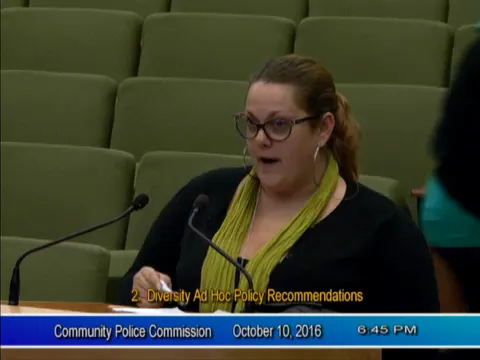
- Diversity Ad Hoc Policy Recommendations (Item 2): The commission spent approximately 40 minutes discussing the 14 recommendations from the Diversity Ad Hoc Committee, presented by Dr. Ernest Uwazie. Key discussion points included:
- Concerns about seniority (Recommendation #2): Several members expressed worry that language about eroding seniority rights in favor of retaining newly hired diverse officers could conflict with union contracts and existing seniority protections. After debate, members agreed to add language emphasizing that the recommendation should not jeopardize seniority but should consider performance and diversity in layoff situations.
- Support services for candidates (Recommendation #9): Members argued that support should focus on preventing academy failures, not just after failure. The recommendation was broadened to include early identification of struggles and pre-academy mentoring.
- Salary equity: Multiple members proposed a salary study to bring SPD pay within 5% of regional averages, but a compromise was reached to phrase it as “ensure that pay and benefits are sufficient to recruit and retain the finest officers” without dictating a specific percentage.
- Other amendments: Expanding the “Links to Law Enforcement” program, re-establishing the Police Chief Multicultural Advisory Committee, increasing minority training officers and field training officers (FTOs), and requiring bias-free training for management and leadership.
- Public testimony: Three speakers provided input:
- Carly Brannin asked for specifics on a community diversity task force, suggested a blended seniority/performance metric for layoffs, and recommended broader community outreach beyond Links to Law Enforcement.
- Alaine Murphy-Hasan suggested paid slots for academy trainees, test-taking techniques, and clarity on incentive allocation (new recruits vs. existing officers). (Noted: recruits are already paid during academy.)
- Sameera Ali recommended that bias-free training include management and leadership.
- Deputy Chief Mike Bray clarified that SPD already conducts bias-free training more frequently than POST mandates, and described the academy remedial process and the Links to Law Enforcement program for minority candidates; he acknowledged the need for better mentoring.
Key Outcomes
- Motion to adopt the Diversity Ad Hoc Policy Recommendations as amended passed unanimously (10 ayes, 0 nays, 0 abstentions) – all present members voted in favor; Thao absent. The language will be combined with the Accountability Ad Hoc recommendations and presented to the Sacramento City Council on December 6, 2016.
- No other formal votes were taken.
- Member Comments:
- Member Betty Williams recommended that future meetings in 2017 not be held at police stations; the calendar will be discussed at the next meeting.
- Chair Simmons and Vice Chair Roberts reported on their visit to Berkeley’s police commission, noting it was a valuable learning experience.
- Dr. Uwazie thanked Director Francine Tournour for participating as a panelist at a criminal justice convocation at Sacramento State.
Meeting Transcript
Calling the two uh the October 10th uh two thousand sixteen police commission's uh meeting to order, Francine for roll call Les Simmons here, Cliff Roberts present Bill Milton here, Kathy has an excuse absence, Betty Williams here, Ernest Siwazi here, Basim Elkara, Mariana Sabina, Rick Jones, Roslyn Van Buren, Tim Davis, we do have a quorum. Great. Uh we will officially start this meeting for those members of the public. Remember this uh is this meeting is being recorded. If you can please silence all your cell phones, speaker slips are located in the back of the room. You can fill it out for items related to uh the agenda or else items relate unrelated to the agenda. Member I mean comments are minim are are two minute minimum, and you can address them to the commission, not any one individual. I think that is it. First item on the agenda is adopting last month, September the twelfth, I believe it was the uh calendar, adopting the calendar items or commission minutes for last month's meeting, and this could be moved with one motion to to move those minutes forward. Um but so move second second. All in favor say aye. Any opposed? No. I think we have I just abstaining because I wasn't here last time. One abstention. Great. That was quick. So second item, and this is the discussion item on the presentation from last month, the diversity ad hoc and policy recommendation, uh discussing the policy recommendations, which I think we all have gotten a list of the 14 recommendations from the ad hoc committee. Thank you so much for this committee doing a wonderful job at connecting to the community and having uh dialogue and then bringing these recommendations back up. So tonight um is our focus is to adopt the language that will be taken to City Council uh for the 14 recommendations based upon what we make a motion to adopt. And anyone can have any member comments related to the 14 recommendations unless there's a motion to adopt all fourteen. Um so I think Ernest, you're first on the queue. Go ahead, sir. Thank you. And two, the supplemental material attachment to which actually you are correct, the 14 items. I think um in a way. Not to suggest that this is in any way in order of priority, but um more of the substance of the recommendations of the uh of the committee. Um as we indicated during the um presentation at the last at the at the last commission meeting. Um the why question I think is already addressed. Uh the Sacramento Police uh department recognizes already the importance and value of the of diversity. Uh there are quite a good number of reports pointing to the need for it. And more importantly, the Sacramento Police Department has taken some positive steps in that regard. These recommendations may overlap, may to some extent. Excuse me. Supplement, complement, but not in any way intended to complicate what the SAC PD is already thinking, doing or may do. So it is in that spirit that the ad hoc committee deliberated, looking at different documents, meeting with community group and as well as individual entities. And our own deliberations as a committee to come up with these recommendations as a step in the in the right direction. And of course, there are three major assumptions that are not necessarily reflected here, but we spoke about that during the presentation. One is that of leadership, which I've already spoken to, that for this to work, it would require the leadership of the respective entities, especially the police department, the city council, and of course the managers of the city manager. The second is resources, being able to provide the appropriate resources for this to happen, both material and non-material resources. And finally, the emphasis on recruitment and retention. The literature suggests clearly that recruitment would not be successful long term if you do not have an equally strong, robust supportive retention mechanism. It's a matter of getting them in and being able to support them to be successful in their work. Otherwise, uh they may attrition or leave the police department. So having the resources, having the leadership, and having a comparable retention mechanism, very critical to the success of this. Right. I think there could be a few questions that some of us may have, but I think we've all had a lot of time to go and look through them and for the interest of keeping our commission meeting in the right time frame tonight. However, I think there are some that I particularly see that may need to be moved on faster than the process that we may have for taking them to city council. One of them is the process in involving the community in the hiring of a new chief, chief of police that is fit for our community. So I don't know how that feels and looks based on our time frame for once we adopt some recommendation and taking that recommendation back up to the city council and then city council taking that and and making a motion for that, whether it will be in the time frame that is needed to be in to be able to involve the community in uh in hiring a new chief.
openpublica.com