Sacramento Community Police Review Commission Meeting - October 9, 2017
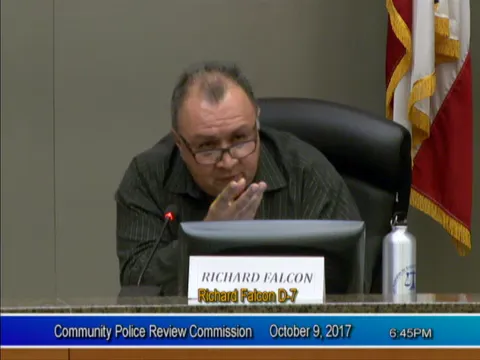
STREAMING COPY IN PREPARATION — RECORDING AVAILABLE FROM THE ORIGINAL SOURCE
Sacramento Community Police Review Commission Meeting - October 9, 2017
The Sacramento Community Police Review Commission met on Monday, October 9, 2017 at 6:00 p.m. in the City Hall Council Chamber. The meeting was called to order with a quorum present. The consent calendar was approved, and the commission received presentations on the Officer Next Door program, the Sacramento Police Department complaint process, and the police department's policy process.
Consent Calendar
- Approval of Commission Meeting Minutes: A motion was made by Member Guerrero, seconded by Member Zamora, to approve the special meeting minutes from August 14, 2017. The motion passed unanimously.
Discussion Items
-
Discussion of Officer Next Door (OND) Program: Francine Tournour, Director of the Office of Public Safety Accountability, presented background on the OND program, established around 2005 by the previous mayor. The program is based on four pillars: training, diversity, engagement, and accountability. She outlined current police department initiatives under each pillar, including fair and impartial policing training, cultural sensitivity training, implicit bias training, de-escalation techniques, crisis intervention training, and less lethal options. Under diversity, the department focuses on hiring that reflects the community, including a mentorship program, home purchase incentives, and a proposed magnet academy. Under engagement, a new Outreach and Engagement Unit was created, along with a Ministers Academy open to non-faith community leaders, cops and clergy programs, and community peacewalks. Under accountability, a transparency section on the police website provides general orders, policies, body-worn camera information, and vehicle stop data. Commissioners asked questions about the educational process, community engagement, and the role of commissioners in outreach. Chair noted that ride-alongs should be completed by the end of the year.
-
Discussion of Sacramento Police Department Complaint Process: Lt. Steve Oliveira, head of the Internal Affairs Division and Professional Standards Unit, presented the complaint process. He explained who can initiate complaints (public, third parties, anonymous, department employees), how they are received (walk-ins, phone, mail, email, via supervisors, OPSA, internal), and the process after receipt. Complaints are categorized as inquiries or formal investigations. Formal investigations involve complainant statements, evidence review, witness interviews, and officer interviews (last). The review process includes the lieutenant, the employee's captain, and the chiefs, with final authority by the chief. Dispositions include unfounded, exonerated, not sustained, and sustained. Formal discipline ranges from reprimand to termination; informal discipline includes documented counseling. Appeal rights include Skelly meetings and arbitration. Notification to citizens is limited to the disposition, not discipline. Commissioners asked about the availability of complaint data (quarterly/annual reports from OPSA), the ability to track repeat offenders without identifying information, the distinction between internal complaints about public interactions vs. officer-to-officer, the logging of supervisor-handled complaints, and the role of video evidence. Lt. Oliveira noted that video has reduced not-sustained findings. The union's role in representation and arbitration was discussed. Questions about the retention of disciplinary records (18 months for reprimand, 5 years for formal) and the involvement of OPSA in the decision process were also addressed.
-
Discussion of Sacramento Police Department Policy Process: Lt. Oliveira continued with the policy process, describing the Professional Standards Unit's responsibilities for creating, revising, and reviewing department policies. The process includes identifying needs from field personnel, legal updates, or subject matter experts; drafting and editing; review by subject matter experts, managers, city attorney, labor relations, and unions; final approval by the chief. Policies are distributed via a training management system (Target Solutions) where officers must acknowledge reading and understanding. Policies are posted on the transparency section of the police website with possible redactions for officer safety tactics. Commissioners asked about proactive communication of policy changes beyond website posting; Lt. Oliveira noted that the department's media unit issues press releases for significant changes.
Commission Comments
- Chair informed commissioners about the Sacramento State convocation on October 10, 2017, from 12-3 p.m., open to the public, with a theme on gun violence.
- Lt. Oliveira offered to meet individually with commissioners for further questions.
- Commissioner Guerrero noted that several commissioners attended the National Association for Civilian Oversight of Law Enforcement (NACOLE) conference in Spokane and will share information with the commission.
- No public comments were made.
Key Outcomes
- The consent calendar (approval of August 14, 2017, minutes) was approved unanimously.
- The discussion items on the OND program, complaint process, and policy process were received and filed as recommended.
- Commissioners were encouraged to complete ride-alongs by the end of the year.
- Future meetings will include further education on critical incidents and policy review, with data on complaints to be presented quarterly or monthly.
- The commission will continue to shape its role in policy recommendations and community engagement.
Meeting Transcript
I'd like to call this meeting to order. Please call roll. Member Carter. Present. Zamora. Present. Present. Savage. So I'm gonna say this wrong, Singwin. Coleman. Wait. Seven Sebian. And Elkara. Present. We have a quorum. If you're here today to speak to the committee before, I'm sorry, on a public item, you'll need to speak a fill out a speaker slip. They're located in the back window. You will complete that and turn it into the assistant clerk here. And they must be turned in before the start of the item. If you need assisted listening or speaking device, you will also see the assistant clerk. This meeting is being recorded in video and live streamed. This is the time to turn your cell phones, iPads, anything to the off or silent position. All right, next first item is the consent calendar. Do we have a motion to approve? Motion approve the meeting minutes from last from August 14th. Okay. Motion made by um Member Guerrero, seconded by Zamora. All those in favor? All right. All right. Opposed. All right, the eyes have it. All right, discussion item number two. All right, thank you, uh, Chair. So basically, at our last public meeting, I mentioned that I would be bringing some background and history regarding the officer next door. Um, the officer next door initiative is something that was brought about right around 2005 from our previous mayor, and it was established to basically um his vision at the time was to make Sacramento the safest big city. And the way he wanted to implement that program was through community input um and community engagement. So the foundation of this particular commission was uh the four pillars. Those four pillars are training, diversity, engagement, and accountability. Uh, what you're gonna hear tonight from the Lieutenant of Internal Affairs will talk a lot about the complaint process as well as the process of going through the professional standards for changing policy um and what the department currently does to make policy changes. So this particular commission, their scope is to make uh policy recommendation and changes, uh recommendation for changes to mayor and council, and then there would be a process of staff, OPSA staff preparing that document to move forward to present to the city manager and the police chief uh for any required uh changes that the council may want to move forward on. But what I really want to discuss as well as some of the things that the police department is currently doing in the area of those four pillars is that um the commission is not necessarily completely charged with always making recommendations for changes to policy, but also maybe given some recommendations on how the police department can better implement the current policies that they have or how to better engage the community with some of the policies that are currently in place. So I definitely want to make sure that when um professional standards does their or when the lieutenant does his presentation regarding the professional standards process, that you understand that policy changes aren't something that happened all the time super frequently. So there's other areas where the commission can definitely engage the police department and the community as well to make some of their current practices and policies uh better for the police department and the community alike. So I'm gonna just run through some of the things that the police department is doing. Um it's a little more recent than our previous two commissioners. I think when I did this presentation last time, it was a little up in the air, and some things that the police department was looking to do, so these are things that are currently in place. So um regarding the training component or the training pillar, um, there is a fair and impartial policing training that the officers get in their continued um training that they have every year. They have cultural sensitivity, implicit bias and discrimination recognition, peaceful conflict resolution and de-escalation techniques, chronic and mental illness recognition. They have the problem-oriented policing that was just recently implemented again, procedural justice, um, procedural justice.
openpublica.com