Sacramento Community Police Review Commission Meeting - November 13, 2017
STREAMING COPY IN PREPARATION — RECORDING AVAILABLE FROM THE ORIGINAL SOURCE
Sacramento Community Police Review Commission Meeting - November 13, 2017
The Sacramento Community Police Review Commission met on Monday, November 13, 2017, at 6:00 p.m. in the City Hall Council Chamber. The meeting included presentations on police and OPSA statistics, police equipment (body-worn and in-car cameras), and critical incidents protocol. The commission received and filed reports on these topics and scheduled future presentations on excited delirium and less-lethal weaponry.
Consent Calendar
- Approval of Minutes (October 9, 2017): Passed with 8 yes votes (Kinsey, Sabeniano, Elkarra, Savage-Sangwan, Guerrero, Escobar, Carter, Coleman) and 1 abstention (Hoyt).
Discussion: SPD and OPSA Statistics
- Presenter: Francine Tournour, Director of OPSA, reported on complaints and investigations for the period January 1, 2016, through June 30, 2017.
- In that period, there were 56 cases with 317 allegations (each allegation counted as a complaint).
- SPD directly received 235 allegations, resulting in 56 investigations; OPSA sent 82 allegations to SPD.
- Of 39 formal investigations completed, 34 were sustained; 17 cases were still open at reporting time.
- 15 officers were disciplined as a result of sustained allegations.
- Tournour clarified that some sustained cases may result in training rather than discipline, which is not considered formal discipline.
- She noted that the 87% discipline rate is based on allegations, not cases.
- Officers are allowed to view body-worn camera video before writing reports, and after critical incidents, video is locked down after initial viewing.
- OPSA will provide quarterly statistical reports starting in January, with more detailed breakdowns of allegations and dispositions.
Discussion: Police Equipment
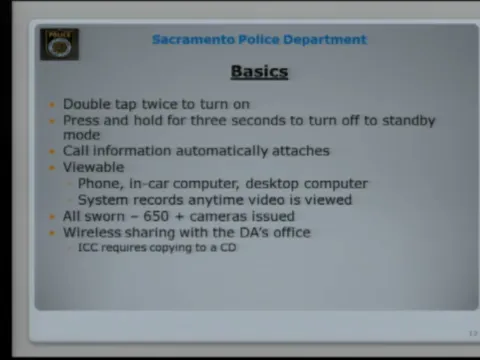
- Presenter: Lieutenant Justin Risley (SPD) discussed both in-car and body-worn cameras (BWC).
- In-car cameras: Panasonic Arbitrator, in use since 2001, upgraded to Gen 2 in 2012. Features include rear cameras, wireless download, and 30-second pre-record.
- Body-worn cameras: Two-year project, selected Taser/Axon (now Axon). Cameras have 12-hour battery life, 43-degree field of view, and 23 hours of record time.
- All sworn officers have been issued BWCs.
- Automatic triggers (e.g., emergency lights, rear door activation) activate both in-car and body cameras.
- Axon system is cloud-based with three layers of encryption; no known hacking incidents.
- Video retention: currently 18 months unless evidence-related; may extend to 2 years minimum, up to 10+ years for homicides.
- Officers are authorized to review their own video; supervisors may review all video.
- One incident of an officer intentionally not wearing a camera was reported; that case is being addressed.
- Body-worn cameras are not used in county jail per sheriff's request; jail has its own cameras, but that footage is not subject to same release policy.
- A 127- or 142-video release for a recent officer-involved shooting is being managed.
- No formal post-implementation survey is planned, but officer feedback has been positive.
Discussion: Critical Incidents Protocol
- Presenter: Lieutenant Bob McCloskey (SPD) and Captain Norm Leong (SPD).
- Overview of response to officer-involved shootings, homicides, and in-custody deaths.
- Statistics: Approximately 14,000 arrests and 117 use-of-force incidents per year; 350,000+ calls for service annually; average 3-5 officer-involved shootings per year, about 1 in-custody death per year.
- For officer-involved shootings, parallel criminal and administrative investigations occur; DA's office performs independent review.
- Public safety statements are limited to who, what, where, when (not why).
- Round counts are conducted for all officers on scene to verify who fired.
- Body-worn video is reviewed by officers before statements, then locked down.
- Witnesses may be detained if they have information; filming police is not illegal, and officers have been briefed on this.
- Lead detective now serves as family liaison, providing direct contact.
- Deceased subjects are not touched until coroner's permission; body screens are used for privacy.
- Officers get a minimum of three days off after a shooting and receive peer support, which is confidential.
- 30-day critical incident review is led by management.
- Reports to Attorney General's office are required within 10 days for deaths in custody or officer-involved shootings.
Key Outcomes
- Consent calendar minutes approved (8 yes, 1 abstain).
- Reports on statistics, police equipment, and critical incidents protocol were received and filed.
- OPSA will provide a breakdown of allegations associated with discipline, expected by next week (as of November 13, 2017).
- Future presentations planned on excited delirium and less-lethal weaponry.
- Commission’s next meeting is scheduled for December 11, 2017.
Public Comments & Testimony
- No public comments were made for items not on the agenda.
Commission Comments
- Commissioner Carter requested more detail on sustained allegations and associated offenses; OPSA will provide.
- Commissioner Guerrero asked about redaction processes; clarified redaction involves blurring/beeping, not removal.
- Commissioner Savage-Sangwan asked about complaint demographic data; OPSA will capture more via a new system.
- Concerns were raised about the clarity of statistics (e.g., whether numbers refer to cases or allegations); OPSA acknowledged the report could be misleading and will clarify.
Meeting Transcript
Meeting to order. Mariana Savion. Wendy Hoyt. Sam Kinsey. Present. Johnny Coleman. Kieran Savage Sanguan. Mario Guerrero. Present. Eddie Escobar. Here. Randy Zamora. Richard Falcone. And Renee Carter. So we do have a quorum. For the meeting tonight, I ask any members of the public and also of the commission to silence your cell phones. Speaker slips are in the back of the room. If you would like to speak on an item, please clarify on the slip which item you would like to speak on. Hand it to the staff at the desk, and we will call you up. The first item on the agenda is the consent calendar. We're looking for a motion to approve the commission minutes for the October 9th meeting. All in favor? Any no's abstentions? And the motion passes. Oh yes, I'm getting saved in the back. All right. So just a little point of clarification. When it comes to inquiries versus investigations, it's important to note that people can call in and make a complaint. So in some cases or instances, the person can get satisfaction with whatever explanation that they're given, or it could be that whatever they're complaining about, even if it was in fact true, would not violate policy, so therefore it wouldn't go into the formal realm of investigation. So a good majority of some of the things that people call and complain about gets resolved prior to it actually being needed to be handed over to internal affairs, or even if internal affairs is involved with the process, there's resolution without it needing a full-blown investigation, which would then have an attached disposition. So in the instances here, there are different cases that may have several allegations. The way we do our reporting is that we list out the allegations and we consider each allegation a complaint. So you may for this reporting period, there were 56 cases, but there were multiple allegations. There were 317 allegations, and I can answer any questions about that towards the end of the presentation. So this was a slide I mentioned. In 2015, there were a total of 110 allegations in the 18-month period that we were reporting on. The police department directly received 235 allegations, which resulted in 56 investigations, and OPSA sent 82 of those. There are periods of time where OPSA and the police department will receive complaints simultaneously. So in those instances, that number is reflected in the SPD number. When we come forward in the future to give you the quarterly reports regarding the different statistical information that the commission will be a part of, we'll try and give you a summary of the type of complaint and some type of explaining about how we got to the disposition we got to. So if the case didn't turn into a formal investigation, especially, we'll tell you exactly how we got that complaint into resolution or why it didn't end up being a formal investigation. So we'll kind of break it down to a lot more detail. Obviously, with these larger numbers in the commission just now getting started, we won't have the opportunity, but we will go back and give you starting in January the last six months where the annual report stops off. So I'm not going to belabor all the allegations that are there for you to see. Not sustained means that they could not determine one way or the other whether or not the employee did the alleged activity. If it was the last one, exonerated, it basically means that the employee actually did do the activity, but it did not violate policy. So that pretty much covers it. Of the statistical information here, the 39 formal investigations, these were the ones that were completed within that period. At the time of reporting, there were still 17 cases that were open. So the critical incidents can be found on page 14 of the annual report.
openpublica.com