Sacramento Community Police Review Commission Meeting - December 11, 2017
STREAMING COPY IN PREPARATION — RECORDING AVAILABLE FROM THE ORIGINAL SOURCE
Sacramento Community Police Review Commission Meeting - December 11, 2017
The Sacramento Community Police Review Commission met on Monday, December 11, 2017, at 6:00 p.m. in the City Hall Council Chamber (915 I Street). The Commission approved the prior meeting minutes, heard three presentations from Sacramento Police Department staff on excited delirium, less-than-lethal force options, and video release policy, received public comment, and discussed future commission business. The meeting adjourned at 7:41 p.m.
Consent Calendar
- Approval of Commission Meeting Minutes for November 13, 2017. Moved by Member Hoyt, seconded by Member Guerrero. Passed with 8 yes votes and 1 abstention (Member Zamora). Note: The agenda recommendation incorrectly referenced "Special Meeting Minutes dated October 9, 2017," while the item title and approved motion referred to the November 13, 2017 minutes.
Discussion Items
Excited Delirium Presentation
- Lieutenant Bob McCloskey of the Sacramento Police Department Major Crimes Division presented. He described excited delirium as a potentially fatal medical distress condition, often linked to intoxication or altered neurochemicals, with indicators such as high body temperature (105+ degrees), irrational behavior, undressing, profuse sweating, and superhuman strength. He stated it is not caused by conducted energy devices (CEDs or Tasers).
- Officers are trained to recognize the condition, call for fire/EMS, and transport subjects quickly; the focus is on rapid medical care rather than pain compliance. Training is POST-mandated and included in an 8-hour block covering officer-involved shootings and in-custody deaths. No written medical research is provided, only signs/symptoms and general orders. In-custody deaths are reported to the state Department of Justice within 10 days.
- Commissioner questions addressed training materials, possible confusion with mental illness or overdose, tracking of outcomes, and whether outside medical professionals are involved (they are not).
Less than Lethal Force Options
- Deputy Chief Dave Polletta presented. Pre-2017 tools included expandable baton, OC spray, CED/Taser, and K9. After two fatal 2016 officer-involved shootings (Center Parkway and Del Paso Heights), the city approved $800,000 in February 2017 for equipment and training.
- New tools include converted Remington 870 shotguns with beanbag rounds, rifled pepperball guns, 40mm launchers with sponge rounds, ballistic shields, and first aid kits. These are assigned to patrol teams for faster deployment.
- Training: 5-hour block, limited to 12 students, focused on communication and de-escalation. 225 patrol officers trained so far; about 300 remain, with a target completion date of March 2018.
- Commissioner questions covered effectiveness, use in excited delirium situations (Deputy Chief unsure), training content, and prioritization.
Video Release Policy
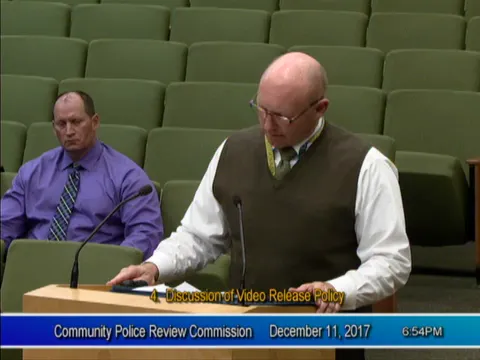
- Captain David Risley presented. The policy originates from the City Council's use of force policy (passed November 29). Section L requires release of video associated with officer-involved shootings, in-custody deaths, or complaints reported to OPSA within 30 days, unless release would hamper an investigation or endanger parties. Families get a preview; faces are blurred; graphic content warnings are given.
- Process includes identifying video from in-car, body-worn, surveillance, and third-party sources. Redaction takes an average of 36 hours per case (12 video recordings, ~10 minutes each). The chief can request a waiver from the council; this has happened once.
- Current redaction is done by one media services staff member, with others being trained. A more comprehensive video release policy is in development, with a target of the first quarter of 2018.
Public Comments – Matters Not on the Agenda
- Muriel Strand read a 1994 quote from John Ehrlichman regarding the Nixon administration's drug policy targeting anti-war groups and black communities. She commented that police forces have been put in unfair situations for political reasons and submitted written materials.
Commission Comments & Ideas
- Member Savage-Sangwan thanked SPD for invitations to the promotion ceremony and town hall, and asked about the status of the use of force policy review. It was agreed an update would be agendized once drafted.
- Member Hoyt requested notification when police-department-related items go to the City Council. OPSA agreed to send agenda notices.
- Discussion about race data on complaints: OPSA will include race when available in the new system, with reports from July 2017 onward; recommendations from Commissioner Carter are being considered for quarterly reports, subject to POBR (Police Officers Bill of Rights) review by the city attorney.
Key Outcomes
- Approved consent calendar minutes (8 yes, 0 no, 1 abstention).
- Received and filed all three discussion items (excited delirium, less than lethal force options, video release policy).
- OPSA to send notifications for police-department-related City Council agenda items.
- Use of force policy update to be presented to the Commission once available.
- Next meeting scheduled for January 8, 2018, with calendar adoption and chair/vice-chair elections.
Meeting Transcript
I'd like to call this meeting to order. We have to see please take roll. Basti Malkara? Here. Ariana Samiano. Wendy Hoyt. Here. Sam Kinsey. Donnie Coleman. Present. Karen Sadid Sangwan. Yeah. Mario Guerrero. Present. Eddie Escobar. Present. Present. Richard Falcon. Here. And Renee Carter. Present. We do have a quorum, but prior to starting, I would like to um make notice to the public that this is a public meeting. If you do have a cell phone or any other um audible device, please turn that off or put it in the uh vibrate position. This particular meeting will be live video streamed on the city's website. Uh any members of the public who wish to address the commission, they can do so by picking up a peaker speaker slip in the back of the room and bringing it forward to the staff member up front. The speaker limits will be two minutes per item. Thank you, Francine. Uh, for the consent calendar, um, do we have a motion to approve the minutes? I approve you. All right, all those in favor? Opposed? Abstentions. Hi. We have one abstention. All right. All right. So minutes are approved. Uh discussion calendar item number two, discussion of excited delirium. Deputy Chief Bernard. All right, good evening. Um Lieutenant Bob McCloskey with the uh major crimes division of our office of investigations for the Sacramento Police Department. I briefly spoke with you guys uh a couple weeks ago regarding the officer involved shooting, so I was gonna finish it up with the uh excited delirium portion. Um just a kind of quick reminder of one of the charts I showed you a couple of weeks ago is uh the uncustity deaths. Uh excited delirium directly kind of reflects the custody deaths. We average about one a year, so again, we're not talking about a whole bunch of cases. Um, but that's the cases they directly uh result or affect. So again, talking about excited delirium, what it is and what kind of some of the misnomers out there. Again, uh there was a lot of uh mistaken beliefs and how um our tasers or CEDs were uh were affecting the number of uh excited delirium cases, and it just after um much debate and proven uh science with coroner's office and medical examiners throughout the country. This is not the case. So what is excited delirium?
openpublica.com