Sacramento Police Review Commission Meeting - April 9, 2018
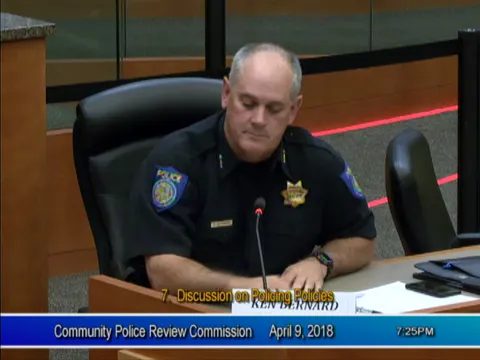
STREAMING COPY IN PREPARATION — RECORDING AVAILABLE FROM THE ORIGINAL SOURCE
Sacramento Community Police Review Commission Meeting - April 9, 2018
This was the first meeting of the commission since the Stephon Clark shooting on March 18, 2018. The meeting featured presentations from the U.S. Department of Justice Community Relations Service and the ACLU on use of force best practices, updates from ad hoc committees on diversity and accountability, and a discussion on policing policies. The commission heard public testimony expressing demands for accountability and policy reform. The meeting concluded with plans for a community forum on May 14, 2018, and a commitment to develop policy recommendations for the City Council.
Consent Calendar
- Approved the March 12, 2018 meeting minutes with one abstention (Commissioner Sam Kinsey abstained).
Public Comments & Testimony
- Charles Castillo: Expressed concern that policies without accountability and consequences are meaningless. Questioned why officers can turn off body cameras and noted that in other professions, taking a life mistakenly leads to consequences.
- Dr. Irfan Haq (President, Council of Sacramento Valley Islamic Organizations): Called for serious sensitivity training, use of non-lethal tactics, changes to pursuit policy, greater diversity in law enforcement, and an end to excessive force and police brutality.
- Gail Guest Brown (private citizen): Spoke about the abuse of legal force, citing the Stephon Clark shooting and a recent settlement of $550,000 for a jaywalking incident. She urged the commission to adopt recommendations from attorney Terry Roberts Robinson, including: justification for deadly force only when no other alternative, turning off body cameras should be a firable offense, implicit bias testing for all officers, and not releasing suspect records before investigations conclude.
Discussion Items
- Presentation of March 2018 Police Complaint Activity Report: OPSA received five community complaints in March. Three were sent to Internal Affairs for further review; two were handled directly by OPSA and closed. The report was received and filed.
- Update from Diversity Ad Hoc Committee (Mario Guerrero): The committee met with Sergeant Greenley to discuss outreach to communities of color. They are developing a survey for police officers of color to identify barriers to entry. An external research department will help draft the survey. Two community forums are planned with a consistent format.
- Update from Accountability Ad Hoc Committee (Wendy Hoyt): The committee has met five times since February, focusing on protocols for foot pursuit, use of force, and multi-jurisdiction communication. They identified three key questions: (1) How does SPD assess training quality for lateral hires? (2) At what point should an officer pursue versus contain and check in with dispatch? (3) How does interagency communication work when multiple law enforcement agencies are involved? The committee will continue to review best practices.
- U.S. Department of Justice Presentation on Community Engagement (Justin Locke, CRS): CRS offers mediation, training, consultation, and facilitation as a neutral third party. Services are confidential, voluntary, and free. The agency does not investigate or litigate. CRS has worked in communities such as Anaheim and Sonoma County after officer-involved shootings. Commissioners asked about team diversity, success measurement (determined by local parties), training, and cultural competency resources. The PowerPoint and handout will be posted on the city website.
- ACLU Presentation on Use of Force and Best Practices (Adriana Wong): The presentation compared Sacramento PD’s use of force policy to state law, constitutional standards, and national best practices (PERF, Campaign Zero, National Consensus Policy). Key findings: Sacramento’s policy lacks (1) an imminence requirement for deadly force, (2) consideration of officer tactics leading up to the use of force, (3) a proportionality standard, (4) a requirement that force be used only when no reasonably effective alternative exists, (5) a requirement to give a warning before deadly force, and (6) a prohibition on shooting at moving vehicles. The policy includes de-escalation language but undermines it by citing Penal Code 835A, which states officers need not retreat. The ACLU rated Sacramento’s policy as “middle of the pack.” The presentation will be shared with the commission.
- Discussion on Policing Policies: Deputy Chief (name not specified) responded to commissioner questions. Topics included:
- Body camera muting: A memo was issued a week prior requiring officers to keep cameras on unless a supervisor approves turning them off. The policy is being reworked, and the commission will have an opportunity to provide input.
- Training for lateral hires: Lateral officers from out-of-state must attend the academy again; in-state laterals undergo a 4-5 week classroom orientation and field training. Background checks include personnel and IA files from prior agencies.
- Foot pursuit policy: Currently no specific foot pursuit policy; one is under discussion. Vehicle pursuit policy is in place.
- Use of force committee: A new committee, including community members, is reviewing policy and training.
- Early intervention system: SPD has a tracking system for officer incidents, with an early warning feature for supervisors if an officer is involved in multiple significant incidents.
- Medical assistance: Policy states officers should provide emergency medical treatment as soon as it is safe. No specific training on expedited care for a person injured by police.
- Multi-jurisdiction incidents: Each agency follows its own policies; there is no formal MOU with the Sheriff’s Department regarding use of force.
- Discussion on Strategic Plan for 2018: Commissioners discussed potential new areas of focus, including gang validation, sanctuary city policies, crimes against women (sexual assault, domestic violence – requested by Hoyt), and interagency cooperation (requested by Sabignano). Commissioner Guerrero requested the commission consider state legislative proposals SB 1421 (Senator Skinner) and AB 931 (Assemblymember Weber) at a future meeting. Commissioner Falcon reiterated the need to re-examine the commission’s charter.
Key Outcomes
- Received and filed all reports (Items 2-6).
- The commission will work with staff to develop a process for receiving and reviewing draft policies from SPD, particularly on body cameras, before finalization.
- The next meeting is scheduled for May 14, 2018. The location may be moved to a larger venue in South Sacramento to accommodate community participation, with live streaming if possible.
- The commission intends to develop recommendations for the City Council on police policy, procedures, and best practices, including the areas identified in the ACLU presentation and the ad hoc committees.
- Commissioner Guerrero requested that SB 1421 and AB 931 be placed on a future agenda for presentation and possible recommendation to the City Council.
- Commissioner Falcon suggested inviting UC Davis and Sacramento State to provide training on equity, diversity, and racial healing.
- The chair reminded the public that the commission’s purpose is to provide community participation in reviewing and recommending police department policies, and encouraged continued attendance.
Meeting Transcript
Like to call this meeting to order. Roll call. Asi Malkara. Present. Mariana Sabignano. Wendy Hoyt. Sam Kinsey. Johnny Coleman. Kieran Savage Sangwan. Mario Guerrero. Present. Eddie Escobar. Present. Richard Falcon. Here. Renee Carter. Chair, we have a quorum. Thank you. And this meeting is being video streamed and can be viewed live on the city's website or viewed later from the archive files. Anyone who wishes to speak should complete a speaker slip and we give it to the clerk. The speaker forms are at the back of the room. Testimony will be limited to two minutes per person. So please turn off or make silent your cell phones or other communications devices. And a cordless microphone is available from the clerk upon request. Thank you. So this is our our first meeting since the Stephon Clark shooting. And I'm sure I speak for other commission members, but we feel a heavy weight on our shoulders. And especially with this commission and the work that this commission is doing, I want to thank the commission commissioners for attending different meetings in the community, listening to the community, listen to the concerns of the community. And at the end of the day, we represent the community. All those in favor? The opposed abstentions? Aye. One abstention. All right. OPSA received a total of five community complaints during the month of March. Three were sent to internal affairs for further review. And two were handled directly by OLPSA and closed. Yeah, go ahead. Okay. Good evening. Mario Guerrero here. I'm just giving a quick update on the diversity efforts. We did uh meet with uh Sergeant Greenley, who's our liaison. Um, and so we um had a great conversation about efforts regarding uh outreach to communities of color with regards to incre in increasing um diverse candidates. One of the things that we talked about was actually creating a survey um for uh police officers, especially police officers of color to figure out what are additional barriers to uh coming into law enforcement. So um one of the responses was that that they don't have personnel to actually create that. Um we've since found an external resource um uh research department at my organization that will help us uh draft a survey, so we'll draft it, send it over, and hopefully that we can implement that again to get that type of feedback with regards to the two forums that we have scheduled. Um we've uh kind of agreed on a rough format of those and we'll um send them to the appropriate staff here so that um we have a format for both so we have a consistent format. And that is our update. Any questions?
openpublica.com