Sacramento Community Police Review Commission Regular Meeting - September 10, 2018
STREAMING COPY IN PREPARATION — RECORDING AVAILABLE FROM THE ORIGINAL SOURCE
Sacramento Community Police Review Commission Regular Meeting - September 10, 2018
The Sacramento Community Police Review Commission convened at 6:00 p.m. on Monday, September 10, 2018, in the City Hall Council Chamber, with open session called at 6:01 p.m. and adjournment at 8:46 p.m. Present were Chair Basim Elkarra, Vice Chair Mariana Sabeniano, Wendy Hoyt, Kiran Savage-Sangwan, Renee Carter, Erandi Zamora, Richard Falcon, Johnny Coleman, and Mario Guerrero. Members Eddie Escobar and Sam Kinsey were absent. The Commission approved minutes, heard presentations on the Brown Act and Sacramento Police Department programs, revised its Ad Hoc recommendations, and created a new ad hoc committee.
Consent Calendar
- Approved the August 13, 2018 Commission meeting minutes via unanimous consent motion (Hoyt/Guerrero), after corrections were noted regarding a recorded vote and a reference to a Senate bill.
Public Comments & Testimony
- Dennis Hewlett: Urged more frequent, ideally monthly, release of use-of-force data rather than annual; suggested the Commission adopt principles similar to AB 931 before the state acts, including clear definitions of terms and consequences for policy violations; and recommended independent third-party review of body-worn camera footage instead of police self-review.
- Joshua Robinson: Argued that a prerequisite to successful diversity recruitment is a public-relations campaign by SPD acknowledging historical racism, civil rights-era abuses, and mass incarceration. He stated the burden of trust is on the police and said impactful black and brown community members will not join until the department admits past mistakes. He also expressed frustration that his repeated comments had not been placed on the agenda.
Discussion Items
-
Brown Act Presentation (Item 2): Deputy City Attorney Audreyell Anderson presented an overview of the Brown Act, including the City Attorney's role as legal advisor, serial meeting prohibitions (daisy chain and hub-and-spoke examples), limits on discussing non-agendized items, public comment rights, and motion procedures. The Commission received and filed the presentation.
-
SPD Response to Commission Ad Hoc Recommendations (Item 3): Sacramento Police Department Captains Kathy Lester and Mark Greenley presented responses to the Commission's accountability and diversity recommendations.
- On accountability, Captain Lester said the department releases use-of-force statistics and will expand data collection under AB 953/RIPA in 2019. She described current use-of-force policy language on de-escalation and reassessment, a new foot pursuit policy requiring specific articulable facts and rejecting flight alone as justification, and body-worn camera policy updates including monthly audits and supervisor reviews. She stated that granting the Commission independent investigatory authority was outside the Police Department's scope and a Mayor/Council matter. There was a discrepancy over AB 931: Captain Lester described it as delayed until fall, while Commissioner Guerrero said it had failed and would need to be reintroduced in a different vehicle.
- On diversity, Captain Greenley reported declining applications from about 6,000 in 2013 to roughly 3,500, a 50-65 percent written-test pass rate, and about 50 percent applicant attendance at testing. He expressed full support for several recommendations, including outside review of recruitment programs, diverse background investigators and hiring panels, bias-free training, and city auditor review of applicant data. He noted union contract limitations on some incentives and described existing programs such as SPD Strong boot camp, hiring workshops, LINKS to Law Enforcement, and the Law Enforcement Candidate Scholars program.
-
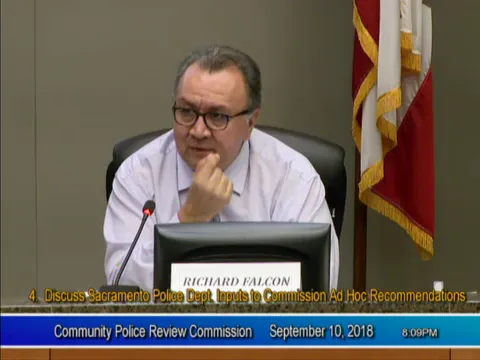
SPD Inputs and Commission Revisions (Item 4): After receiving SPD feedback, the Commission voted by two-thirds to waive formal City Council rules to reconsider its prior August 13 motion. It then approved revised Diversity Ad Hoc Committee recommendations, incorporating changes to emphasize diversity throughout the hiring process, test-preparation workshops, priority for local applicants, surveys of no-show applicants, ethnic studies coursework, a diversity and cultural change plan, and a public-relations/dialogue campaign acknowledging historical racism. For Accountability Ad Hoc recommendations, the Commission approved a focused recommendation that Sacramento adopt a deadly-force standard of 'only when necessary and when reasonable alternatives have been exhausted,' with use-of-force policy data on demographics and force type posted publicly monthly. Body-worn camera and foot pursuit policy recommendations were deferred for further review at the October 2018 meeting. Commissioner Hoyt expressed discomfort with dropping body-worn cameras from the package, citing community concern after the Stephon Clark shooting and the importance of body-worn camera policy to trust and accountability.
-
Mental Health and Substance Abuse Training and Protocols (Item 5): Lieutenant Dan Monk presented SPD's mental health and homelessness programs. He reported 35,000 homelessness-related calls in 2016, 41,000 in 2017, and a pace exceeding 45,000 in 2018. He described the IMPACT team (one sergeant, six officers), the Mobile Crisis Support Team pairing officers with county clinicians, Crisis Intervention Training (40 hours for officers), mental health investigators, a peer navigator, and plans to hire a social worker and create a multidisciplinary team. The Commission received and filed the presentation.
-
Select Ad Hoc Membership (Item 6): The Commission established a new ad hoc committee to evaluate SPD training and protocols for interactions with people living with mental illness or substance abuse disorders. Commissioners Guerrero, Falcon, and Savage-Sangwan were appointed. The committee was tasked to report back, research best practices, and educate the Commission on community outreach assistance.
Key Outcomes
- Consent calendar approved.
- Brown Act presentation and SPD presentations received and filed.
- Revised Diversity Ad Hoc recommendations approved for presentation to Mayor and Council.
- Accountability Ad Hoc recommendation prioritized: deadly force standard and monthly public reporting of use-of-force data; body-worn camera and foot pursuit policies deferred to October 2018.
- New ad hoc committee created with members Guerrero, Falcon, and Savage-Sangwan.
- Meeting adjourned at 8:46 p.m.
Commission Comments & Outreach
- Commissioner Guerrero expressed frustration with the parallel SPD Use of Force Committee and sought more transparency about its membership and processes.
- Commissioner Zamora urged the Commission not to forget other recommendations, including body-worn cameras and discipline.
- Several commissioners discussed community outreach needs, including recruitment of women, dialogue between police and communities of color, and sanctuary-city policy follow-up.
Meeting Transcript
Member Hoyt. Coleman. Sangwan. Escobar. Mora. Falcone. Here. Carter. Vice Chair Sabiano. Chair Elkara. Present. If you're here today to speak to the committee, you will fill out a speaker slip that are located in the back window and turn into the assistant clerk, and they must be received before the start of the item. There are no exceptions. If you happen to be here for the Sacramento Metropolitan Arts Committee meeting, they're normally here but meeting in this building right here behind us. If you need an assisted listening or speaking device, you'll also see the assistant clerk. All right. Thank you everyone for coming out tonight. We've been looking looking forward to discuss these issues. Our first order of business tonight under the consent calendar is to approve the minutes. Do we have a motion? Everyone reviewed them. Because I think you spotted them. Just on my attendance, but um I I think that um there are there was uh a vote that not everybody was uh here for. There's just one minor thing on number nine. I think on the vote, um Commissioner Coleman was not here. It was a minor thing, but just to correct that, and the other thing that I thought uh which was Mario was marked absent, and he corrected me that he showed that uh he absolutely is here, he just wasn't here at the very beginning. So it was just that, just item nine. And also along with item nine, um, discussion on commission support for Senate bill, not state bill, but it is a state bill, but it's it was a Senate bill. Might as well correct that. All right, any other changes? With those changes, we have a motion to approve. I would so move. Second. All right, all those in favor? Abstentions. Sorry, nays. All right, the minister approved. Uh we'll move on to the discussion calendar. Our first uh topic is a brief from our new city attorney advisor, Miss Anderson. Good evening, Commission. My name's Audrey Anderson. I've been assigned to staff you as your attorney. So tonight I'm gonna make this as painless as possible. And uh feel free to ask me any questions at the end. If you have specific questions that you want to discuss with me, you can email me or call me, and uh we can get into the details. Because as you all know, the law functions on details. So some things I might not be able to answer right away, but I will do my best to get an answer to you. So I'm gonna just do a brief overview of the Brown Act and some rules related to how you conduct meetings and motions and interact with the public. Just for side note, there are a number of things, a number of laws that impact your public meetings, including the Brown Act, there's Public Records Act and GIFs limitations, hiring bias, there's a whole bunch of other things that also interact with how you conduct your meetings and how you do your business, but I'm gonna simplify it tonight and just discuss the Brown Act. First, I'm gonna talk about my role as your attorney.
openpublica.com