Sacramento Community Police Review Commission Meeting - December 10, 2018
STREAMING COPY IN PREPARATION — RECORDING AVAILABLE FROM THE ORIGINAL SOURCE
Sacramento Community Police Review Commission Meeting - December 10, 2018
The Sacramento Community Police Review Commission met on Monday, December 10, 2018, from 6:01 p.m. to 7:16 p.m. at City Hall. The Commission approved the consent calendar, discussed and amended recommendations for police department diversity and accountability, and received an update from the Mental Health Ad Hoc Committee.
Consent Calendar
- Item 1: Approved the meeting minutes of September 10, 2018.
- Item 2: Received and filed the July through September 2018 Police Complaint Activity Report.
- Item 3: Passed a motion to dissolve the Diversity Ad Hoc Committee.
The consent calendar was adopted by a single motion (Moved: Member Hoyt, Seconded: Member Sabeniano; all present members voted yes: 8-0).
Discussion Items
Item 4: Discuss Potential Amendments to Commission Ad Hoc Recommendations
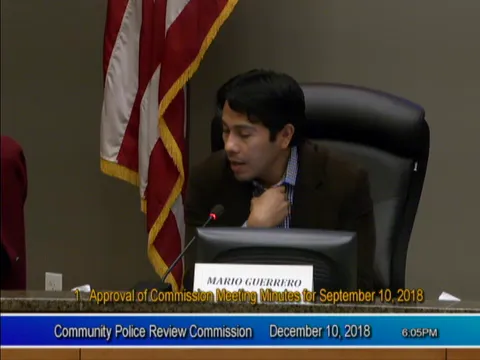
Commissioner Mario Guerrero presented proposed amendments to two recommendations from the Diversity and Accountability Ad Hoc Committee, based on meetings with Chief Hahn, Mayor Steinberg, and Deputy Chief Lester. The amendments aimed to address concerns about recruitment barriers and community engagement:
- Ethnic studies requirement: Phase in a requirement for new recruits to complete an ethnic studies course by 2022 (allowing them to take it while in community college), and require transfer officers to complete the course within two years of hire. Commissioner Guerrero suggested the language could also state that the requirement is contingent upon labor negotiations.
- Community input tools: Replace the original recommendation with a call to develop tools (e.g., podcasts, public conversations) to acknowledge the history of racist laws that police have enforced, reaffirming departmental values.
Commissioners discussed whether the language had been pre-vetted with the police department. Commissioner Kiran Savage-Sangwan asked if the department had reviewed the exact proposed language, noting a risk of further pushback. Commissioner Guerrero acknowledged the process was still being refined and that the changes were intended to show responsiveness to input.
After discussion, the Commission voted to suspend its rules (by two-thirds vote) to reconsider a prior motion from September 10, 2018, and then passed a motion (Moved: Member Guerro [sic], Seconded: Member Savage-Sangwan; all present: 8-0) approving the revised Diversity and Accountability Ad Hoc recommendations to be forwarded to the Mayor and City Council.
Item 5: Mental Health Ad Hoc Committee Update
The Commission received and filed an update from the Mental Health Ad Hoc Committee regarding its work with the Sacramento Police Department. No further action was taken.
Public Comments – Matters Not on the Agenda
No public comments were made.
Commission Comments & Next Steps
- Chair Basim Elkarra requested an update from the Sacramento Police Department on the draft Use of Force policy.
- Member Richard Falcon recommended that commission materials be published in Spanish.
- Member Kiran Savage-Sangwan asked how the Police Department ensures services are available to community members with limited English proficiency.
- Director Francine Tournour informed the Commission that a resolution would go to the Mayor and Council on January 22, 2019, which, if passed, would direct the Commission to evaluate the Sacramento Police Department's Body Worn Camera program.
Key Outcomes
- Approved consent calendar (8-0).
- Approved revised Diversity and Accountability Ad Hoc recommendations to send to City Council (8-0).
- Received and filed Mental Health Ad Hoc Committee update.
- Multiple inquiries raised for follow-up with the Police Department.
Meeting Transcript
We have a motion. Okay, we have a second. All those in favor? Aye. Any opposed? Abstentions? Or the eyes have it? So now I'd like to hold the discussion on what was happened since the September meeting and why we want the commission to reconsider the recommendations. Since the last since we've developed our recommendations, the a group of a small delegation of us have met with Chief Hahn and Mayor Steinberg. We had the opportunity to walk through the recommendations from both ad hoc committees. And I believe the vast majority of our recommendations desire to implement them all. There were two that seemed like they would be difficult, or the SPD might not be able to do. And you can read the rest. On those two, on the first one, Chief Hahn in particular had concerns with the impact on recruitment. And certainly it was not our intention to build to bring up another barrier for recruitment. So I emailed a recommendation to the committee to change it, change that recommendation as follows. Phase in a requirement of an ethnic studies course as part of the college course requirement for new recruits and for transfer officers, require them to take a course at a community college waiting within their first two years. What this does is for um it gives uh SAC PD an opportunity to phase in with new recruits. So say this was phased as in 2022. Um the recruits they're recruiting that are in community college, they can say, hey, you're in community college, rem, you know, you we have this three unit requirement, make sure to take the course as part of your you know education. And then in terms of transferred police officers, they can have one to two years to take or an appropriate time to take the course at a local community college. So I believe that and we had a conversation about how this could um uh achieve the goal and not be a barrier to the point to the recommendation. Um and then the I'm just gonna keep going. And then to the second one, um, I think it's important to have uh to have community input on some of these tools. Um I don't we're not there's they may have been a misunderstanding of what the the point was. Um so this this initial recommendation um was to work with communities to build tools to talk about um this country and states um uh you know just blatant in some cases uh racist laws that police officers have had to implement and they've had to implement them, right? To acknowledge that, not to apologize, but to acknowledge um that history and and to say that's not who we are, that's not what we're about. We want to, these are our values. This is why it's important for us to recruit diverse um uh police officers uh from the communities that we serve. And so um I think with these changes with that one, the changes to to put together a community to think of tools like podcasts or um uh opportunities to uh to have uh conversations with the public uh about this this topic. And so with those, those are the two changes that I think um might make those two recommendations easier. Achieve our goal and um and um you know just amend uh those recommendations a little bit any comments uh comments or questions on that item. Can I just I just want to clarify so this the modifications that you're proposing tonight, that specific language was discussed with the police department and city staff, and they're okay with the specific language you're proposing? No, no, no, not exactly. So in the in we had um and I and I apologize, I I've neglected one additional meeting we had with Officer Deputy Chief Lester. So we had three meetings and we received some feedback with regards to um these two points in particular, and so through conversation, uh this is what I thought and what I shared with our our fellow um colleagues, what I thought would be a response to that. My only um reason for asking the question is if what we phrased before gave them pause, even though conceptually you're in agreement, if they haven't actually seen the language, is there a chance that we're gonna have yet another concern? I mean, wouldn't it be good for Sacramento PD to respond to the language? And um so we know whether or not they're comfortable with it, and Commission obviously can make whatever action they want, like no, we're gonna stay with the course, or okay, we'll modify it slightly. I just wonder if there's a chance we're gonna get into a third round by accident. Sure. And I just you know, the we acknowledge through these conversations uh with the chief and and with the mayor um and others that we're still fine-tuning our process. We probably should have had these conversations um with them to kind of gauge where they were. That doesn't mean that we wouldn't make the recommendations. Um and so, you know, these meet literally one of the meetings just happened um last week. And so just timing-wise, and when our meeting comes up, this is what we have. So um I think that they that these with these changes they still um meet what our initial intent was, and it I think it it I hope that it'll make it easier to implement, but I'm recommending language we can either move forward or we can punt another meeting till next year. I I think there's value in putting forward um language that shows that we've heard um you know the input and that we're responding to it. Now just to uh clarify um for even phasing it in, say 2022, um it wouldn't be a requirement before they apply, it would be after they come on come on, then they would have two years to complete the ethnic studies. No, so not exactly.
openpublica.com