Sacramento Community Police Review Commission Meeting - February 11, 2019
STREAMING COPY IN PREPARATION — RECORDING AVAILABLE FROM THE ORIGINAL SOURCE
Sacramento Community Police Review Commission Meeting - February 11, 2019
The Sacramento Community Police Review Commission met on February 11, 2019, at 6:00 PM in the City Hall Council Chamber. Commissioners present: Mariana Sabeniano, Richard Falcon, Mario Guerrero, Eddie Escobar, Renee Carter, Erandi Zamora, Sam Kinsey. Absent: Chair Kiran Savage-Sangwan and Basim Elkarra. The meeting covered a presentation on Senate Bill 1421, discussions on the Sacramento Police Department's Use of Force Policy draft and recommendations, a directive from Mayor and Council Resolution 2019-0018, and establishment of new ad hoc committees.
Consent Calendar
- Item 1 – Approval of Meeting Minutes (January 14, 2019): Approved with an edit noted by Commissioner Zamora. The motion passed unanimously.
Public Comments & Testimony
- No public comments were made on matters not on the agenda.
Discussion Items
- Item 2 – Presentation on Senate Bill 1421 (SB 1421): Sean Riordan, Senior Staff Attorney from the ACLU of Northern California, presented on the new law that expands public access to police records involving use of force, sexual assault, and dishonesty. He explained the retroactivity debate and ongoing litigation. The City of Sacramento and Police Department are in the process of disclosing records, while the Sacramento County Sheriff's Department and Attorney General's office are taking a "wait and see" approach. Commission members asked about timelines and the law's implementation. The presentation was received and filed.
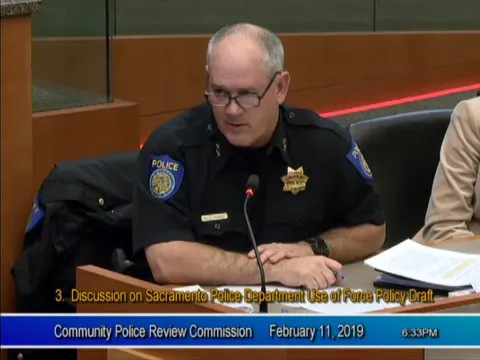
- Items 3 & 4 – Discussion on Sacramento Police Department Use of Force Policy Draft and Policy Recommendations: These items were combined. Kevin Greene from the City Clerk's Office confirmed the draft policy (General Order 580.02) is unchanged from the previous meeting and still evolving. Commissioner Falcon emphasized community outreach and transparency. Commissioner Zamora suggested making emergency medical care for arrestees a separate section and adding follow-up requirements. She proposed this as a formal recommendation but after discussion, it was agreed to provide written comments to the Use of Force Policy team instead of a vote. The items were received and filed.
- Item 5 – Discussion on Mayor and Council Resolution 2019-0018 Directive: Francine Tournour, Director of OPSA, explained the resolution directs the commission to focus on use of force, body worn cameras, and mental health. Commissioners discussed concerns about the original limiting language and the compromise that allows adding items through council members. They voted to create a Use of Force Ad Hoc Committee and a Body Worn Camera Ad Hoc Committee. Appointments: Use of Force – Commissioners Guerrero, Elkarra, Zamora, Carter; Body Worn Camera – Commissioners Sabeniano and Escobar. The motion passed.
- Item 6 – Establishment of an Advisory Committee to Meet Quarterly with SPD: The proposal to create a quarterly meeting between commission and police department was discussed. A motion to table the item until the next meeting (to clarify purpose with the Chair) passed. (Original motion was denied; substitute motion to table approved.)
- Item 7 – Discussion on Outreach Efforts: Commissioners reviewed a list of community organizations for outreach. The item was received and filed.
- Item 8 – Mental Health Ad Hoc Committee Update: Commissioner Falcon reported no progress but volunteered to chair the committee and will report at the next meeting. The item was received and filed.
- Commission Comments: Commissioner Guerrero requested a future presentation on Assembly Bill 392 (use of force standard). Commissioner Falcon requested an agenda item to discuss a partnership with the Parks Commission for outreach events. Member Coleman's vacant seat was noted.
Key Outcomes
- Approved consent calendar with edits.
- Received and filed presentations and updates on SB 1421, Use of Force Policy draft, outreach efforts, and mental health committee.
- Created Use of Force Ad Hoc Committee (members: Guerrero, Elkarra, Zamora, Carter) and Body Worn Camera Ad Hoc Committee (members: Sabeniano, Escobar). Motion passed.
- Tabled (postponed) the proposal to establish an advisory committee with SPD until the next meeting.
- Formal recommendations from previous commission work will be scheduled for a city council public hearing; staff working on a date.
- Future agenda items: AB 392 presentation and Parks Commission partnership.
- Next regular meeting: March 11, 2019, with presentation from the California Attorney General's Office on use of force recommendations for Sacramento PD.
Meeting Transcript
Good evening, everyone. We're gonna call uh the meeting to order. Do you want to call the roll? Go ahead and then call roll. Commissioner Kinsey. Commissioner Sabiano. Oh, here. Sorry. I didn't took you out of order in the rule. Commissioner Alcara. Commissioner Guerrero. Present. Commissioner Escobar. President. Commissioner Zamora. Here. Commissioner Falcone. Mr. Member Carter. And Chair Savage Sanguine is absent. We have a quorum. If you are here to speak to the Commission this evening, you'll need to fill out a speaker slit located at the back of the room and you'll and you'll turn those into the staff member located in the front of the dais before the topic of discussion is raised. Also, if you need any assisted listening or speaking devices, you'll also need to see the staff member. This is the time to silence or mute any of your electronic devices. Thank you. Our first order of business is to approve the consent calendar, which is the meeting minutes from our January 14, 2019 meeting. Is there a motion? Whereas the end of the meeting. Commission comments. So it states that uh I question the need for a new committee to address accountability, and so I just wanted to change that to advocated for a new committee. So with that edit, I make a motion. Aye. Opposed? Abstentions. Passes. Let's move on to this discussion calendar. The first our first presentation is on SB 1421, the law that was just passed and the enactment. Can you please introduce yourself? Good evening. Sean Reardon. I'm an attorney with the ACLU. I'm based here in Sacramento. And I am gonna pull up the presentation here. There we go. Great. So thank you for inviting me to present on this subject. And then I'll be available for uh questions or or for a discussion, whatever you all think is is most useful in terms of the use of your time and and mine. So SB 1421 radically changes the ability of the public to access records relating to a few areas of uh police conduct. So uh the initial slides are gonna run through the technical aspects of what the new law does. Uh explain a little bit about how this marks a change from where the law was previously, and and then also goes into what some of the the challenges have been in terms of the early implementation of the law.
openpublica.com