Sacramento Redistricting Citizens Advisory Committee Meeting - May 16, 2011
STREAMING COPY IN PREPARATION — RECORDING AVAILABLE FROM THE ORIGINAL SOURCE
Sacramento Redistricting Citizens Advisory Committee Meeting - May 16, 2011
The Sacramento Redistricting Citizens Advisory Committee met on May 16, 2011, to receive educational presentations on redistricting with sensitivity to minority interests and on race and ethnicity in redistricting. The committee heard extensive public testimony from the Latino and LGBT communities, who urged recognition as communities of interest. The deadline for public map submissions was that day, with 29 maps submitted by 4:30 PM and 31 by the meeting's end. The committee approved the minutes of the previous meeting and agreed to agendize a discussion on recognizing the LGBT community as a community of interest.
Staff Presentations
- Weekly Report Out of Redistricting Activities: Staff reported on media articles about redistricting, reminded the committee that May 16 was the map submission deadline, and noted 29 submissions as of 4:30 PM (later rising to 31). An upcoming community outreach meeting with the Robla Park Community Association on May 18 was announced. The report was received and filed.
Presentation: Redistricting with Sensitivity to Minority Interests
- Dr. Jesse Mills (PhD, Ethnic Studies, USD San Diego) delivered a 1-hour 55-minute presentation on structural racialization, historical residential segregation in Sacramento, and the implications for redistricting. He emphasized the difference between descriptive and substantive representation, and argued that redistricting can foster community empowerment and counter structural racialization. Committee members asked questions about applying the framework to redistricting constraints and about the Latino community's representation.
Public Comments & Testimony
-
On the Latino Community:
- Arnulfo Hernandez (attorney, Latino Redistricting Group) presented a map showing Latino population density (30%–57% in some areas) and argued that the Latino community (27% of the city population) lacks representation on the committee and city council. He stated that a redistricting plan that excludes Latino communities would be "dead on arrival" if challenged in court.
- Eric Guerra (Latino working group) elaborated on the data, noting that the map identifies two concentrated areas of Latino households, and that the community shares cultural, linguistic, and socioeconomic ties.
- Gustavo Arroyo (school board president) highlighted the Latino community's efforts in the 2010 Census and urged that their work be reflected in the final map.
- David Deluz (Greater Sacramento Urban League, African American Leadership Coalition) argued that the issue is not merely descriptive representation but substantive representation of priorities like police protection, predatory lending, and schools. He supported creating districts that enable communities of color to elect representatives of their choice.
-
On the LGBT Community:
- Bonnie Osborne (Sacramento Rainbow Chamber of Commerce) described the LGBT community's economic power and the need for a voice on the city council, urging recognition as a community of interest.
- Paul Mitchell (redistricting consultant, working with Equality California) presented a map based on 850,000 data points (donor lists, domestic partner data, Prop 8/22 voting patterns) showing the LGBT community concentrated in the urban core (river to river, freeway to freeway). He stated that within that area, residents are six times more likely to be members of LGBT organizations and voted 50 points differently on Prop 8 than the surrounding area.
- Derek Lawson (resident, business owner) described the difficulty of having three council members representing the downtown/midtown area and asked for the urban core to be kept together.
- Gail Mancarti (Sacramento Gay and Lesbian Center) supported the LGBT community as a community of interest and noted the center's location in the Central City.
- Dan Roth (Stonewall Democratic Club) argued that the city's Convention and Visitors Bureau already recognizes the LGBT community as a distinct community, and that the city council has historically led on LGBT rights.
- Rosanna Herber (LGBT redistricting committee) presented a map of the urban core and asked the committee to recognize the LGBT community as a community of interest.
- Eireann Flannery (LGBT commission, cycling advocate) noted that LGBT institutions and the cycling community overlap in the same geographic area.
- Ben Phillips-Lesenana (Rainbow Chamber of Commerce) emphasized the visibility of the LGBT community and urged the committee to use the provided data.
- Mary Helen Doherty (California Faith for Equality) identified at least 60 faith congregations in the Sacramento area that support LGBT rights, 90% of which are located in the urban core.
-
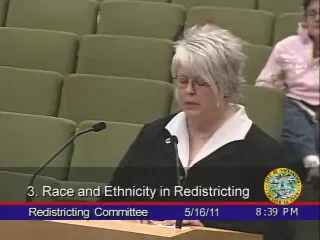
On Race and Ethnicity in Redistricting (item 3):
- Darrell Roberts (African American Leadership Coalition) presented a map that connects South Natomas with Del Paso Heights, noting it was done in consultation with the LGBT, Asian, and Latino communities. He asked the committee to consider the map and recognized that District 1 might be left short due to anticipated future growth.
- Additional speakers included Bonnie Osborn, Paul Mitchell, Darrick Lawson, Gail Mancarti, Dan Roth, Rosanna Herber, Eireann Flannery, Mary Helen Doherty, and Ben Phillips-Lesenana (some of these spoke on both items).
Discussion Items
-
Race and Ethnicity in Redistricting Presentation: Staff (Scot Mende) presented demographic data: whites constitute 45% of the city population (49.1% voting age), Latinos 26.9% (23.2% voting age), Asians 18%, and Blacks 15%. He noted that it appears unlikely to create a majority-minority district for any single group, but that communities of interest can be considered. The presentation emphasized that the Voting Rights Act does not require minority influence districts and that the city has district elections. The committee discussed the need for disaggregated data (e.g., within Asian and Latino communities) and the possibility of using voter registration data to identify finer ethnic or linguistic communities. Staff indicated they would investigate data availability.
-
Committee Questions and Ideas:
- Members asked about the availability of data on Asian sub-ethnicities and linguistic groups. Staff said they would look into obtaining and presenting such data.
- Members discussed the potential for considering future growth when evaluating district deviations, but City Attorney Matthew Ruyak cautioned that concrete evidence would be needed to support growth projections.
- The committee agreed to agendize a discussion on recognizing the LGBT community as a community of interest, with a motion to place it on the next agenda.
Key Outcomes
- Minutes Approval: The minutes of the May 9, 2011 meeting were approved by a vote of 14–0 (1 absent, Julius Cherry).
- Recognition of LGBT Community of Interest: The committee agreed to agendize a formal discussion and vote on recognizing the LGBT community as a community of interest for the redistricting process.
- Data Requests: Staff will investigate the availability of disaggregated data (e.g., Asian sub-ethnicities, voter registration country of origin) and report back to the committee.
- Next Steps: The committee will begin reviewing submitted maps at the next meeting. Public map submitters are encouraged to speak (2 minutes each) at that meeting. The committee also discussed possibly grouping multiple speakers on the same map to manage time.
Meeting Transcript
Oh, good evening. Um, I'd like to call the meeting to order. Uh, we're almost have a quorum, so we do have a quote. All right. Okay, Shirley, can you do recall, please? I will. Okay, Roman Porter. Bill Camp? Here. Searle Shaw. Steve Hanson. Bill Mottman's. Bernard Bowler. Here. Sandra Fry Lucas. Steve Maviglio. Miranda Perry. Bill Pluckabum. Here. Maya Wallace. Michelle Ru Rubokaba. And Nadia Leal Currillo. Here. And then uh our chair, Julius Cherry is absent. And Lynn Holm is our vice chair and we'll be sharing this evening's meeting. Thank you, Shirley. We do have a quorum. A couple of announcements. If you are in the audience and wish to speak, please complete one of the speaker slips located in the back of the room and submit it to the assistant clerk here at the front. And if you have a phone, please turn it to the silent position. This meeting is also being being video streamed and we'll be available to view on the web following the meeting. So first on the agenda is our weekly report out of redistrict activities. Okay. I'll take that. Good evening. And thank you. Let's see. I wanted to just remind you of some media articles that have been published over the last week locally. Sacramento News and Review has a couple of small articles on the frontline bite section, I believe. And the Sacramento B swarm has also had an article on the time clock ticking, as in today is the last date to submit your plans online. And then this today there was another article in the Sacramento Bee, primarily focusing on Elk Grove and the redistricting that's happening there, as well as another one on the Latino and Asian populations rising in California. And that fewer whites are residing in California. This was on the front page of the B today, so just uh wanted to let everybody know about those. Um we do just publish uh the articles that are relevant to this redistricting process on our website, so at any time people can go and look at those and um or provide links to those. As I mentioned, today is May the 16th, and that is our redistricting um plan submission deadline. And I wanted to let you know that there's been several reminder notices that have gone out over the past week. Um, one today for all the registered users, a couple last week from neighborhood services to their wide distribution list. And um that as of about 4 30 today, we had 29 map submissions. So there were about nine or so in over the weekend. We had several today, and I anticipate that we'll have several more by the end of the submission time frame.
openpublica.com