Law and Legislation Committee Special Meeting – January 7, 2020
STREAMING COPY IN PREPARATION — RECORDING AVAILABLE FROM THE ORIGINAL SOURCE
Law and Legislation Committee Special Meeting – January 7, 2020
The Law and Legislation Committee held a special meeting on January 7, 2020, at 1:00 p.m. in City Hall Council Chamber. The committee approved a consent calendar item, pulled one item for later consideration, and forwarded two ordinances to the City Council after discussion and public testimony. The meeting lasted approximately 30 minutes.
Consent Calendar
- Item 1 – 2020 Regular Meeting Schedule: Approved unanimously. The committee passed a motion adopting the 2020 regular meeting schedule for the Law and Legislation Committee.
Public Comments & Testimony
- Item 4 – Transit-Oriented Development Ordinance Amendments: Two speakers, Ricky Hecht and Todd San Filippo, expressed support for the proposed amendments. Hecht, a commercial real estate consultant, said the changes are vital to allow property owners to maximize leasing of buildings occupied by small entrepreneurs. San Filippo, representing owners of 1601–1607 Julius Avenue, stated the changes would protect their ability to collect rent and maintain existing tenants.
Discussion Items
- Item 2 – Proposed Ordinance Regarding Ballot Argument Authors: The committee pulled this item from the agenda, deferring consideration until after the March 2020 election to avoid confusion.
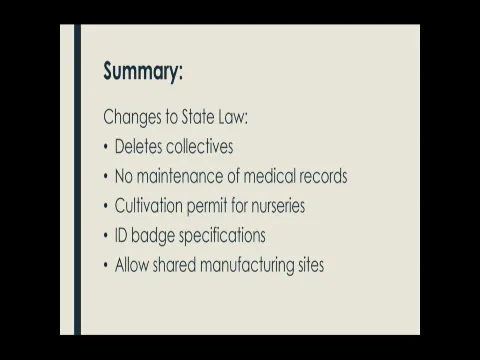
- Item 3 – Cannabis Businesses Ordinance (Cleanup): Leyne Milstein, Assistant City Manager, presented a proposed ordinance to amend Chapter 5.150 of the City Code to align with state law, remove outdated requirements (e.g., collectives, medical records), add nursery cultivation permits, standardize ID badge specifications, allow shared manufacturing sites, require permit holders to report state license revocations, create uniform video security retention, expand grounds for denial, and codify 180-day inactivity denial. No public comments were received. The committee moved and seconded the motion to forward the ordinance to the City Council.
- Item 4 – Transit-Oriented Development Ordinance Amendments: Staff presented changes to the TOD ordinance, primarily altering how distance between light rail stations and projects is measured (from straight-line “as the crow flies” to using existing streets and pathways). The ordinance also deletes the transit overlay zone, removes auto-oriented restrictions, removes the “significant barrier” requirement, and applies special use regulations only to new buildings. A rezone of 61 parcels (MT zone) would allow housing and commercial by right. Councilmember Harris praised the flexible distance measurement and said it solves issues for enclaves like Railroad Drive. Councilmember Hansen expressed concern about undermining the original TOD ordinance and asked about incentives for housing near transit; staff noted concurrent efforts on ministerial housing approvals. The committee voted 3–0–1 (with one abstention) to forward the ordinance to the City Council.
Key Outcomes
- Consent item approved: 2020 meeting schedule adopted.
- Item 2 deferred: Ballot argument authors ordinance pulled to return after March 2020 election.
- Item 3 forwarded to City Council: Cannabis ordinance cleanup approved by a unanimous vote (no opposition noted).
- Item 4 forwarded to City Council: TOD ordinance amendments approved by a vote of 3–0–1, with one committee member abstaining.
- Committee comments: Chair Schenirer noted a pending resolution from the youth commission on public safety definitions. Councilmember Hansen requested that the discussion on charter amendment placement for November ballots be brought back to a future committee meeting.
Meeting Transcript
All right, we're gonna call this meeting of the law and legislative committee to order. Please uh call the role to establish a quorum. Member Harris? Here. Member Hansen? Member Garrett? Here. And Chair Shineer? Here. We have a quorum. If you are here to speak before the committee, you'll need to fill out a speaker slip. They're located in the back window and turn into the assistant clerk prior to the start of the item. This is the you'd also see the assistant clerk for any assisted listening or speaking devices. And this is the time I'd ask you to turn all your cell phones and other devices to silent. Okay, great. Let's uh go ahead to the consent calendar item one. Any comments? Is there a motion? I have a motion. And a second. All those in favor signify by aye. We're gonna take pull item two off and bring it back after the March election so it doesn't get confused on that. Uh we'll move to item three. Item three, cannabis. All right. But the right thing to do. So the transit-oriented development ordinance was approved in December, December 11th, 2018, went into effect January 10th, 2019. I'm sorry, do you want to pull the mics down a little bit? There you go. Thank you. Thank you. The primary amendment would change how distance is measured between a light rail station and nearby projects. Distance is currently measured as a crow flies. Staff proposes to measure distance using existing streets and pathways. As seen in the staff report, the proposed ordinance would make the following changes to the planning and development code. The transit overlay zone would be deleted. It currently limits housing opportunities by having a maximum of 100 dwelling units per net acre, which is often less than what we see in the underlying zone, such as the C2 zone. The auto-oriented restrictions that are in the TO zone have been applied citywide already. So regarding the TOD's special use regulation for conditional use permits, the biggest change would be to remove the significant barrier portion of the code, since the new methodology to measure distance would eliminate the need for this provision. Another change would be to apply all the special use regulations to new buildings only and not to existing buildings that are seeking a change in land use. A change in use would still require pedestrian amenities such as lighting, benches, treat shading, and landscaping. If requested, I am prepared to provide a longer, more detailed presentation. Matt Hurdle, the acting long-range planning manager and I are available to answer questions. Thank you. Thanks very much. We have uh two folks who would like to speak on this issue. Rick or Ricky Hecht and then Todd Sem Filippo. Good afternoon. Good afternoon, thank you. And um hi, commissioners and staff.
openpublica.com