Law and Legislation Committee Meeting - February 4, 2020
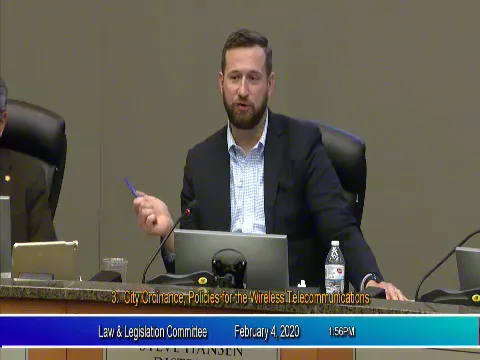
STREAMING COPY IN PREPARATION — RECORDING AVAILABLE FROM THE ORIGINAL SOURCE
Law and Legislation Committee Meeting Summary - February 4, 2020
The Law and Legislation Committee of the Sacramento City Council met on February 4, 2020, at 1:00 PM in the City Hall Council Chamber. The meeting focused on the consent calendar and a major discussion on wireless telecommunications ordinances, policies, and practices. The committee unanimously approved consent items and forwarded the wireless telecommunications ordinance, design guidelines, and master license agreement to the full City Council.
Consent Calendar
- Motion carried unanimously to approve the Law and Legislation Log (File ID: 2019-00473) and forward the ordinance amending City Code relating to the City Manager’s Contracting and Purchasing Authority (File ID: 2019-01749). Committee Member Guerra added a request to include youth commission recommendations on the log, and Member Hansen requested staff follow-up on the governor’s proposal for funding for the Front Street Shelter.
Public Comments & Testimony
- Noah Davidson (resident) expressed concern about a 4G antenna near his home, stating that FCC limits are exceeded in a small area of his property, and requested a section prohibiting exceeding FCC limits on residential property. He cited a 2019 California Supreme Court decision and submitted engineering reports.
- Lynette Scalera Palacios (resident) supported Davidson and criticized removal of protective language, urging the city to stand up to telecom companies.
- Patty Krieg (Pocket resident) opposed 5G in her neighborhood and proposed a 500-foot residential setback, increased notification radius from 300 to 1,000 feet, and a removal process for problematic antennas.
- Roark Vane (resident) echoed health concerns, emphasizing the antenna’s placement near a second-story window and potential under-measurement of emissions.
- Radha Sharma (Verizon senior real estate manager) thanked staff and expressed support for the ordinance once a final technical amendment is resolved.
- Rudy Reyes (Verizon public policy lead) praised Sacramento as first to launch 5G and supported the ordinance as a workable pathway.
- Nels Olson (AT&T) thanked the city and noted AT&T’s letter outlining issues with the ordinance.
- Ben Gumpert (Sacramento Republic FC president) expressed full support for the initiative, emphasizing investment and connectivity for city growth.
- David Nelson (Sacramento Asian Pacific Islander Chamber of Commerce) spoke in support, stressing the importance of technological advancement for small businesses and the region.
- Joe Bebbs (representing Senator Richard Pan) relayed Senator Pan’s support for 5G, citing a joint letter with the Asian Chamber CEO.
- Julian Canete (California Hispanic Chambers of Commerce) expressed support on behalf of 815,000 enterprises, emphasizing competitiveness and safety.
- Eric Windheim (building biologist and RF safety specialist) argued the meeting was too late, claiming high radiation levels in bedrooms (13–460 times over extreme concern range for sleeping areas) and criticizing FCC limits based on only 30 minutes of thermal testing.
Discussion Items
- Wireless Telecommunications Ordinance and Design Guidelines (File ID: 2019-01793) – Maria MacGunigal (Chief Information Officer) and Ryan Moore (Public Works Director) presented a proposed ordinance, design guidelines, and master license agreement. Key points included: limited local authority due to federal preemption, application and reservation processes, FCC shot-clock compliance, design standards for aesthetics, priority locations, notification processes, FCC compliance demonstrations, contractor qualifications, and maintenance obligations.
- Committee Questions and Concerns – Members discussed siting on type 15 poles (30 feet high), separation distances (500 feet between same-carrier equipment but not different carriers), and the potential for new poles in older neighborhoods with ornamental lights. Concerns were raised about the Davidsson installation, with Member Guerra suggesting Verizon consider moving the antenna as a good-faith gesture. City attorney Jennifer Gore clarified that a recent court decision (referenced by Davidson) does not require NEPA/CEQA review for small cell installations. Staff compared RF emissions of 5G/4G antennas to other devices (smart meters, smartphones, police radios), showing lower levels. Member Hansen raised trench cut and construction disruption concerns, requesting an update on the trench cut fee program. Staff noted a process to update the circa-1997 fee. Member Guerra questioned how 5G expansion would affect public safety communications; staff acknowledged the potential but said it was early to determine specifics.
- Motions – A motion to forward the ordinance, design guidelines, and master license agreement to City Council was made by Member Harris and seconded by Member Guerra. It passed unanimously.
Key Outcomes
- Consent Calendar approved unanimously.
- Wireless Telecommunications Item forwarded to City Council unanimously for consideration.
- Directives: Staff to follow up on the Front Street shelter funding proposal; staff to bring back an updated trench cut fee program before the end of the calendar year; staff to provide a policy on city engagement with TV crews accompanying fire department, as requested by Member Hansen.
- Committe Comments: Member Hansen requested a policy discussion on TV crews filming with the fire department, citing exploitation of trauma and lack of council awareness.
Meeting Transcript
All right, we're gonna call this meeting of the law and legislation community to order. Please call the role to establish the quorum. Member Harris, Member Hanson, Member Gera. Here, Chair Shane. Here. We have a quorum. If you're here to speak to the committee today, you'll need to turn in your speaker slip to the assistant clerk here prior to the start of the item. Speaker slips are located in the back window. If you need an assisted listening or speaking device, you will also see the assistant clerk. And this is a time I'd ask everyone to check their cell phones and other devices to make sure they've been turned to silent. Okay, thanks. We're going to go to the consent calendar and any comments on the consent calendar. I have one on the log, but anything else? Okay. Let me let me add to the log if I can here. Um to the youth commission meeting, and they've been working on uh putting young people on a number of our boards and commissions, and they have a set of recommendations that they're working with the city clerk, and so I'd like to get that on the log to come back to uh this committee. With that, is there a motion? Uh oh, I did uh ask one of the Mr. Chair. I wanted to ask our staff about uh uh working with the uh the on the governor's proposal for funding that could support the front street shelter, and if we could follow up on it, okay. Okay, great. So, with that, there was a motion by Mr. Here, second by Mr. Garrett. All those in favor signify by aye. Aye, aye opposed, abstain. The motion carries unanimously. Uh welcome, Mr. Hansen. Let's move to item three. Item three, the city ordinances, policies and practices for wireless telecommunications. Ms. McGonagall, out of the out of your sickbed. Welcome. Thank you. Uh, good afternoon, committee members. My name is Maria McGonagall, and I'm the city's chief information officer. And as directed by a city council staff has been again actively engaged in a comprehensive review of the city's ordinances, policies, and practices regarding the deployment of small cell technology, both for and 5G. As you're aware, the city's authority over the development of wireless facilities is limited. Though federal laws and regulations issued by the Federal Communications Commission and state laws and regulations mostly preempt local authority. The city does play an important role in ensuring compliance with the law and meeting the needs of the community and businesses. In order to fully inform the discussion on policies to be considered by this committee and the council, um, the staff have taken the following actions. We've reviewed the city's legal authority to regulate wireless development. We've researched and reviewed actions taken by other cities. We've conducted a pilot study in the pocket greenhaven area to test devices for FCC compliance. The items before you today represent best practices policy that takes into account the city's legal authority, the concerns of the community, businesses, the industry, and the city as a whole. So I'll start with covering what's in the ordinance in broad terms. The ordinance before you provides a roadmap for telecommunication deployment in the city of Sacramento. It specifies an application process and a reservation process for carriers on our infrastructure. It establishes timelines for the city, which are well within actually faster than the FCC shock clock timelines.
openpublica.com