Sacramento Law and Legislation Committee Meeting - June 16, 2020
STREAMING COPY IN PREPARATION — RECORDING AVAILABLE FROM THE ORIGINAL SOURCE
Sacramento Law and Legislation Committee Meeting - June 16, 2020
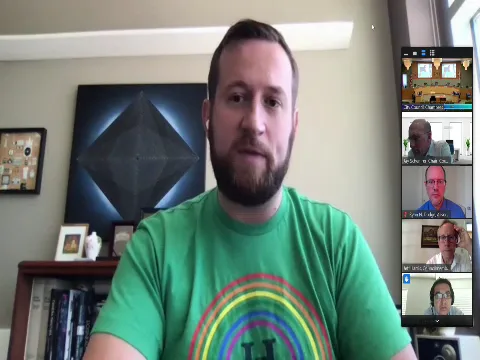
The Sacramento Law and Legislation Committee met via teleconference on Tuesday, June 16, 2020, from 1:01 p.m. to 1:55 p.m., with all members (Chair Jay Schenirer, Vice Chair Steve Hansen, and members Eric Guerra and Jeff Harris) present. The committee reviewed and advanced several items, including a consent calendar, two major discussion items on infill housing and the West Broadway Specific Plan, and heard public comment on racial equity. Key outcomes included unanimous votes to forward ordinances to the City Council and directives to staff on future agenda items.
Consent Calendar
- Item 1 – Law and Legislation Log (File ID 2020-00100): Approved unanimously.
- Item 2 – Legislative Advocacy Correspondence (File ID 2020-00101): Received and filed.
- Item 3 – Ordinance Amending City Code Section 15.148.965 Relating to Digital Billboards on City-Owned and City-Leased Lands (M19-014): Reviewed and forwarded to the City Council for consideration. The committee also expressed support for Assembly Constitutional Amendment 5 (ACA 5), which would repeal Proposition 209, and directed staff to send a separate letter on that issue.
Public Comments & Testimony
- Nia Mooreweathers, community organizer for Youth Ford, spoke in support of a racial equity initiative. She noted that Councilmember Guerra has been working with the national nonprofit Race Forward, which has partnered with over 200 local jurisdictions to embed racial equity into policy and budgeting. She urged the committee to pursue a more intentional racial equity framework for Sacramento.
Discussion Items
- Item 4 – Ministerial Approval of Infill Housing (M20-007): Ryan Dodge, Associate Planner, presented an ordinance to create a local ministerial permit option for infill housing, complementing the state’s SB 35 process. Key points: Sacramento is behind on its Regional Housing Needs Allocation (RHNA), needing over 45,000 housing units over eight years (about 5,700 per year), but only issued just under 3,100 units in 2019. The proposed ordinance would limit city ministerial projects to 200 units (down from an initial 500), exclude historic districts and sites within 1,000 feet of landfills, prohibit demolition of tenant-occupied units within the past year, and require objective design standards. The Planning and Design Commission recommended approval on June 11, 2020, with an added condition to prohibit projects that reduce site density. Staff noted that affordable housing projects can use this option and that ministerial approval does not require CEQA review or public hearings. Committee discussion focused on the link between supply and affordability, with Councilmember Hansen emphasizing the climate and equity benefits of infill, and Councilmember Guerra calling for a more comprehensive housing strategy. The committee voted unanimously to forward the ordinance to the City Council.
- Item 5 – Ordinances Amending Title 17 Relating to the West Broadway Specific Plan and Central City Special Planning District: Helen Selph, Associate Planner, presented two ordinances rezoning parcels within the West Broadway Specific Plan area (bounded by the Sacramento River, U.S. Highway 50/Broadway, Muir Way/5th Street, and 4th Avenue). The plan aims to redevelop outdated industrial uses, provide new housing opportunities, and integrate the historically segregated Alder Grove and Marina Vista public housing sites. The ordinances would rezone land from industrial to residential or mixed-use, increase density allowances, and remove overlapping Central City Special Planning District designations. The plan has a 20-year horizon and includes a special study area for Miller Regional Park. Councilmember Hansen highlighted the community-driven process, noting the federal Choice Neighborhoods Initiative grant and the goal of desegregation. Councilmember Harris praised the effort as a model for integrated income communities. The committee voted unanimously to forward the ordinances to the City Council.
Key Outcomes
- Item 4 – Ministerial Approval of Infill Housing: Unanimous vote (4–0) to forward the ordinance to the City Council for consideration.
- Item 5 – West Broadway Specific Plan Rezoning: Unanimous vote (4–0) to forward both ordinances to the City Council for consideration.
- Committee Comments: Councilmember Guerra requested that two items be added to the committee’s work plan: (1) a workshop on racial equity, potentially leading to a city Office of Racial Equity, building on the work of the Government Alliance on Race and Equity (GARE) and Race Forward; and (2) a review of policies to address illegal fireworks, including options for a complete ban, a fee/abatement program, or a hybrid approach. Councilmember Harris supported both requests, noting the urgency of fireworks as a public safety and nuisance issue. Staff will bring back recommendations.
Meeting Transcript
Is that the illegal contraband that you've been slipping to her? Uh no, Jay, it was not for the record. Okay to talk about that online, gentlemen. Chair Shaneer, we may start whenever you're ready. Thank you very much. I want to call this meeting of the law and legislation committee to order. Um, Madam Clerk, if you could please call the roll to establish a quorum. Thank you. Councilmember Harris. Present Councilmember Guerra. Here Shaneer. And Councilmember Hansen just joined us. Yes. So uh let's mark Mr. Hanson here by state. I was I was waiting in the uh holding chamber for a while. But okay Jay, I like your virtual background. Uh yeah. Actually, I'm I'm well, I'll tell you later. We're on we're we're broadcasting. Let's go ahead and get to the calendar. Um we have the consent calendar. Any questions or comments on consent? Mr. Chair, um, I'll uh move the uh consent calendar, but I do wanted to ask uh that uh looking at the legislative law and uh legislate or legislation legislative platform. Um I wanted to see if uh we would all be in the in agreement that ACA five, a assembly constitutional five, which would um which would put on the ballot for voters to uh repeal 209 Prop 209 um could be part of that. And I looked at a couple sections, both on the equal rights piece, but also on our inclusion and diversity on improving uh you know outreach to minority businesses and uh women-owned businesses. Um I just feel you know, Prop 209 has done a disservice to us as a city on that, and um what it would support that. No, I I think it's totally within our framework, but I think it wouldn't be a bad idea to take a separate vote on it just to make a statement on it. So I'm assuming Mr. Guerra, that was uh um that was a motion and Mr. Hanson's seconds, so we'll include that in with the consent calendar then. That's all right. Sounds good. Okay, other comments? Uh yeah, Jay. I'm I'm not familiar with what you're talking about, so you're gonna have to force that just a bit. Eric, why don't you give us a quick rundown on it? I think it's sure. So uh constitutional five is an effort to repeal Prop 209, which proposition 209 in the late 90s uh made it uh a strict prohibition for uh a local government entity like the city of Sacramento to consider any kind of direct um uh uh policy that would affect uh anybody by race, religion, or gender. And because of it, we've had to look at uh different tactics and approaches to making sure that inclusivity is part of our strategy, but it really has resulted in tinkering around the edges of addressing issues like pay equity, issues like supporting uh you know, minority-owned businesses and women-owned businesses, and also in our efforts to recruit and hire a diverse workforce. So, you know, I I feel like that uh Prop 209 is actually taking a tool, uh, one tool out of many that we have to try to address those inequities. And so I uh for us as a city, I think it makes perfect sense to support the efforts that are uh to repeal that, which is assembly constitutional five that's in the legislature for the first time passed out with a two-thirds vote from the assembly, which now it's moving towards the Senate. It will require a two-thirds vote in each house. Uh, and also uh it'll go on the ballot so that the voters can decide whether they want to repeal the constitutional uh provisions uh in November. Okay, thank you. I appreciate that. So uh Jeff, any objection to just including that in with the consent calendar? No, that that'll work for me. Okay, so we have motion and a second.
openpublica.com