Law and Legislation Committee Meeting – March 2, 2021
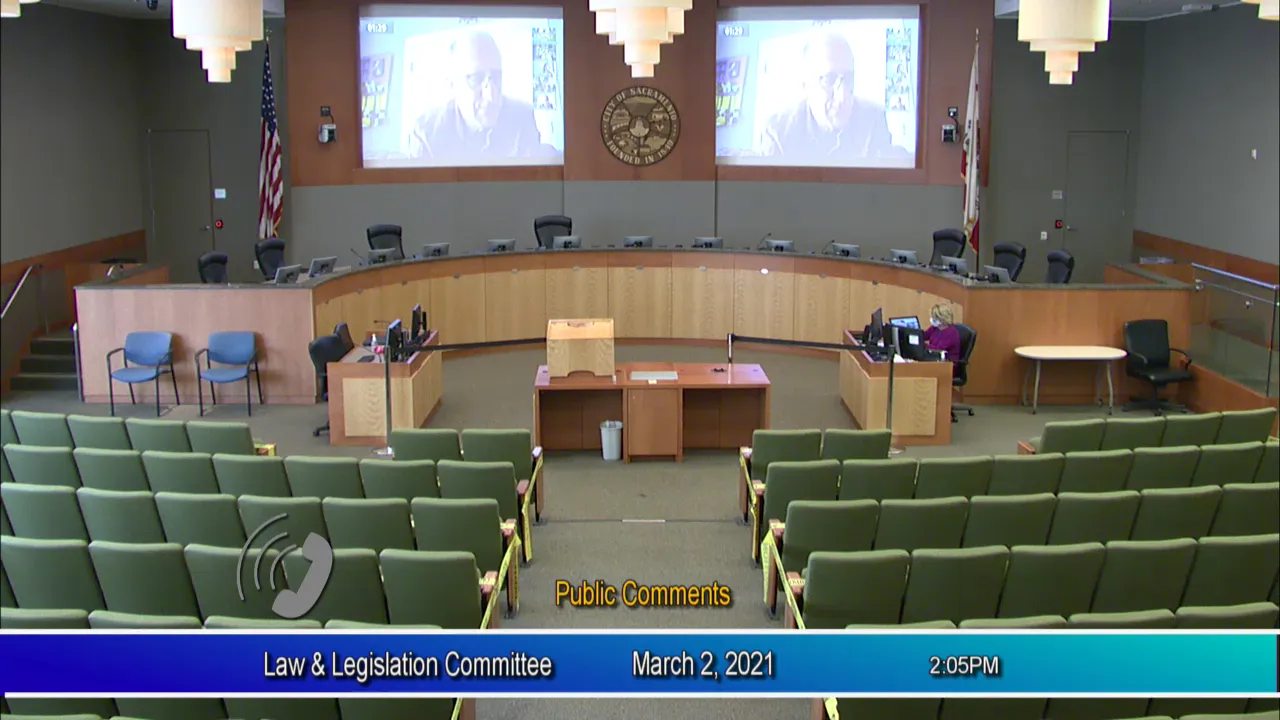
STREAMING COPY IN PREPARATION — RECORDING AVAILABLE FROM THE ORIGINAL SOURCE
Law and Legislation Committee Meeting – March 2, 2021
The Sacramento City Law and Legislation Committee met on Tuesday, March 2, 2021, at 1:01 p.m. via teleconference. All four members (Chair Schenirer, Vice Chair Harris, and Members Valenzuela and Guerra) were present. The meeting lasted until 2:34 p.m. The committee considered three agenda items, including a consent calendar item, a zoning ordinance for the Sacramento Valley Station Area Plan, and a major building electrification ordinance. Public comments were heard on Item 3, with 17 callers expressing a range of positions.
Consent Calendar
- Item 1 – Law and Legislation Log: Approved unanimously by a 4‑0 vote.
Public Comments & Testimony (Item 3 – Green Building Standards / Electrification)
Seventeen members of the public provided testimony. Key positions included:
- Emily Bay Michaels (Midtown Association): Urged caution, citing concerns that restaurants cannot feasibly operate on all‑electric equipment and that premature mandates could harm the local food sector, which generates over 60% of Midtown sales tax.
- Jamie Jang (architect): Expressed disappointment, stating the ordinance is too weak and that Sacramento should lead with stronger electrification requirements.
- Brandon Black (Sacramento Metro Chamber): Supported the committee’s direction to review the infeasibility waiver process before moving forward, and emphasized the need for clear, predictable, and equitable policy.
- Matt Sutton (Restaurant Association): Requested exemption for restaurants and noted the lack of waiver language in the draft ordinance.
- Alex (Sunrise Sacramento): Urged a more ambitious ordinance with earlier effective dates, citing climate urgency and the health impacts of gas.
- Bill Paveo (Sacramento Housing Alliance): Supported the concept but called for three caveats: virtual net energy metering from SMUD, cost mitigation for affordable housing, and increased city loan amounts.
- Rick Codena (former SMUD analyst and Mayor’s Climate Commission member): Strongly endorsed the ordinance, stating that electrification is the most compelling action for reducing building emissions and that the city should move quickly.
- Rosie Yaknu (resident, District 4): Opposed blanket exceptions, arguing they undermine the ordinance; called for 100% EV‑capable parking requirements.
- Alice Vondreck (resident, District 3): Supported the ordinance but urged very narrow exceptions, and stressed the need for a comprehensive retrofit plan for existing buildings, starting with low‑income communities.
- Several speakers (including Cornelius Burke, Steve Blanton, Ben Granholm, and a restaurant owner/architect) raised concerns about costs, technical feasibility, workforce transition, and the need for clear infeasibility standards.
Discussion Items
- Item 2 – Sacramento Valley Station Area Plan (Ordinance Amending Title 17): Staff presented an overview of the plan to create a regional rail hub and update zoning within the Railyards and Central City Special Planning Districts. The committee reviewed the ordinance and unanimously voted (4‑0) to forward it to the City Council for consideration.
- Item 3 – Green Building Standards Including Electrification: Staff presented a detailed ordinance that would require all‑electric construction for new buildings (≤3 stories by 2023, ≥4 stories by 2026) and introduce enhanced EV charging requirements. Committee members expressed a range of views:
- Chair Schenirer proposed a motion to exempt restaurants and industrial manufacturing, develop an expert‑panel process for infeasibility waivers, conduct annual evaluations, and begin work on retrofits immediately. He later removed the 30‑day deadline, agreeing to work with staff on a reasonable timeline.
- Member Valenzuela argued the ordinance is inequitable because it separates new construction from retrofits and fails to engage low‑income residents; she advocated for a slower, more holistic approach.
- Member Harris supported moving forward but requested a faster development of the infeasibility waiver, and asked for data on methane leakage from gas lines and grid reliability from SMUD.
- Member Guerra stressed the importance of workforce development and economic opportunity, urging that the ordinance be paired with training programs and support for local manufacturing.
Key Outcomes
- Motion 1 (Schenirer/Harris) – Directing staff to amend the building electrification standards: The committee unanimously approved a motion to direct staff to (a) develop exemptions for restaurants and industrial manufacturing, (b) create an expert‑based infeasibility waiver process, (c) evaluate the ordinance annually, (d) proceed with stakeholder engagement on equity and economic development, and (e) return to the Law and Legislation Committee for review on a timeline to be determined.
- Motion 2 (Harris/Valenzuela) – Forwarding EV‑related provisions to City Council: The committee unanimously voted to forward the Title 15 and Title 17 electric vehicle capability standards and incentives directly to the City Council for adoption within 30 days, without waiting for the broader electrification ordinance.
- Next Steps: Staff will revise the building electrification ordinance based on committee direction, engage stakeholders (including on the infeasibility waiver and equity), and bring a revised ordinance back to the committee. The EV‑related provisions will go to the City Council on an expedited track.
Meeting Transcript
All right. I'd like to call this meeting of the law and legislation committee to order. Madam Clerk, please call the role to establish a quorum. Thank you, Councilmember Gata. Here. Councilmember Harris. Councilmember Valenzuela. Here and Chair Shaneer. Here, thank you very much. We have three items today. Yes, Chair, that's okay. I know that prior to me joining this committee. I know Councilmember Garrett and others were involved in a discussion about an ordinance to establish a hospitality worker right to recall. And I was hoping that maybe we could agenda that for our first April meeting. I'm going to add that back onto the law. Okay, let's put it on the log and we'll talk to Ms. Hernandez about our what else we have on those dates. Thank you. Mr. Chair. Yep. Yeah, on that item. Um we had asked direction that uh they work they reach out to uh some of the uh uh organizations there if uh if we can ensure that staff does that as it comes back, really appreciate that. And with that, I'll move the uh the law and limbs log. Okay, so Miss Consuelo uh with that direction, uh that would be great. We'll we'll see where we're timing is on that. Um it's a motion. I'll go ahead and second. Um clerk. Thank you. And for the record, I have no callers on the consent calendar. Councilmember Geta. Hi. Councilmember Harris. Hi. Councilmember Valenzuela. Yes, and Chair Shaneer. Hi, thank you very much. Uh, let's go ahead and move to item two, Sacramento Valley Station Area Plan. Mr. Taylor, are you doing this one? Yes, I am. Okay. Chair, I'm trying to myself uh video to start here. Sorry. There we go. Thank you. So I will pull up my screen here and presentation today. I will uh just give five brief slides for an overview and turn it over to Carlos Felix from community development to over the particular um items uh regarding the ordinance before you today. Um just these are just background just kind of set the stage.
openpublica.com