Law and Legislation Committee Special Meeting on Cannabis Industry Study – March 15, 2022
STREAMING COPY IN PREPARATION — RECORDING AVAILABLE FROM THE ORIGINAL SOURCE
Law and Legislation Committee Special Meeting on Cannabis Industry Study – March 15, 2022
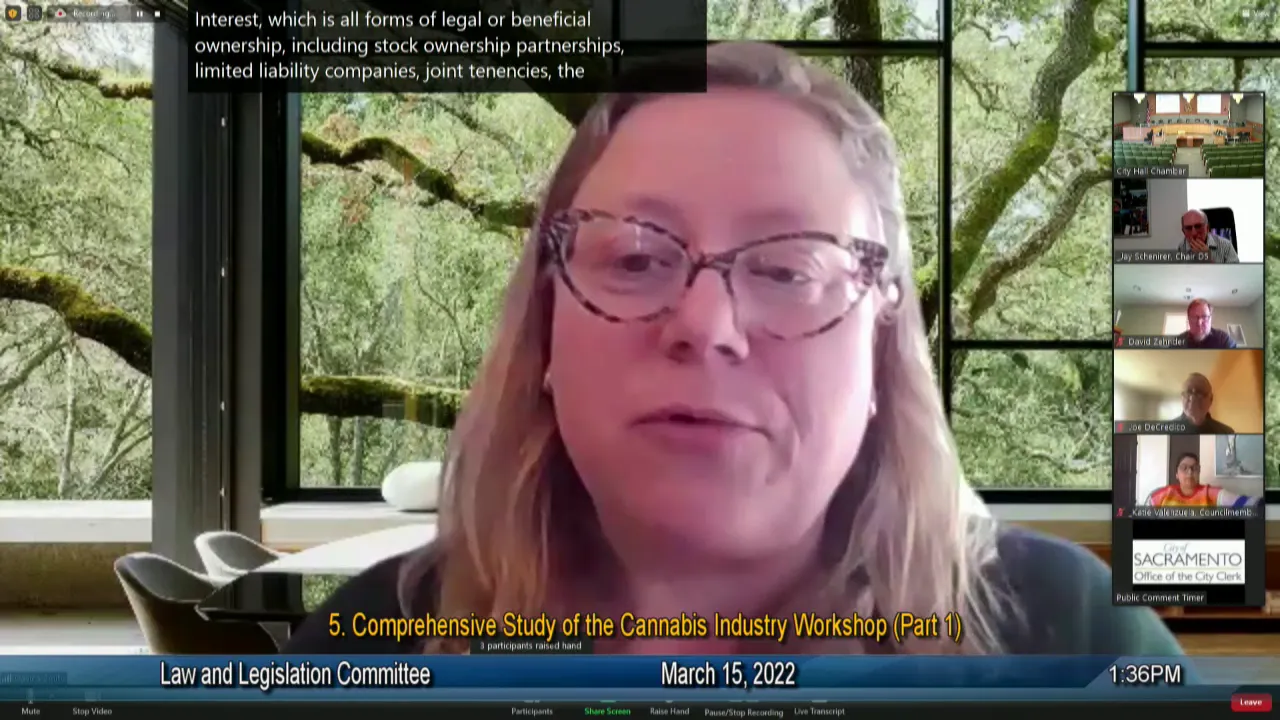
The Sacramento City Council's Law and Legislation Committee held a special meeting on March 15, 2022, from 12:30 p.m. to 2:40 p.m., to conduct a workshop on the comprehensive study of the cannabis industry (Part 1) with a focus on ownership issues. The committee reviewed the EPS study findings, heard public testimony, and discussed the future of cannabis regulation, including the impending expiration of the ownership transfer moratorium. No formal action was taken on the moratorium, but the committee indicated a preference to let it expire while continuing to explore nuanced ownership policies in future meetings.
Consent Calendar
- Item 1 – Law and Legislation Log: Approved (File ID: 2022-00068).
- Item 2 – Legislative Advocacy Correspondence: Received and filed (File ID: 2022-00069).
- Item 3 – Meeting Minutes (January 4, 2022): Approved (File ID: 2022-00587).
- Item 4 – Ordinance Adding 3.56.075 to Sacramento City Code (Procurement of Organic Mulch and Paper): Reviewed and forwarded to City Council with a two-thirds vote recommendation (File ID: 2022-00560).
All consent calendar items were approved by a single motion with a unanimous vote (4-0).
Public Comments & Testimony
- Kevin Hooks (core business owner): Expressed that the city must invest directly in the core community, not just through revolving loans, and emphasized that cannabis is a top-10 employer in Sacramento generating a surplus of revenue. He urged the city to collaborate to reduce front-end costs and barriers.
- Brad Hirsch (counsel to COLAS group): Cited Internal Revenue Code section 280E as a major economic barrier, preventing cannabis businesses from deducting most expenses, thus requiring capital raising through equity transfers. He implored the committee to let the ownership transfer moratorium expire.
- Mindy Galloway (social equity operator): Supported revisiting the 10-year restriction on equity transfers of core dispensaries and urged consideration of shared facilities to reduce costs for core licensees. She also warned against monopolization by large corporations like Cresco.
- Kimberly Cargyle (CEO of A Therapeutic Alternative): Stated that restricting ownership transfers is discriminatory, as no other industry in Sacramento faces such limits. She noted her 15-year dedication and personal health challenges, arguing that without transferability, her family would receive nothing if she died. She asked the committee to align local regulations with state regulations.
- Jarrett Hill (core member): Argued that the city should match state grant dollars dollar-for-dollar and that core members should be allowed to combine grant and loan money to avoid being forced into partnerships with large MSOs.
- Malachi Amen (Institute for More): Urged the committee not to change ownership policies without completing the separate equity study, noting that the EPS study is not the equity study. He suggested that any ownership transfer be conditioned on representation of core owners in the new ownership structure.
- Zion (Queen Sheba's): Emphasized the need for inclusion of Black people in decision-making and called for direct funding and resources rather than equity studies that fail to address community needs.
- Trey Ish (dispensary owner, 13 years): Stated that storefront dispensaries are the only cannabis businesses in Sacramento not allowed to transfer ownership, making it impossible for him to sell his business or provide for his family upon death. He asked the council to let the moratorium expire on May 11.
- Joe Devlin (Northern California Cannabis Alliance): Argued that the state already requires detailed ownership information sufficient for transparency, and that most cities simply align with state regulations, making the city's duplication unnecessary.
- Michael Snell: Supported the EPS study but highlighted barriers to entry and limited capital. He suggested that during permit hearings, applicants and their partners be verified to prevent monopolization.
- Steve Cash: Commented on the need to track growth and development.
- John Long (SkyCloud): Noted that barriers to entry, including land use issues, make it nearly impossible to get a license even with suitable real estate, and called for removing barriers.
Discussion Items
- Comprehensive Study of the Cannabis Industry Workshop (Part 1):
- Presentation by EPS (David Zender, Joe DeCretico, Tom Martins, Sean Fisher, Emilio Banglet):
- The industry is growing 40–50% year-over-year in Sacramento, with total dispensary sales of approximately $270 million across 30 dispensaries (about $500 per capita). An estimated 60% of product sold in Sacramento is to non-residents. The industry supports 8,500 direct jobs in the city and 12,400 jobs regionally.
- The city receives about $27 million annually in general fund revenues from cannabis, with expenses of at most $7.5 million, yielding a net surplus of about $20 million per year.
- The study found no significant adverse effects on nearby home values or commercial real estate displacement, and crime rates at cannabis businesses are not unusual.
- Large multi-state operators (e.g., Cresco, Scott's Miracle-Gro) are consolidating, posing a threat to small and local operators. The city should consider protecting core participants and small firms.
- Ownership issues were highlighted: the current moratorium on storefront dispensary ownership transfers (expiring May 11, 2022) restricts capital raising and exit strategies. Options include adopting a one-to-one social equity ownership model, providing incentives for small local owners, and improving ownership tracking (either through outside consultants or in-house staff).
- Vertical integration and consolidation are expanding rapidly, pressuring small operators. The city could consider opening new IFG categories (e.g., consumption lounges) to increase equity opportunities.
- Staff Presentation (Davina Smith, Cannabis Manager):
- Current regulations require tracking of 100% ownership for storefront dispensaries, with a broad definition of ownership interest. The city lacks expertise to track complex ownership structures; hiring a consultant or adding staff may be necessary.
- The moratorium on ownership transfers for storefronts expires May 11, 2022. If the committee wishes to renew or extend it, a draft ordinance would need to be brought forward by March 29 for council consideration. If no action is taken, the moratorium lapses automatically.
- Staff is seeking direction on whether to renew the prohibition, let it expire, or develop a hybrid approach (e.g., allowing transfers after a vesting period for core applicants).
- Committee Deliberation:
- Councilmember Valenzuela: Supported ending the ownership transfer limitation but emphasized protecting core participants. She suggested priority processing for core (already in place), shared licenses/spaces, and a vesting period for core permits (e.g., 3 years, as in Oakland).
- Councilmember Guerra: Favored relaxing the moratorium to allow local owners to access capital and talent, but warned against unintended consequences (e.g., shell companies misusing core preferences). He supported monitoring and potentially a simpler approach of letting the moratorium expire to focus on ownership definition.
- Councilmember Harris: Not prepared to take action that day due to complexity; favored loosening restrictions but wanted careful analysis of market forces. He supported hiring a consultant for ownership tracking and noted that cultivation is shifting to large-scale greenhouse operations, suggesting local focus on manufacturing, distribution, and retail.
- Chair Schenirer: Questioned why dispensaries are treated differently than other license types (no ownership caps on delivery, cultivation). He suggested exploring self-reporting with penalties for false ownership declarations, and noted that the one-person-one-permit rule may be too restrictive. He indicated the committee would likely let the moratorium expire and continue discussions at future meetings.
- Presentation by EPS (David Zender, Joe DeCretico, Tom Martins, Sean Fisher, Emilio Banglet):
Key Outcomes
- No formal motion was made or voted on regarding the ownership transfer moratorium. The committee consensus was to let the moratorium expire on May 11, 2022, without immediate action to extend or renew it, while continuing to explore modified ownership policies in upcoming workshops.
- Staff will bring back menu options for ownership tracking and definition (e.g., aligning with state thresholds, self-reporting with penalties) at a future meeting, likely integrated with the land use discussion scheduled for April 5, 2022.
- The committee agreed to hold additional workshops: April 5 (land use), April 19 (taxation and permit fees), May 3 (unconsidered issues, including public health as requested by Jim Keddy of California Youth Forward), with a goal to present a package of recommendations to the City Council on May 17, 2022.
- The separate equity study (RFP closes March 22, 2022) is expected to be completed by end of 2022, and its findings will inform future policy changes.
- Committee members directed staff to ensure that the equity study's results are integrated into ongoing discussions, and that public health considerations (e.g., youth marketing) are addressed in the May 3 workshop.
Meeting Transcript
So I might remind participants if you were it's not your agenda item, please turn your video off and mute. Um I'd like the members to um turn their video on and unmute. But if you're not participating in the meeting yet, your agenda item is not up, please turn off your video. Chair Staff is ready when you are. Great, thank you, madam clerk. Appreciate that. Um let's go ahead and call the role to establish a quorum. And I did get a note from uh councilmember Gera. He is on daddy duty and uh will be just slightly late, but he will be here in a few minutes. So looks like council member Gatta is joining us now. Um Councilmember Harris, Councilmember Valenzuela. Here, Councilmember Gata. Chair Shane. Here okay, great. We have a quorum. Let's go ahead and uh do the pledge, Mr. Harris. Do you want to lead it lead us in the pledge today? Uh yeah, I'd be happy to, Chair, but give me just a second because my computer just dropped everything. And we're starting with the land acknowledgments too, right, Chair. Uh yes, we'll do that as well. And if if you'd like to do that, Katie, that would be great. You want to go ahead and do that first? Sure. Um, please. Oh, sorry, wrong slide there. There we go. Please rise for the opening acknowledgements in honor of Sacramento's indigenous people and tribal lands. So the original people of this land, the Nissanon people, the Southern Maidu, Valley and Plains, Mewalk, Hutland Wind 2 people, and the people of the Wilton Rancheria. Sacramento's only federally recognized tribe. May we acknowledge and honor the native people who came before us and still walk beside us today on these ancestral lands by choosing to gather today in the active practice of acknowledgement and appreciation of Sacramento's indigenous people's history, contributions, and license. Thank you. Great, thank you. All right, Jeff. Hand over heart, please. And Pledge of Allegiance. I pledge allegiance to the flag of the United States of America and to the Republic for which it stands. One nation under God, indivisible, with liberty and justice for all. Thank you. All right. Uh let's let's go ahead and get started. I want to I want to thank uh the clerk for helping us to arrange this special meeting. And I know we are adding meetings over the next couple of months, uh, particularly to deal with the issues surrounding cannabis, and we'll get to that in a minute. Let's go ahead and see if there are any comments on the consent calendar. Chair, I have no hands raised to make comments on the consent calendar. Okay, and I don't see any of my colleagues with a question on that. Is there a motion? I'll move consent, sure. Okay. The motion, I'll go ahead and second.
openpublica.com