Law and Legislation Committee Special Meeting: Cannabis Land Use Study Workshop – April 5, 2022
STREAMING COPY IN PREPARATION — RECORDING AVAILABLE FROM THE ORIGINAL SOURCE
Law and Legislation Committee Special Meeting: Cannabis Land Use Study Workshop – April 5, 2022
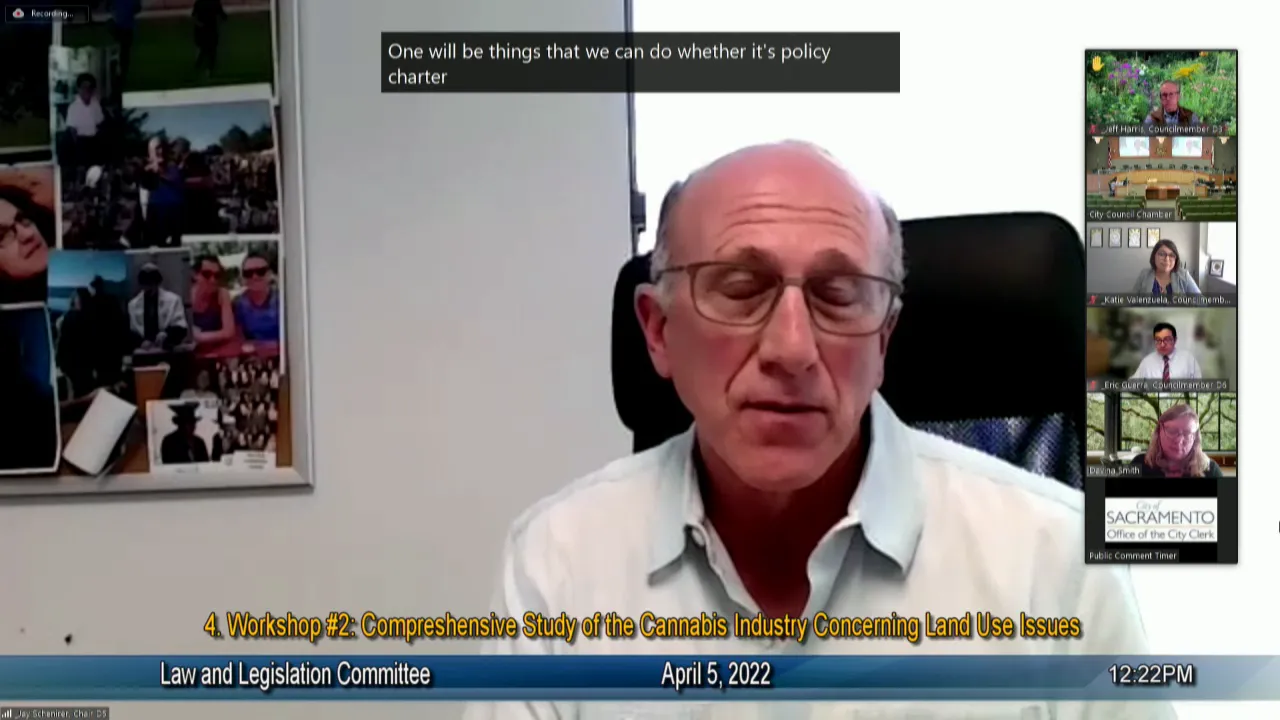
The Law and Legislation Committee held a special meeting on April 5, 2022, from 10:35 a.m. to 12:36 p.m. to conduct the second workshop on the Comprehensive Cannabis Study, focusing on land use issues. The committee reviewed a consent calendar and heard presentations from consultants Economic & Planning Systems (EPS) and Office of Cannabis Management staff, followed by public testimony and committee deliberation. Direction was provided to staff on several zoning, buffer, cap, and event policy recommendations.
Consent Calendar
- Item 1 (Law and Legislation Log): Approved unanimously.
- Item 2 (Meeting Minutes – March 15, 2022): Approved unanimously.
- Item 3 (Ordinance Amending Section 12.72.060 and Adding Chapter 12.100 – Old Sacramento Docks): Reviewed and forwarded to City Council for consideration. Unanimous vote.
Public Comments & Testimony
- Maisha Bahati (Crystal Nuggs): Expressed support for opening event licenses beyond Cal Expo; noted difficulty and cost of using Cal Expo for cannabis events.
- Jarrett Hill (Core Participant): Supported opening C3 and EC zoning for cannabis businesses, and urged the city to make surplus real estate available to core participants.
- Kevin Hooks: Urged that any zoning changes be limited to social equity and core applicants; criticized tobacco buffer distances and high rents; requested smaller event spaces for brand awareness.
- John Long (Sky Cloud): Supported matching state buffer reductions; questioned security requirements that are not applied to existing dispensaries; requested C3 zoning.
- Rachael Brown (Power In Alliance): Raised concerns about defining mixed-light cultivation and its odor impacts; asked that caps on cultivation in District 6 be maintained until businesses are spread citywide.
- Jay J. (Trees of Knowledge Delivery): Supported opening more zones; argued that restricted zones inflate rents and hurt core members; noted that many patients rely on delivery and would benefit from nearby storefronts.
- Deanna Garcia: Requested on-site consumption and events throughout the city, not just at Cal Expo, to boost tourism and equity.
- Joe Devlin (Northern California Cannabis Alliance): Supported reviewing buffers between cultivation and residential; suggested tobacco buffers should be reconsidered; argued indoor cultivation remains viable in Sacramento.
- Michael Snell: Supported on-site consumption and expanded events; urged removal of stigma; asked for more incentives for social equity businesses and no time limit for retail licensees to open.
- Kimberly Cargyle (Therapeutic Alternative): Questioned the $130,000 in neighborhood responsibility fees paid; requested an accounting and use of those funds for community projects like the Yellow Brick Road safe pathway to school.
Discussion Items
- Workshop #2: Comprehensive Study of the Cannabis Industry Concerning Land Use – EPS presented findings: cannabis businesses have not negatively impacted neighboring retail, industrial, or residential property values; crime rates at cannabis businesses are low relative to citywide; short-lived rent spikes in 2018 have normalized; and concentrations are highest in Districts 2 and 6 due to limited zoning. Staff then presented seven recommendations: 1) cultivation use and odor plan review; 2) maintain comparable security standards when opening new zones; 3) allow expiration of the District 6 delivery cap; 4) retain a district-based cultivation/distribution cap until additional zones are opened (possibly excluding distribution); 5) review sensitive uses and buffers (e.g., schools, youth centers, tobacco retailers, light rail); 6) determine additional zones for cannabis (e.g., C3, EC); 7) consider allowing consumption lounges or expanding temporary event locations.
Committee members discussed each recommendation. Councilmember Guerra supported retaining the cultivation cap in District 6 until the market matures, stressed the importance of safety and security, and urged using the 1% neighborhood fee for community safety and youth programs. Councilmember Valenzuela advocated for opening C3 zoning, removing unnecessary buffers (tobacco, light rail), but keeping buffers for schools, youth, and medical treatment centers; she supported exploring on-site consumption and events. Councilmember Harris agreed with a buffer between cultivation and residential areas, supported retaining the cultivation cap until other zones open, and stated firm opposition to on-site consumption until a reliable sobriety test for cannabis exists. Councilmember Schenirer emphasized treating the industry more like other businesses, letting market forces work, and using a phased approach to zoning changes. Sergeant Young (SPD) noted that cannabis businesses are currently prime targets for burglaries, but compliance with security conditions and enforcement are improving. Staff noted that delivery caps were originally based on traffic and crime concerns, but studies show no adverse impacts, while cultivation caps protect against rapid displacement of traditional industrial uses.
Key Outcomes
- The committee directed staff to move forward with the following recommendations and report back to the committee and/or City Council:
- Cultivation Odor Plan Review: Analyze best practices and enforcement tools (e.g., nasal rangers) and consider differentiating indoor vs. mixed-light cultivation.
- Security Standards: Ensure any new zoning includes comparable security conditions, developed with SPD.
- Delivery Cap in District 6: Allow the existing cap to expire, unless a compelling rationale is found to extend it.
- Cultivation/Distribution Cap in District 6: Retain the cap until additional zones are opened; consider removing distribution from the cap.
- Sensitive Uses & Buffers: Re-evaluate all buffers; preserve buffers for schools, youth centers, and medical treatment facilities; remove or reduce buffers for tobacco retailers and light rail stations; maintain PDC review for parks.
- Additional Zones: Open C3 and possibly EC zoning for appropriate cannabis uses to reduce concentration in Districts 2 and 6.
- Consumption Lounges & Events: Continue exploring on-site consumption and temporary event locations beyond Cal Expo, with careful consideration of impaired driving enforcement.
- The committee also requested that the 1% neighborhood responsibility fund be used for public safety, community improvements, and youth education, and that an accounting of the fund be provided.
- Staff will continue stakeholder engagement with SPD, industry, and community groups on security and compliance.
- The next workshop (Workshop #3) is scheduled for April 19, 2022, at 1:00 p.m. to discuss fiscal issues, business operations tax, and overall policy principles.
- The equity study will address co-op spaces and other items deferred from this workshop.
Meeting Transcript
Chair Staff is ready when you are. Great. Let's go ahead and call this meeting of the law and legislation committee to order. Please go ahead and call the roll to establish the quorum. Thank you, Chair. Councilmember Getta is expected momentarily. Councilmember Harris. Here. Councilmember Valenzuela. And Chair Shaneer. I am here. Thank you very much. Let's go ahead and do the land acknowledgement. Ms. Valenzwella, will you lead us in that, please? And Mr. Harris, would you like to lead us in the pledge? Yes, let me have it, Chair. Sure, thank you. Please rise for the opening acknowledgement in honor of Sacramento's indigenous people and tribal lands to the original people of this land. The Nissanan people, the Southern Maidu, Valley and Plains, Niwok, Putland Winton peoples, and the people of the Wilton Rancheria, Sacramento's only federally recognized tribe. May we acknowledge and honor the Native people who came before us and still walk beside us today on these ancestral lands by choosing to gather together today in the active practice of acknowledgement and appreciation for Sacramento's Indigenous People's History contributions and lives. Thank you. All right, hand over heart and pledge. I pledge allegiance to the flag of the United States of America and to the Republic for which it stands. One nation under God, indivisible with liberty and justice for all. Thank you very much. Appreciate that. Um we are going to in a minute get to our discussion items. Um but we first let's go ahead and see if we can dispense with a consent calendar. Any comments on the consent calendar? If not, is there a motion? Yeah, I'll move consent, Chair. Okay. All right, we have a motion and a second. Uh I don't see any public comment on this, Miss Madam Clerk. If no public comment, go ahead and call the roll. That is correct. We have no hands raised to make public comment on this item. Councilmember Gatta is absent. Councilmember Harris. Aye. Councilmember Valenzuela. Yes. And Chair Shaneer. Aye, and why don't we go ahead and leave that open for Councilmember Gera if he would like to when it comes. That that takes us to item number four, which is the second workshop that we're doing on a whole series of cannabis issues. Um, we're basing a lot of the discussion on a lot of work that EPS has done and that our folks, uh, Davina Smith, Laney Millstein, Zara, and others uh have done internally within the um within the department office of cannabis. And really the point here is to take a comprehensive look at the industry in Sacramento, see what we need to do to number one uh keep the industry healthy. Um, but number two is keep it um keep our city healthy, and that means regulation in a lot of ways, uh means revenues in some ways and others.
openpublica.com