Law and Legislation Committee Meeting - August 16, 2022: Review of New Building Electrification Ordinance Framework
STREAMING COPY IN PREPARATION — RECORDING AVAILABLE FROM THE ORIGINAL SOURCE
Law and Legislation Committee Meeting - August 16, 2022
On Tuesday, August 16, 2022, at 1:02 p.m., the Sacramento City Law and Legislation Committee met in a hybrid format to review and comment on the proposed framework for the New Building Electrification Ordinance. The committee unanimously approved the consent calendar, then heard public testimony and deliberated on the ordinance’s alignment with the 2022 California Building Standards Code. Members expressed concerns about worker displacement, outreach to non-English-speaking communities, and the timeline for appeals, but no formal vote was taken to advance the ordinance. Staff will return on September 20, 2022, with updated language, an infeasibility waiver guidance document, and plans for worker transition and stakeholder outreach.
Consent Calendar
- Item 1 – Law and Legislation Log: Approved (File ID 2022-00195).
- Item 2 – Legislative Advocacy Correspondence: Received and filed (File ID 2022-00193).
- Item 3 – Law and Legislation Committee Meeting Minutes (July 19, 2022): Approved (File ID 2022-01538).
- All items were passed by a single motion with a vote of 3-0 (Councilmember Harris absent).
Public Comments & Testimony
- Derek Lim (former city staff): Expressed concern that the 10-business-day appeal deadline for infeasibility waivers is too short, especially for resource-constrained businesses and cultural communities reliant on high-heat gas cooking. Recommended a 30-day appeal period.
- Rosie Yacov (community member): Voiced strong support for the ordinance, noting that reducing new gas infrastructure helps avoid future cost shifts to remaining gas customers and aligns with state policy to phase out fossil gas.
- Jenna Abbott (Sacramento Metropolitan Chamber of Commerce): Stated the Chamber’s support for the ordinance but urged additional in-language outreach to commercial corridors, particularly to restaurants, manufacturers, and coffee roasters who may be unaware of the details.
- Kathy Cresswell (affordable housing advocate): Thanked the committee for the limited exemption for affordable housing developments reliant on virtual net metering. Urged that the exemption not be removed until SMUD’s virtual solar program is proven to work for affordable housing projects.
- Timothy I (Environmental Democrats of Sacramento, SAC 350, Sacramento Climate Justice Coalition): Urged the committee to move forward without delay, arguing that all-electric construction is simpler, safer, and cheaper, and that continuing to allow gas infrastructure is the costly decision. Opposed extending the waiver indefinitely.
- Herman Barahona (Sacramento Environmental Justice Coalition): Supported the ordinance’s environmental goals but cautioned that the city must consider unintended consequences for low-income families, citing a pilot project in Gardenland that revealed glitches in electrification efforts. Suggested the city learn from that pilot before implementing the ordinance.
Discussion Items
-
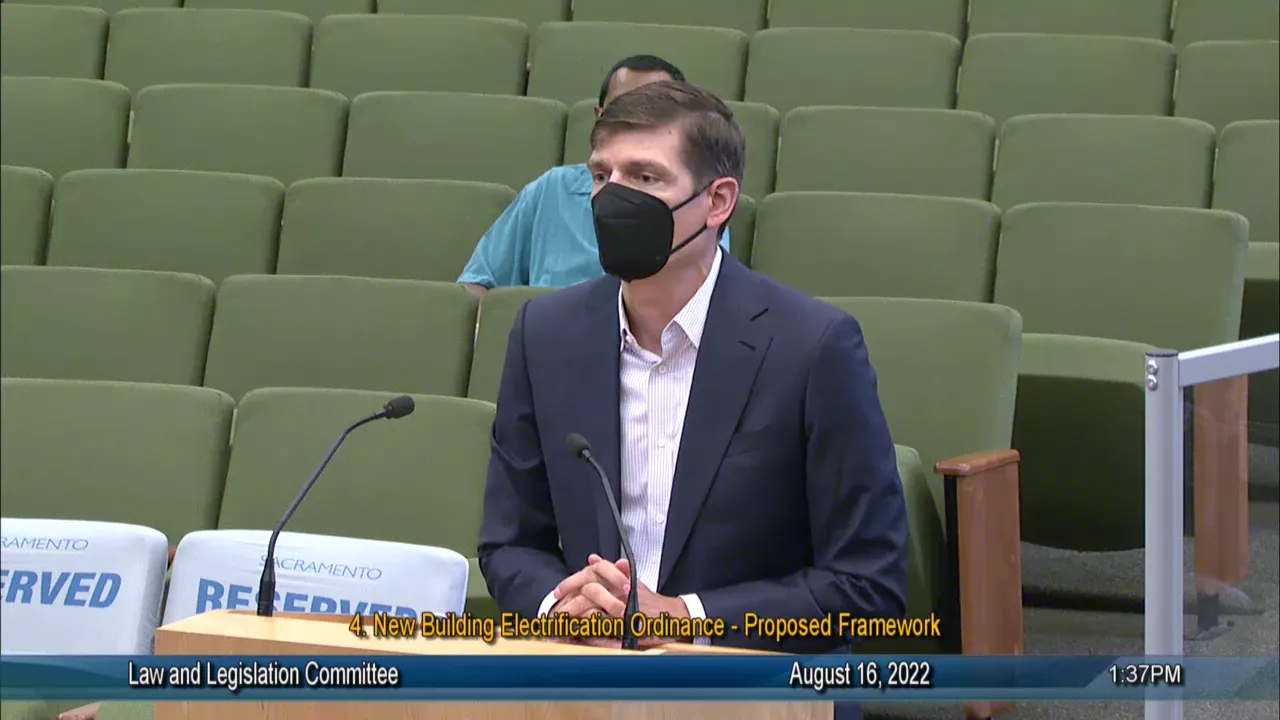
Item 4 – New Building Electrification Ordinance – Proposed Framework: Staff presented the proposed framework, which requires all-new buildings of three stories or less to be all-electric starting January 1, 2023, and buildings of four stories or more starting January 1, 2026. The ordinance includes an infeasibility waiver process. Staff recommended revisions to align with the 2022 California Building Standards Code, including moving the local amendment to the CalGreen code, adjusting definitions, and rescinding the city’s existing EV charging requirements in favor of stricter state standards. A 14-member technical panel has been meeting to develop the waiver guidance document. Staff also noted that existing buildings and businesses are not affected.
-
Councilmember Valenzuela: Expressed strong reluctance to move forward without a concrete strategy for displaced workers, particularly plumbers and pipefitters, who may lose an estimated 20% of jobs. She emphasized that a just transition for workers is essential and that the dual plumbing/water reuse study had not yet provided a sufficient job replacement plan. She stated she was not ready to support sending the ordinance to council until a worker transition plan is in place.
-
Councilmember Guerra: Agreed on the need for a just transition and stressed the importance of additional in-language outreach to Latino and AAPI business communities to reduce confusion. He supported extending the appeal deadline to 30 days. He suggested that components conforming to state law (e.g., EV charging requirements) could be separated and advanced immediately, but overall preferred to wait for the next meeting.
-
Staff Response (Matt Hertel, Principal Planner): Confirmed that the timeline remains feasible and that staff will return on September 20, 2022, with the full ordinance language, an update on the dual plumbing/water reuse study, and a plan to address worker transition concerns. He noted that many large gas jobs (e.g., state buildings, hospitals) are not affected by the city’s ordinance, so actual job losses may be less than 20%. Staff also committed to multilingual outreach, including facilitated conversations in Spanish and Vietnamese.
Key Outcomes
- The committee did not vote to forward the ordinance to the City Council. Instead, members made clear that they expect a detailed plan for worker transition and completed outreach before the ordinance advances.
- Staff will return to the Law and Legislation Committee on September 20, 2022, with:
- The draft ordinance language for review.
- A draft infeasibility waiver guidance document.
- Follow-up on the dual plumbing and on-site water reuse study, including discussions with the Plumbers and Pipefitters Union (Local 447).
- An update on the affordable housing virtual net metering issue and SMUD’s virtual solar program.
- The committee also directed staff to consider extending the appeal deadline for infeasibility waivers from 10 to 30 business days.
- The meeting was adjourned at 1:40 p.m.
Meeting Transcript
Okay, no worries. Okay, uh, we are going to go ahead and get started. Uh let me call this meeting of the law and legislation committee to order. Um, please call the roll to establish a quorum. And I know that we have Mr. Gera on Zoom. Thank you. Councilmember Gada. Here like a voice from God. Councilmember Harris will be absent today. Councilmember Valenzuela. Here and Chair Shane. I'm here. Let's go ahead. I'm gonna ask Ms. Hernandez to do the land acknowledgement and the pledge. Please stand up. There you go. Please rise for the opening acknowledgments in honor of Sacramento's indigenous people in tribal lands to the original people of this land, the Nissanon people, the Southern Maidu Valley, the Southern Maidu, Valley and Plains Miwok, Putwin Wind Tune peoples, and the people of the Wilton Rancheria, Sacramento's only federally recognized tribe. May we acknowledge and honor the Native people who came before us and still walk beside us today on these ancestral lands by choosing to gather today in the active practice of acknowledgement and appreciation for Sacramento's indigenous peoples' history contributions and lives. Thank you. Now for the pledge. Pledge allegiance to the flag of the United States of America and to the Republic for which it stands. One nation under God, indivisible with liberty and justice for all. I know it was off. Sorry. And these are for the item. No, Chair, I have no speaker slips for the consent calendar, nor do I have hands raised in Zoom. Okay. Is there a motion? I'll move, Chair. I'll go ahead and second. Um please call the roll. Councilmember Guerra. Councilmember Harris is absent. Councilmember Valenzuela. Yes. And Chair Shineer. I am here, and I say aye. Thank you. All right, let's go ahead and move to our one uh item tonight, new building electrification ordinance proposed framework, Mr. Hertel. You're gonna educate us. On June 1st, 2021, City Council adopted the new building electrication ordinance, which adopted local amendments to the California Building Standards Code. However, the California Building Standards Code is on a three-year cycle, and when council adopted the new building electrication ordinance last year, the 2019 California Building Standards Code was in effect. The 2022 California Building Standards Code was published on July 1st of this year and goes into effect on January 1, 2023. For the new building electrification ordinance to be enforceable, it must be readopted to align with the 2022 California Building Standards Code. Today I'll present the proposed framework for the updated ordinance and provide a brief update on a technical panel and development of the infeasibility waiver guidance document. Starting on January 1st, 2023, newly constructed buildings of three stories or less will need to be built as all electric. Then on January 1st, 2026, newly constructed buildings of four stories or more will need to be built as all electric.
openpublica.com