Cannabis Business Operations Tax Update and Options Discussion - September 5, 2023
STREAMING COPY IN PREPARATION — RECORDING AVAILABLE FROM THE ORIGINAL SOURCE
Cannabis Business Operations Tax Update and Options Discussion - September 5, 2023
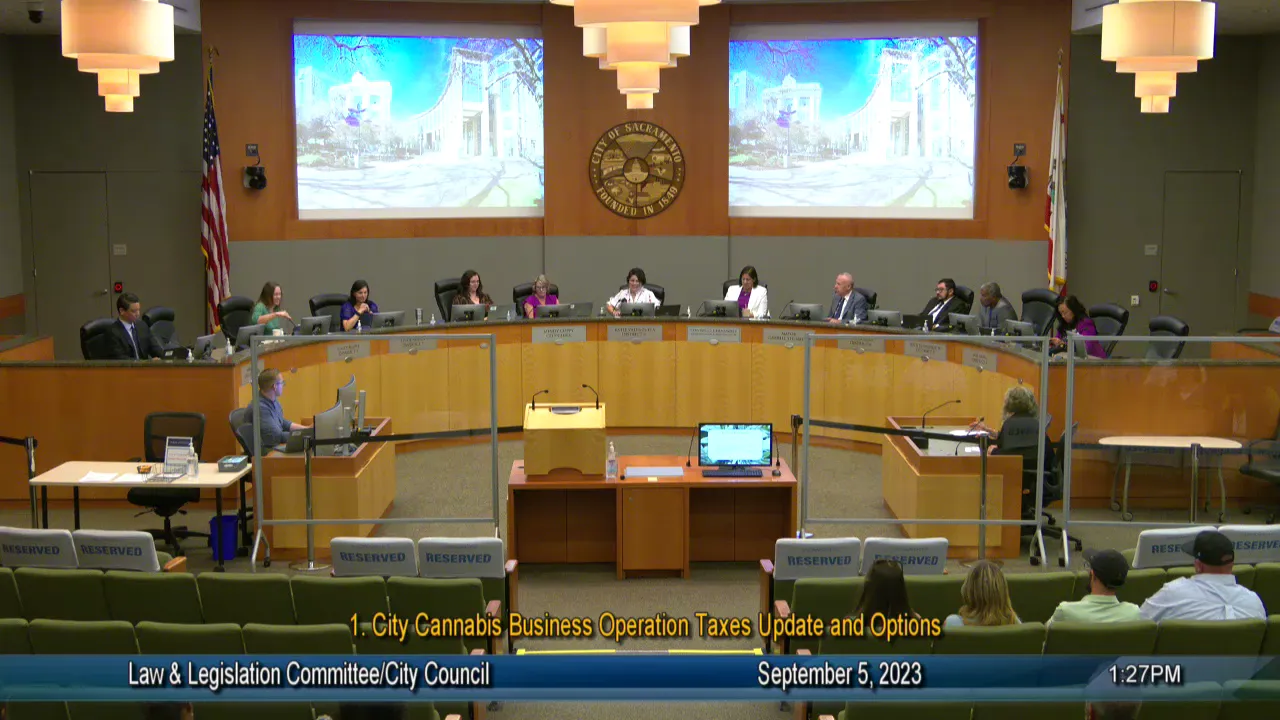
On September 5, 2023, the Sacramento City Council and Law and Legislation Committee held a joint special meeting to discuss updates and options for the city's Cannabis Business Operations Tax (CBOT). The meeting focused on four tax reduction models, with a staff recommendation to advance a phased tax model for CORE (equity) businesses. Public comment was heard, and council members deliberated on next steps, leading to a motion to forward the core proposal to the full council and to bring back a broader tax discussion in November.
Public Comments & Testimony
- Youth Forward Policy Advocate (Adjawa Acianu) expressed support for core relief but opposed industry-wide cannabis tax cuts, emphasizing the importance of Measure L funding for youth.
- Adiola Adlepipe (Owner, Aiden's Relief) shared personal story as a parent and equity operator, urging tax relief for core businesses and noting that many cities have suspended or reduced cannabis taxes.
- Laura Mendez (Medical Patient) advocated for the removal of taxes on medical cannabis, citing personal health benefits and the burden of high taxes on patients.
- Mindy Galloway (CEO, Camilla Shared Manufacturing) urged across-the-board tax reduction, arguing that high taxes drive patients to the unregulated market and that many cities have suspended their cannabis taxes.
- Angelica Sanchez (Perfect Union) supported any tax break for cannabis businesses, criticizing the staff report's comparison to cities with less mature programs.
- Anthony Cortez (General Counsel, Natura Life and Science) challenged the accuracy of the staff report's comparisons, stating that San Francisco's cannabis tax does not take effect until 2026 and that other jurisdictions have lower effective rates.
- Cyrus Javadi (Connected Cannabis) supported tax relief, noting the high costs of testing, security, and compliance for legal cannabis businesses.
- JJ (Trees of Knowledge) supported phased tax relief for core and overall tax reduction, stating that the current tax system is unsustainable and that other cities have paused taxes.
- Michael Snell (Owner, Off the Charts) supported equity tax relief and suggested expanding the tax base to include alcohol.
- Richard Miller (Medical Patient) highlighted the dramatic increase in cannabis prices since 2016, urging a no-tax structure for medical patients as done in Davis.
- Rhonda Ernett (CEO, Natural High) supported tax cuts for core businesses, emphasizing the difficulty of competing in the market.
- Kimberly Cargyle (CEO, The Therapeutic Alternative) argued for medical tax exemption, noting that medical patients are disproportionately affected and that the city already collects data on medical sales.
Discussion Items
- Staff Presentation (Davina Smith, Cannabis Program Manager): Presented four tax reduction models: (1) across-the-board reduction (to 3%, 2%, or 1%), (2) phased-in tax for CORE businesses (0% first year, increasing 1% annually to 4%), (3) graduated tax by gross receipts (0.5% for under $100k to 4% for over $1M), and (4) different rates by business type (storefront 4%, delivery 3%, others 2%). Staff recommended advancing the phased model for CORE businesses, noting minimal impact on Measure L and general fund.
- Mayor Darrell Steinberg: Framed the need for careful analysis to balance industry relief with general fund impacts. Suggested considering tax credits tied to business performance, similar to entertainment tax credits, and asked about vacant CUP holders and unissued permits.
- Councilmember Lisa Kaplan: Supported moving forward with core relief but called for a more comprehensive report on tax reduction scenarios, including growth projections and comparisons with other jurisdictions. Requested analysis of medical tax relief and a graduated tax rate by volume.
- Councilmember Mai Vang: Supported the phased tax model for core businesses and urged modernizing the broader Business Operations Tax (BOT) to raise the cap on large corporations like Walmart.
- Vice Mayor Eric Guerra: Emphasized caution, noting the need to balance enforcement funding, recruitment of businesses to fill vacant CUP sites, and the impact of the illicit market. Supported the core proposal but wanted a progressive approach to avoid undermining enforcement.
- Councilmember Katie Valenzuela (Chair): Expressed readiness to support 2% across the board and 0% for distribution, citing double taxation and the need for equity. Requested a fee study to align staffing costs with actual impacts, and noted that the city can always adjust taxes later.
- Councilmember Caity Maple: Shared industry experience, noting that many cities made arbitrary tax rates and that Sacramento should lead with updated ordinances. Emphasized the importance of union jobs and the need to reduce barriers like excessive reporting requirements.
Key Outcomes
- Motion Passed Unanimously (Law and Legislation Committee): To forward the phased tax model for CORE businesses (0% first year, increasing 1% annually to 4%) to the full City Council for consideration.
- Direction to Staff: To return in November 2023 with a comprehensive analysis of tax relief options for all cannabis businesses, including:
- Potential across-the-board reductions (e.g., 2% or 3%)
- Medical patient tax relief
- 0% tax for distribution
- Tax credit mechanisms (as suggested by the Mayor)
- Updated comparisons with other jurisdictions, including permit numbers and actual open businesses
- Fee study to align permit fees with actual regulatory costs
- Analysis of building permit process bottlenecks and vacant CUP sites
- Next Steps: The Law and Legislation Committee will schedule a special meeting in November for further discussion, with the goal of taking action on broader tax relief.
Meeting Transcript
Staff, let's hold our video stream. We need a quorum of the council to start the meeting. Let's put 30 seconds on the clock again and start our video stream. Now call this joint meeting of the law and legislation committee and the city council to order. Will the clerk please call the role to establish a quorum? Thank you. Councilmember Kaplan. Councilmember Vang. Councilmember Jennings. Vice Mayor Gatta. And Chair Valenzuela here. And Chair, this is a joint meeting with the City Council and Law and Ledge Committee. The actions today, though, are law and legislation actions, but we do have the full council that may attend, should they choose. Yes, thank you. So thank you all for it's probably a little complicated on a few fronts. Um we are doing a joint meeting today because the racial equity committee heard the core proposal, and so in order not to violate the Brown Act, we have invited a couple of our colleagues from the Racial Equity Committee to join us today. So Councilmember Maple will be joining us as well as Councilmember Vang, and I appreciate their time in doing this so that we could also talk about the full scope of proposals today at Law and Ledge. Um, if you were here for the consumption lounge item, just want to make sure that you are aware that that has been postponed for two weeks. So it's not on the agenda, but I just want to make sure I know we talked a lot about hearing consumption lounges on the fifth, and that has been postponed um for two weeks until our next law and ledge meeting. Um so we hope you'll join us for what should be a very robust discussion on that day. Um so we only have one item on our calendar today, and that is the city cannabis business operations taxes operation. Oh, and we just lost our fifth. Um, so we are so for members on the dias, we need five people up here to be able to do this. Oh, hi Mayor. Hello. You're joining us as well. Yeah, of course. All right. We're just yeah, thank you. And you're now our fifth, so we can proceeding with our business. Here to serve. Thank you very much. All right. Um, so we'll invite Davina up here to start with our staff presentation. And for folks in the audience, if you'd like to comment on this item, please fill out a speaker slip in the back or up here at the front and turn it into the clerk. And if you're online, we will enable the raise hand feature, and you will have till the end of the first commentary to raise your hand, and we will call on you after we call on folks in the room. Um so with that, we will turn it over to Davina to start our presentation. Thank you. Um, and good afternoon, everyone. My name is Davina Smith, and I'm the program manager for the city's Office of Cannabis Management. Um, we're here today, as the um chair mentioned, to provide this requested update to the law and legislation committee regarding some tax uh cannabis business tax items. Um I do have colleagues um either here or online from the Department of Um Revenue or our revenue division to answer questions that there may be on current practices regarding cannabis business operations tax. Currently it's four percent for all of our cannabis businesses, and it's calculated on gross receipts. Businesses support uh self-report monthly, and um transfers from one business to a separate business is considered a taxable event. Uh, apart from our four percent tax, retailers collect and remit to the state a 15% excise tax and an 8.75% sales tax per cannabis transaction. So I think it's important to understand how we fit both in our region as well as in similarly sized cities. So, first we'll look at our region. Uh Sacramento taxes in comparison with our neighbors are um we're actually less than our neighbors. The one we don't have up here is uh West Sacramento because they don't have a flat tax rate, they do development agreements and their taxes range from 2% to 5% and speaking with their staff based upon the the details of the development agreement. So that was too um difficult to calculate, so we just kind of put that as an asterisk.
openpublica.com